
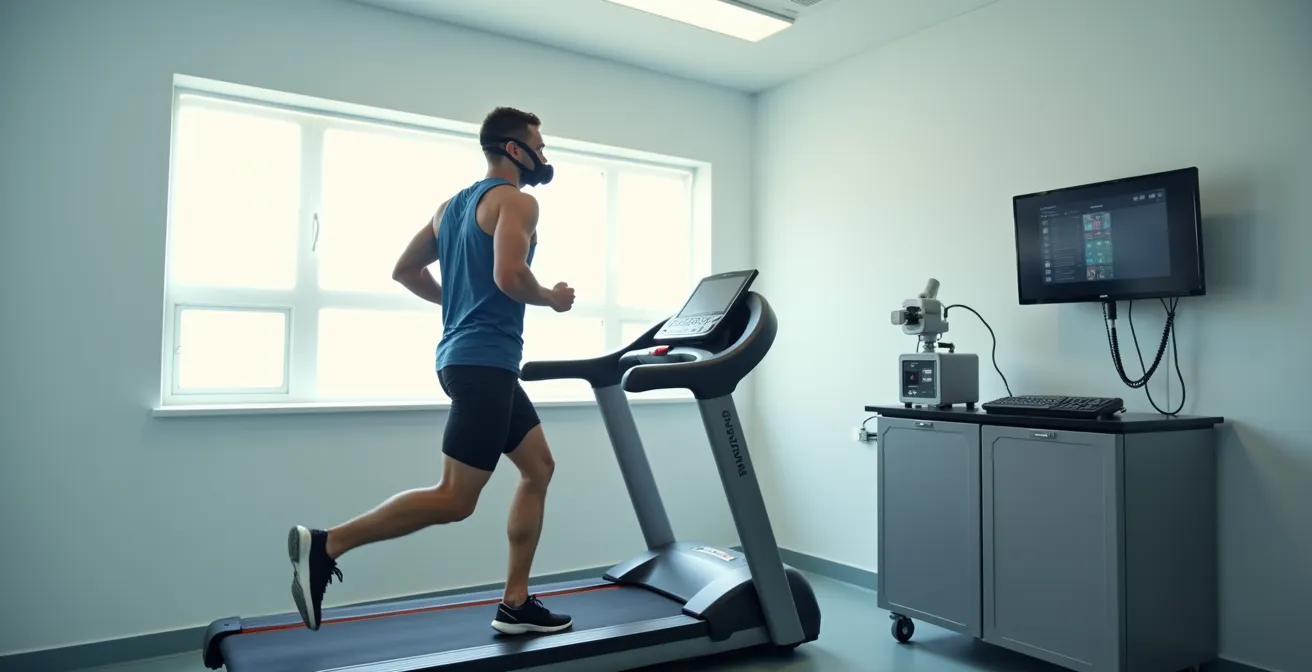
The greatest performance gains for amateurs don’t come from accessing elite labs, but from systematically translating that precise data into a personalized physiological blueprint.
- Generic training zones based on age are inefficient; true VO2 Max and lactate threshold testing provides a metabolic map for precision training.
- Common injuries are often symptoms of specific, measurable biomechanical flaws that can be corrected with targeted interventions.
Recommendation: Instead of collecting data points, focus on finding a performance center that helps you build an integrated, data-driven system for training, fueling, and recovery.
For the dedicated recreational athlete, hitting a performance plateau is a frustrating reality. You follow the training plans, buy the expensive gear, and push through grueling workouts, yet your race times stagnate. The common advice is to simply “train harder” or “be more consistent.” You might even consider mimicking the habits of professional athletes, thinking that more volume or more intensity is the universal key to unlocking the next level. This approach, however, often leads to overtraining, injury, and burnout, not breakthroughs.
The allure of professional performance centers is strong. They promise access to a world of data: VO2 max tests, gait analysis, metabolic profiling, and advanced recovery tools. But many amateurs approach these services like a checklist, collecting impressive-sounding metrics without a clear framework for application. The result is a folder of expensive data that provides little more than bragging rights, failing to translate into tangible performance improvements on the road or trail.
The fundamental error is not in the tools, but in the mindset. What if the key to hacking your fitness wasn’t merely about using pro-level tests, but about adopting a pro-level analytical process? The real value lies in moving beyond generic advice and using precise physiological data to construct a personalized blueprint that dictates exactly how you should train, fuel, and recover. It’s about shifting from guessing to measuring, and from following plans to building your own data-driven system.
This article provides a framework for that shift. We will deconstruct the most impactful services offered by performance centers and reveal how to interpret and apply their data to create a cohesive, year-long strategy for tangible, sustainable improvement. Prepare to move beyond the hype and into the science of personal performance.
Summary: A Data-Driven Blueprint for Amateur Athletes
- Why knowing your true VO2 Max changes your training zones completely?
- How to fix the one running gait flaw that causes your knee pain?
- Cryotherapy or Sauna: Which triggers better hormonal adaptation after endurance?
- The fueling error that makes your expensive training camp 30% less effective
- How to use your test results to build a 12-month training block?
- When to stop heavy leg training to ensure you are fresh for the start?
- How many grams of protein do you really need during a 4-hour training day?
- Compression Boots vs. Massage: Which Clears Lactate Faster?
Why knowing your true VO2 Max changes your training zones completely?
Most amateur athletes train using heart rate zones calculated from a generic formula, typically “220 minus your age.” This method is fundamentally flawed because it fails to account for individual physiology. Two athletes of the same age can have vastly different maximum heart rates and, more importantly, different metabolic responses at any given intensity. Training with these generic zones means you are likely working too hard on easy days and not hard enough on hard days, leading to inefficient adaptation and a high risk of burnout. This is where a true VO2 Max test becomes a non-negotiable tool for serious improvement.
A laboratory or validated field test does more than just provide a single “VO2 Max” number. It reveals your unique metabolic signature. By measuring gas exchange (oxygen consumed vs. carbon dioxide expelled) and often blood lactate at various intensities, it pinpoints your precise aerobic threshold (VT1) and anaerobic threshold (VT2). These are not theoretical percentages of a predicted max HR; they are the exact points where your body’s energy systems shift. Knowing your VT1 heart rate, for example, allows you to perform true “Zone 2” training, maximizing mitochondrial development and fat-burning efficiency without accumulating unnecessary fatigue. Similarly, knowing your VT2 provides a precise target for tempo and threshold work, the most effective way to raise your sustainable race pace.
The data from a comprehensive test allows you to build a physiological blueprint, transforming your training from a guessing game into a surgical operation. Instead of five generic zones, you get personalized anchor points that dictate the exact intensity required to trigger specific, desired adaptations. This ensures every minute of training has a purpose and yields the maximum possible return.
Case Study: Lab-Quality VO2 Max Testing in the Field
An amateur athlete can achieve highly accurate VO2 Max and threshold data without entering a traditional lab. An INSCYD field testing protocol demonstrates that using a 3-4 minute all-out effort combined with pre and post-effort blood lactate samples allows their software to calculate total energy expenditure. This process separates the aerobic and anaerobic contributions, providing lab-quality VO2 Max data that can be used to set precise, individualized training zones without the need for expensive gas exchange equipment.
How to fix the one running gait flaw that causes your knee pain?
Runner’s knee, IT band syndrome, and other common running ailments are often treated as isolated issues. Athletes rest, foam roll, and stretch the site of pain, only for it to return as soon as they resume their normal training volume. This is because the pain is a symptom, not the root cause. For a significant number of runners, persistent knee pain can be traced back to a single, critical biomechanical flaw: the pelvic drop, also known as Trendelenburg gait. This occurs when the hip on the non-stance leg drops during the support phase of running, causing the femur to rotate inward and placing excessive stress on the knee joint.
While you might feel the pain in your knee, the problem originates from a lack of strength and neuromuscular control in the gluteus medius muscle of the standing leg. Without a professional gait analysis, this flaw is nearly impossible to self-diagnose. You cannot “feel” your hip dropping by a few degrees, but the cumulative stress over thousands of strides is what ultimately leads to injury. A performance center equipped with 3D motion capture and force plates can quantify this movement precisely, revealing the exact degree of pelvic drop and the associated impact forces on your joints.

This data-driven diagnosis is the first step toward a permanent solution. Instead of generic strengthening, a sports scientist can prescribe a targeted protocol focused on gluteus medius activation and single-leg stability. Correcting this upstream issue not only alleviates knee pain but also improves biomechanical efficiency, meaning you waste less energy with each stride. Fixing this one flaw doesn’t just make you a healthier runner; it makes you a faster and more economical one.
The table below, based on professional assessment methods, outlines how specific gait flaws are detected and addressed in a performance lab setting. This illustrates the shift from treating symptoms to correcting root causes.
| Gait Flaw | Professional Detection Method | Targeted Solution |
|---|---|---|
| Overstriding | Force plate impact measurement | Cadence drills + forward lean exercises |
| Pelvic Drop | Motion capture hip analysis | Gluteus medius strengthening protocol |
| Knee Valgus | 3D biomechanical assessment | Single-leg stability training |
| Excessive Pronation | Slow-motion video analysis | Foot strengthening + shoe selection |
Cryotherapy or Sauna: Which triggers better hormonal adaptation after endurance?
Amateur athletes often approach recovery with a “more is better” mindset, jumping into an ice bath or sauna immediately after a hard workout, believing it will accelerate recovery. However, the science of data-driven adaptation reveals that the timing and type of thermal stress are critical. The goal of recovery isn’t just to feel less sore; it’s to signal the body to rebuild stronger. Cryotherapy and heat therapy trigger distinct hormonal and cellular responses, and using them incorrectly can actually blunt the adaptive signals you worked so hard to create during your session.
The inflammatory response immediately following a hard endurance workout is a crucial signal for adaptation. Flooding the system with intense cold via cryotherapy too soon can suppress this process. Conversely, using a sauna immediately post-workout can enhance the production of Heat Shock Proteins (HSPs), which play a vital role in cellular repair and long-term resilience. Professional performance centers use this knowledge to periodize recovery. A sauna might be prescribed after a key developmental workout to maximize the adaptive signal, while cryotherapy might be reserved for situations requiring rapid reduction of inflammation, such as during a multi-day stage race or when a quick turnaround is needed before another competition.
Case Study: Strategic Timing for Optimal Results
Data from the Professional Athletic Performance Center (PAPC) highlights the importance of timing. Their protocols show that athletes using a sauna immediately after a workout see increased HSP production for long-term adaptation. In contrast, those who use cryotherapy 2-4 hours after training successfully reduce excessive inflammation while preserving the initial, necessary inflammatory signals for adaptation. This suggests a hybrid, timed approach yields the best overall results for endurance athletes looking to maximize their gains.
The choice is not simply “cryo or sauna,” but “which modality, at what time, for what specific purpose?” An amateur athlete can leverage these principles by structuring their recovery with intent. For instance, after a high-intensity interval session aimed at boosting VO2 max, allowing a natural cool-down and waiting several hours before any thermal therapy may be optimal. For a long, slow distance run, a post-workout sauna session could be beneficial. The following protocol, based on professional strategies, provides a clear framework for timing your recovery.
- Immediately Post-Workout (0-30 min): Light movement and hydration only – allow the natural inflammatory response to begin.
- 2-4 Hours Post-Workout: If acute recovery is the priority (e.g., another hard session tomorrow), use cryotherapy for 3-10 minutes to reduce excessive inflammation.
- 4-6 Hours Post-Workout: For a focus on long-term adaptation, use a sauna for 15-20 minutes at 80-100°C to stimulate HSPs.
- Next Day Recovery: Combine contrast therapy (e.g., 3 rounds of 3 minutes cold, 3 minutes hot) to promote circulation without interfering with initial adaptation signals.
- Weekly Protocol: Incorporate 2-3 sauna sessions during a build phase of training, and save cryotherapy for the competition phase or acute situations.
The fueling error that makes your expensive training camp 30% less effective
Many amateur athletes invest thousands in a training camp, meticulously planning their travel and training sessions, yet they sabotage their potential gains with a critical fueling error: following generic carbohydrate intake guidelines. Standard advice, such as consuming “60-90 grams of carbs per hour,” fails to account for the most important variable: an individual’s actual carbohydrate oxidation rate at different intensities. This rate—how much carbohydrate your body can effectively process and use for fuel—is highly personal and trainable.
During a high-volume training camp, you are placing an unprecedented demand on your body. If you under-fuel, you won’t be able to hit the intensity targets in your key workouts, and your recovery will be severely compromised. This effectively reduces the return on your investment, as you fail to generate the training stimulus the camp was designed to provide. Conversely, over-fueling by trying to force down more carbohydrates than your gut can absorb can lead to significant gastrointestinal distress, which can derail a session or even an entire day of training.
A professional performance center can eliminate this guesswork. Using VO2 Max breath-by-breath analysis, a sports scientist can pinpoint your exact carbohydrate and fat oxidation rates across a range of intensities. This data reveals your unique “crossover point,” the intensity at which your body switches from primarily using fat for fuel to primarily using carbohydrates. It also determines your maximum carbohydrate oxidation rate. This creates a personalized fueling map, telling you precisely how many grams of carbohydrate you need at your endurance pace versus your threshold pace. According to The Performance Lab Ireland’s testing protocols, this analysis is crucial for creating an effective race and training nutrition plan.
Armed with this personalized metabolic signature, you can approach a training camp with a prescriptive fueling strategy. You know exactly how much fuel is required to support each specific workout, preventing both the performance decline from under-fueling and the GI distress from over-fueling. This ensures you get the full 100% adaptive benefit from every single session of your expensive camp.
How to use your test results to build a 12-month training block?
One of the biggest mistakes amateurs make after visiting a performance center is treating the results as a one-time snapshot. They might adjust their training zones for a few weeks, but they lack a long-term vision for how to integrate that data into a full-year periodized plan. A true physiological blueprint is not a static document; it’s a dynamic guide for structuring your training across different phases, from off-season base building to peak race performance. The power of lab testing is fully realized when it informs the architecture of your entire season.

The key is to use your specific threshold data (VT1 and VT2) to define the purpose of each training block. For example, the initial base-building phase, which might span 3-4 months, should be dominated by volume at or slightly below your lab-determined VT1. This is your “Zone 2,” and training here maximizes metabolic efficiency and aerobic base development with minimal stress. Following generic heart rate zones could easily push you above VT1, accumulating unnecessary fatigue and compromising the goal of this phase.
As you move into a build phase, your VT2 (anaerobic or lactate threshold) becomes the primary focus. Workouts should be structured around this precise intensity to directly improve your sustainable race pace. Finally, in the peak phase leading up to a key event, you’ll introduce short, high-intensity intervals at or above your VO2 Max power or pace. A critical component of this long-term plan is a scheduled mid-cycle re-test. This allows you to validate your progress, see how your thresholds have improved, and recalibrate your zones for the final push toward your goal event. This creates a feedback loop, turning your training into a responsive, data-driven system.
This sample 12-month structure, based on recommendations for athletes who have completed VO2 Max assessments, shows how lab data can be periodized across an entire season.
- Months 1-4 (Base Phase): Focus on Zone 2 work at the lab-determined VT1 heart rate to build metabolic efficiency and a deep aerobic base.
- Months 5-7 (Build Phase): Add tempo and threshold work at your precise VT2, with a maximum of two such sessions per week.
- Months 8-9 (Peak Phase): Introduce VO2 max intervals once per week, targeting the specific power or pace identified in your lab test.
- Month 10 (Re-test): Schedule a mid-cycle lab reassessment to validate progress, measure improvements in your thresholds, and adjust zones for the final training block.
- Months 11-12 (Competition Phase): Taper training volume while maintaining intensity at your newly updated threshold values to arrive at the start line sharp and rested.
When to stop heavy leg training to ensure you are fresh for the start?
For endurance athletes, strength training is a double-edged sword. Heavy leg sessions are essential for building power, improving running economy, and preventing injury. However, the fatigue they induce can mask fitness and compromise race-day performance if not managed correctly. The traditional approach is a generic taper, where athletes reduce lifting volume and intensity based on a predetermined schedule, often stopping all heavy lifting 2-3 weeks before a race. This one-size-fits-all method fails to account for individual recovery rates and can result in arriving at the start line either still fatigued or having lost too much strength adaptation.
This is where prescriptive tapering, guided by objective recovery data, becomes a game-changer. Rather than adhering to a rigid timeline, an athlete can use daily measurements of Heart Rate Variability (HRV) to make informed decisions. HRV is a measure of the variation in time between each heartbeat and serves as a powerful indicator of your autonomic nervous system’s state. A low HRV score indicates that your body is under stress (e.g., from a heavy leg day) and is in a “fight or flight” state, while a high HRV score indicates it is in a relaxed, “rest and digest” state, ready to adapt and perform.
By monitoring your HRV trend during the taper period, you can see exactly how your body is responding to your training. If your HRV remains suppressed for several days after your last planned heavy leg session, it’s a clear, objective signal that you have not recovered and should cease all lower-body resistance training immediately, regardless of what the generic plan says. This data-driven approach allows you to individualize your taper, ensuring you shed all residual fatigue while preserving your hard-won strength. It replaces guesswork with a precise, physiological feedback loop.
Case Study: HRV-Guided Tapering for a Personal Record
METS Performance Consulting documented the case of an amateur marathon runner who used daily HRV monitoring during their taper. After a leg session 10 days before the race, the athlete’s HRV remained suppressed, indicating a lack of recovery. Instead of following their predetermined plan, they ceased all lower body strength work immediately. As a result, their HRV recovered to its baseline by race day. The athlete achieved a 5-minute personal record, a success attributed to this individualized, data-driven tapering decision over a rigid, generic protocol.
How many grams of protein do you really need during a 4-hour training day?
Protein intake is a constant source of debate and confusion for amateur athletes. Vague advice to “eat more protein” is unhelpful. For an endurance athlete undergoing a demanding 4-hour training day, protein timing and quantity are not just about recovery; they are about maximizing muscle protein synthesis (MPS) and minimizing muscle breakdown. The key isn’t just the total daily amount, but delivering the right dose at the right time to trigger the desired physiological response.
The most critical concept is the leucine threshold. Leucine is an essential amino acid that acts as the primary trigger for MPS. Without a sufficient amount in a single meal, the muscle-building process is not optimally activated. Consuming small amounts of protein throughout the day (grazing) is less effective than consuming distinct, larger doses that meet this threshold. According to laboratory testing data, a dose of 2.5-3 grams of leucine is required to robustly stimulate MPS. This translates to roughly 25-30 grams of high-quality protein (like whey or eggs) per meal.
For a 4-hour training day, the strategy must be meticulously planned. Protein intake should be bookended around the workout and, for very long sessions, even included during. Consuming protein before the session helps to pre-load the amino acid pool, reducing muscle breakdown during exercise. A fast-absorbing protein source immediately after is crucial to kick-start the repair process by hitting the leucine threshold. Finally, a slow-digesting protein like casein before bed provides a sustained release of amino acids overnight, supporting recovery while you sleep. This systematic approach ensures that your body has the building blocks it needs, precisely when it needs them, to adapt and grow stronger.
Action Plan: 4-Hour Training Day Protein Timeline
- 2 Hours Before Training: Consume 20-25g of complete protein with breakfast (e.g., eggs, Greek yogurt) to preload the amino acid pool.
- During Training (Hour 1-2): Focus on hydration and carbohydrates; protein is not yet necessary.
- During Training (Hour 2+): If the session is intense, consider sipping on a drink containing 5-10g of Essential Amino Acids (EAAs) or Branched-Chain Amino Acids (BCAAs) per hour.
- Immediately Post-Training (within 30 min): Ingest 25-30g of a fast-absorbing protein, such as whey, to quickly hit the leucine threshold and initiate muscle protein synthesis.
- 2-3 Hours Later: Eat a whole-food meal containing another 25-30g of complete protein to continue the recovery process.
Key Takeaways
- Stop using generic “220-age” formulas; lab-tested VO2 Max and lactate thresholds (VT1/VT2) are essential for creating personalized and effective training zones.
- Persistent running pain is often a symptom of measurable biomechanical flaws like a pelvic drop, which can be permanently fixed with targeted strength work identified through 3D gait analysis.
- Recovery is about adaptation, not just feeling better. The timing of sauna (for HSP production) and cryotherapy (for inflammation control) must be strategic to avoid blunting training signals.
Compression Boots vs. Massage: Which Clears Lactate Faster?
The question of whether compression boots or massage is superior for recovery is a common one, but it’s based on a faulty premise. Many athletes believe the primary goal of these modalities is to “flush lactate” from the muscles. This leads them to chase a feeling of immediate relief without understanding the underlying mechanisms of recovery. The scientific reality is that lactate, or more accurately, the associated hydrogen ions, is not a waste product to be flushed. It is a valuable fuel source that is naturally cleared and buffered by the body within 60-90 minutes post-exercise, regardless of the recovery method used.
As sports science researcher Dr. Lex Mauger of the University of Kent notes, the focus should be different. The real question is not about lactate clearance, but about which modality best prepares the body for the next training session. This shifts the decision-making process from a simple “which is better?” to a more nuanced “which is the right tool for this specific situation?”
Lactate naturally clears within 60-90 minutes anyway. The real question is which modality better promotes recovery for the next session.
– Dr. Lex Mauger, University of Kent Sports Science Research
Compression boots excel at reducing swelling and improving overall circulation through systemic, passive compression. They are ideal for addressing general leg fatigue and can be used conveniently while working or resting. Massage, on the other hand, is a targeted tool. A skilled therapist can identify and release specific muscle adhesions or trigger points, improving mobility and addressing localized issues that compression boots cannot. The choice depends entirely on the nature of your fatigue and your goals. One is not inherently “faster” because they are not truly competing in the same event. The following decision matrix can help guide your choice based on your specific recovery needs.
| Your Situation | Best Choice | Duration | Expected Benefit |
|---|---|---|---|
| General leg fatigue | Compression boots | 20-30 min | Reduced swelling, improved circulation |
| Specific muscle knot/trigger point | Targeted massage | 15-20 min | Adhesion release, improved mobility |
| Time-limited (at desk) | Compression boots | 30 min | Passive recovery while working |
| Pre-competition (next day) | Light massage | 20-30 min | Neural relaxation without fatigue |
| Post-hard session | Compression + self-massage combo | 20 min each | Systemic + targeted recovery |
Building a truly effective performance plan requires moving beyond isolated metrics and adopting an integrated, systematic approach. By using data to define your training intensities, correct biomechanical flaws, optimize nutrition, and prescribe recovery, you create a powerful feedback loop that drives continuous improvement. The next logical step is to consult with a sports science professional who can help you interpret this complex data and build your own personalized physiological blueprint.