

The key to conquering fear in ice climbing isn’t mental toughness, but methodical deconstruction.
- Trust is built through systematic testing and reading the ice’s signals, not through blind faith.
- Efficiency and control come from relaxed, precise technique, not a fear-induced death grip on your tools.
Recommendation: Shift your focus from suppressing fear to understanding and responding to the data the ice and your own body are giving you.
For a rock climber, solid granite is a known quantity. It is ancient, predictable, and its strength is taken for granted. The sheer vertical face of a frozen waterfall is an entirely different beast. It is ephemeral, alive, and its language is one of creaks, colors, and crystalline structures. The transition from rock to ice is less a physical challenge and more a profound psychological one, centered on a single, intimidating question: how can you trust something so fragile with your life?
Most will tell you to “breathe” or “just trust your gear.” This advice, while well-intentioned, is useless when you’re 50 feet up a column of brittle ice, calves burning, and the only thing holding you is a piece of metal screwed into frozen water. This is because fear on ice isn’t an irrational emotion to be suppressed; it’s a response to a perceived lack of data. The solution isn’t to ignore it, but to systematically dismantle it. It’s about transforming fear from a paralyzing force into a high-performance signal.
This guide rejects platitudes. It provides a framework for deconstructing fear into manageable components. We will not teach you to be fearless; we will teach you how to achieve a state of calculated trust. We will explore why your mind rebels against an ice screw, how to swing your tools for maximum efficiency and minimal fatigue, how to assess risk for both yourself and your partner, and finally, how to manage the profound physiological aftermath of operating at your limit. This is the alpinist’s approach: respect the elements by understanding them completely.
This article breaks down the essential strategies for managing the unique psychological and technical pressures of ice climbing. The following sections provide a structured approach to building confidence and competence on vertical ice, from the gear you trust to the way you control your own physiological responses.
Summary: Mastering the Mental Game of Vertical Ice
- Why trusting a 13cm ice screw is mentally harder than trusting a rock bolt?
- How to swing your ice axe to conserve energy and avoid “screaming barfies”?
- Mono-point or Dual-point: Which provides better stability on mixed terrain?
- The positioning error that puts your belayer in the direct line of falling ice
- How to identify solid ice for anchors when the surface looks aerated?
- Why time seems to slow down when you are in physical danger?
- What are the 5 tools you must carry to fix a mechanical failure on the trail?
- How to Manage the “Adrenaline Dump” After Extreme Sports?
Why trusting a 13cm ice screw is mentally harder than trusting a rock bolt?
A rock climber’s brain is wired to trust solid mass. A bolt in granite is a symbol of permanence. An ice screw, by contrast, is an intrusion into a transient medium. The mental leap required to trust it is enormous because the ice itself is the variable. Your fear isn’t about the screw; it’s about the invisible integrity of the ice it’s biting into. Objectively, the gear is more than capable; modern ice protection standards show a minimum strength rating of 10kN, an immense force far exceeding a typical fall. The battle, therefore, is not with physics but with perception.
To win this battle, you must replace blind hope with data. You need to build a personal library of evidence that proves the system works. This is achieved not by simply climbing more, but through a deliberate process of “fear inoculation.” You expose yourself to the stress of weighting the gear in a controlled environment, systematically proving its reliability to the most skeptical part of your brain. Each successful placement, each weighted screw that holds firm, becomes a data point that chips away at the uncertainty. Trust becomes a logical conclusion, not an emotional hope.
The goal is to move from a mindset of “I hope this holds” to “I know this holds because I’ve verified the conditions and have tested this system hundreds of times.” This is the foundation of calculated trust. It requires discipline and a structured approach to practice, turning the abstract concept of trust into a tangible, repeatable skill.
Action Plan: The Fear Inoculation Protocol for Ice Screw Trust
- Placement Practice: Begin by placing screws repeatedly while on the security of a top-rope. Focus on different angles and a wide variety of ice conditions to understand how the medium changes.
- Progressive Weighting: Systematically weight each placement. Start by hanging your full body weight on it, bouncing lightly to simulate dynamic forces. This is your initial data collection.
- Controlled Fall Testing: With a secure backup, take small, controlled falls onto your own placements. This directly confronts the core fear and proves the system’s resilience under load.
- Auditory Analysis: Pay close attention to the sound of good versus poor placements. A high-pitched, ringing sound as the screw goes in indicates dense, solid ice, while a dull thud signals aerated, weaker ice. This trains your ears to be a primary assessment tool.
- Mental Library Construction: Through relentless repetition of this protocol, you build an internal catalog of successful placements. This mental library is what you draw upon when leading, replacing fear with the confidence of experience.
This methodical process is the only way to silence the primitive part of your brain that screams about the fragility of ice. It is the first and most critical step in becoming a confident ice climber.
How to swing your ice axe to conserve energy and avoid “screaming barfies”?
On vertical ice, fear manifests physically as tension. The most common symptom is a death grip on your ice tools. This instinct to hold on for dear life is a fast track to exhaustion and a dreaded condition known as the “screaming barfies.” This phenomenon occurs when cold, constricted blood vessels in your hands and forearms suddenly dilate as you lower your arms. The rush of warm blood into the oxygen-starved tissues creates excruciating, nauseating pain. It’s a direct, physiological consequence of inefficient, fear-driven movement.
The antidote is not to grip harder, but to climb smarter. The key lies in the pendulum swing—a technique that uses gravity and momentum, not brute force. A proper swing originates from the shoulder and elbow, with the wrist remaining relaxed until the moment of impact. It’s a fluid, whip-like motion. The goal is a “one-swing stick,” where the pick sets securely on the first try. Over-driving the tool wastes immense energy and can fracture the ice, creating a less secure placement. A light, relaxed grip between swings is crucial for allowing blood flow and preventing the onset of the screaming barfies.
This technique transforms the ice axe from a simple anchor into a high-precision instrument. It requires you to trust that a light, well-aimed tap is more effective than a panicked, forceful hack. To achieve this level of control, your focus must shift from a desperate need for security to a calm pursuit of efficiency. It’s a physical discipline that directly translates to mental control.
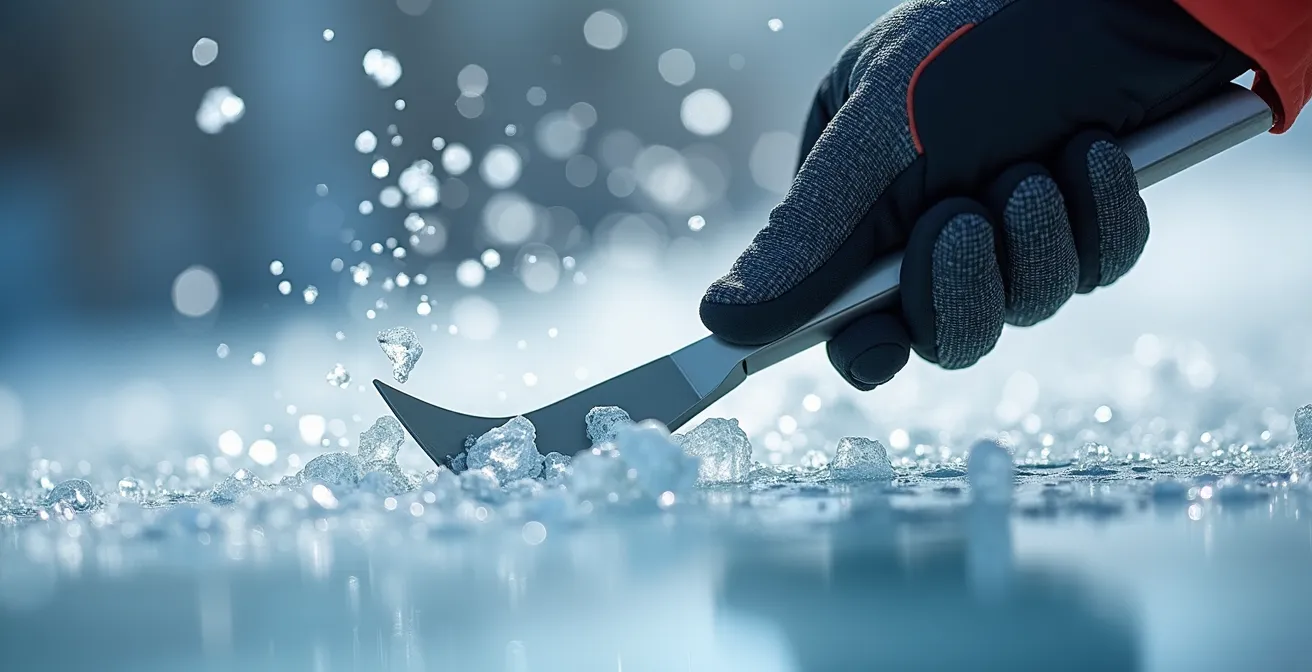
As the image illustrates, the placement is about precision, not power. The aim is to find the natural concavities and features in the ice where the pick will seat with minimal effort and maximum purchase. Mastering this relaxed, efficient swing conserves precious energy, keeps your hands functional, and allows you to stay on the ice longer and more securely. It is the physical expression of a calm and focused mind.
Ultimately, a good swing is silent and feels effortless. It is a testament to your ability to work with the ice, not against it, and a clear indicator that you are climbing with your head, not just your muscles.
Mono-point or Dual-point: Which provides better stability on mixed terrain?
The choice between mono-point and dual-point crampons is a classic debate in ice climbing, but for the climber transitioning from rock, it’s a question that cuts to the core of stability and confidence. On pure, soft ice, dual-points offer a wide, stable platform that feels incredibly secure. For a beginner, this increased sense of stability provides a huge psychological boost, allowing them to focus on movement and technique rather than worrying about their feet shearing off the ice. This feeling of security is not to be underestimated; it can be the difference between a fluid ascent and a terrified, shaky one.
However, the moment rock or thin, brittle ice enters the equation—the hallmark of mixed terrain—the game changes. A mono-point acts like a surgeon’s scalpel. It can pivot on tiny rock edges, slot into minute cracks, and find purchase on delicate ice features where a dual-point would shatter the hold. This precision requires greater ankle strength and a high degree of confidence, as you are balancing your entire weight on a single, tiny point of contact. It demands commitment. There is less room for error, but the potential for more technical and delicate movement is far greater.
As professional ice climber Will Gadd notes, the technically superior tool is useless if the climber lacks the mental security to use it effectively. He has observed that climbers who feel more psychologically secure on dual-points often climb more efficiently, even on terrain where a mono-point might be technically better. This is because fear leads to ankle rigidity, which completely negates the benefits of any crampon design. The lesson is to match the tool not just to the terrain, but to your current mental state and skill level.
This comparative analysis shows there’s no single “best” option; the choice depends on the trade-off between psychological security and technical precision. As a study of expert advice from Gripped Magazine highlights, versatility is key, but not at the expense of confidence.
| Feature | Mono-point | Dual-point |
|---|---|---|
| Precision on small holds | Excellent | Good |
| Psychological security | Lower (requires commitment) | Higher (feels more stable) |
| Mixed terrain versatility | Superior for rock features | Better for pure ice |
| Learning curve | Steeper | More forgiving |
| Ankle flexibility required | High | Moderate |
Start with what gives you the confidence to climb well. As your technique and mental fortitude grow, you can progress to more specialized tools. The best crampon is the one that allows you to move with fluid, confident intention.
The positioning error that puts your belayer in the direct line of falling ice
In rock climbing, the fall line is relatively predictable. In ice climbing, it’s a wide, chaotic cone of debris. Every swing of your axe, every kick of your crampons, sends shards of ice downward. A dinner-plate-sized chunk falling from 100 feet can be lethal. The single most critical positioning error is for the leader to climb directly above their belayer, placing them in the direct line of this inevitable bombardment. This is not a matter of “if” but “when.” As alpinist Will Gadd bluntly states, “Every time we go climbing stuff is going to fall down… An ice climbing area is an accident waiting to happen; protect yourself at all times.”
Mitigating this objective hazard requires a systematic approach that begins before the first tool is swung. The leader and belayer must operate as a single risk-management unit. The belayer’s position is not static; it must be off to the side of the primary fall line, ideally sheltered by an overhang or other natural feature. This requires the leader to map a route that deviates, wanders, or zig-zags to keep their partner out of the line of fire. Communication is non-negotiable. Clear, pre-established signals for “Ice!” are essential, but they are a last resort. The primary defense is intelligent positioning.
This shared responsibility for safety is formalized through a “Pre-Climb Safety Contract.” It’s a verbal agreement that establishes the rules of engagement for the climb. This system transforms unspoken assumptions into a clear, actionable plan. Key elements include:
- Belay Position Mapping: Defining the primary and backup belay stations for each pitch before leaving the ground.
- Fall Line Analysis: Visually tracing the cone of potential falling ice and rock from the intended route.
- Safe Zones: Identifying protected areas for transitions and belays.
- Communication Protocol: Establishing clear, unambiguous voice or whistle signals for warnings and commands.
This protocol removes guesswork and instills a sense of mutual protection. It acknowledges the inherent dangers of the environment and replaces anxiety with a shared, systematic plan for managing it.
Your safety and that of your partner are not separate concerns. They are two parts of the same system, and that system must be built on a foundation of deliberate planning and constant communication.
How to identify solid ice for anchors when the surface looks aerated?
One of the most unnerving sights for an ice climber is a surface that is sun-rotted, aerated, or “candled.” It looks and feels like junk ice, and the instinct is to assume it’s all worthless. However, solid, trustworthy ice often lies just beneath this compromised surface. The challenge is locating it without resorting to guesswork. Relying on visual inspection alone is a high-stakes gamble. The expert alpinist, however, treats this as a data-gathering problem, employing systematic methods to map the ice’s internal structure.
The most effective method is known as the ‘Spiderweb Tap Test.’ This is a systematic approach to reading the ice with your tools and your ears. Instead of random tapping, you start at a central point and tap with the pick of your tool in expanding concentric circles, like a spiderweb. You are listening for a change in pitch. The dull, hollow ‘thud’ of aerated or delaminated ice is distinctly different from the high-pitched, resonant ‘ping’ of dense, solid ice. This methodical pattern allows you to map the boundary between weak and strong zones and identify a solid core for your placement.
This technique transforms uncertainty into a systematic search for good data. Once a solid core is identified, the screw placement must be meticulous. Clear away the rotten surface ice first, then place the screw in the dense core you have located. Building a trustworthy anchor in these conditions is about redundancy and equalization. Never rely on a single piece. A standard anchor in good ice involves two screws, but in questionable ice, three or more screws, equalized with the rope or a sling, are the standard. This distributes the load and ensures that even if one placement were to fail, the system as a whole remains secure.
The resulting anchor is a piece of engineering, built on data gathered through systematic testing and deployed with strict adherence to the principle of redundancy. It is the physical manifestation of calculated trust.
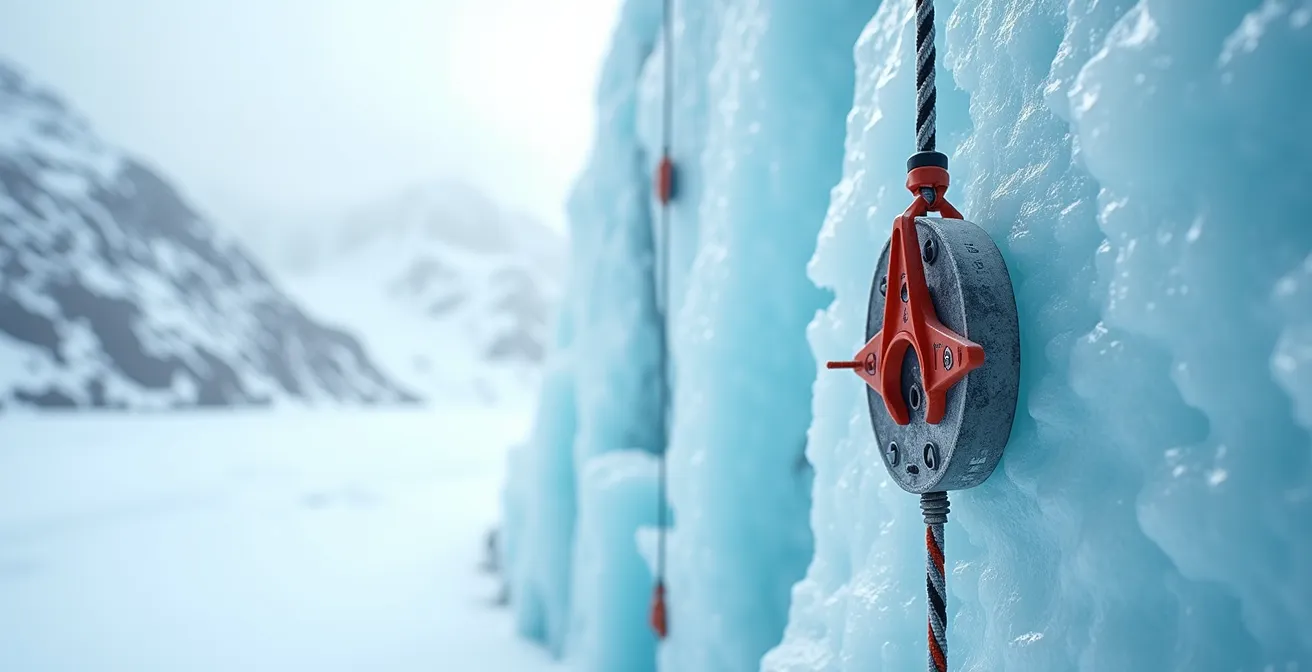
This image of a multi-point, equalized anchor demonstrates the end goal: a system where the failure of a single component does not lead to catastrophic failure of the whole. It is a visual representation of security built from methodical assessment and careful engineering, not hope.
By transforming ice assessment from a visual guess into an auditory, data-driven process, you can build secure anchors even when the surface inspires zero confidence.
Why time seems to slow down when you are in physical danger?
In moments of extreme danger—a piece of ice breaking away, a tool popping unexpectedly—many climbers report a strange perceptual distortion: time seems to slow down. This phenomenon, known as tachypsychia, is not a supernatural event but a powerful evolutionary survival mechanism. As climber Matt Lloyd described a near-death experience, “Time slowed, and I watched for signs of the whole climb collapsing—with me on it. My mind was a white-hot fury of input, and an electric heat ran through me.”
This feeling is a byproduct of the amygdala, the brain’s fear center, going into overdrive. When faced with a mortal threat, it floods the system with adrenaline and norepinephrine. This doesn’t actually slow down the external world, but rather speeds up your internal processing. Your brain begins to absorb and process sensory information at an incredibly high rate. In this hyper-aware state, you are laying down memories that are far richer and more detailed than normal. When you recall the event later, the sheer density of the stored information makes it feel as though the event lasted much longer than it actually did. Some neuroscience research on tachypsychia reveals that time perception can be distorted by a significant margin during these acute stress events.
While this heightened state can feel terrifying, it is a biological advantage. The perceived “extra time” gives your brain more processing power to analyze the situation and find a solution. You might notice the subtle shift of your weight, the precise texture of the ice, or the exact angle of your tool with a clarity that is impossible in a normal state. The key is to recognize this phenomenon for what it is: your body’s ultimate survival tool kicking in. Instead of being a passive, terrified passenger, you can learn to use this state of heightened awareness to your advantage. By training your responses through drills and visualization, you can populate these slow-motion moments with productive actions rather than panic.
Recognizing tachypsychia as a physiological asset rather than a symptom of panic is a critical mental shift. It allows you to harness your body’s most powerful fear response and channel it into life-saving focus and action.
What are the 5 tools you must carry to fix a mechanical failure on the trail?
On a remote frozen waterfall, you are your own mechanic. A broken crampon bail, a loose axe pick, or a stuck ice screw is not an inconvenience; it’s a potentially life-threatening emergency. Carrying a small, well-thought-out repair kit is not about adding dead weight; it’s about carrying what professional guides call “purchased confidence.” The psychological value of knowing you have the tools and the skills to solve common gear failures eliminates a massive source of background anxiety, freeing up mental bandwidth to focus on climbing.
The key is not just having the tools, but having the muscle memory to use them in the worst possible conditions. As experts emphasize, you must practice these repairs at home, in the cold, while wearing the gloves you climb in. This preparation transforms the kit from a collection of items into an integrated part of your safety system. The essential field repair kit is minimalist but versatile. Your kit should be built to handle the most common and critical failures, adhering to a simple protocol before any repair: S.T.O.P. (Stop, Think, Options, Proceed).
The five non-negotiable components of your on-route repair kit should include:
- A Multi-tool: This should feature pliers and a blade, ideally with a specialized attachment for clearing ice-choked screw tubes.
- A V-thread Tool: If your screws become unusable or are lost, this tool is your lifeline, allowing you to build a secure V-thread anchor in the ice itself for rappelling.
- Cold-Resistant Zip-Ties and Duct Tape: These are the universal problem solvers. Heavy-duty zip-ties rated for extreme cold and a length of duct tape wrapped around your tool shaft can fix everything from a broken boot buckle to a loose crampon.
- Spare Crampon Parts: A spare bail and any small binding parts specific to your model are critical. A crampon failure mid-pitch is one of the most dangerous scenarios imaginable.
This kit isn’t just about gear; it’s a statement of self-reliance. It’s an acknowledgment of the unforgiving nature of the environment and a testament to your preparedness to meet its challenges.
Carrying these tools—and more importantly, knowing how to use them without thinking—is one of the most powerful forms of fear management available to an alpinist.
Key takeaways
- Trust in ice climbing is not blind; it’s earned through systematic testing, auditory analysis of the ice, and methodical practice.
- Efficient technique, like a relaxed pendulum axe swing, is a primary tool for managing fear by conserving physical and mental energy and avoiding conditions like “screaming barfies.”
- Managing fear is a holistic process that extends beyond the climb itself, involving pre-climb partner safety protocols and structured post-climb physiological recovery.
How to Manage the “Adrenaline Dump” After Extreme Sports?
You’ve made it. You’re back on solid ground, the rope is coiled, and the immediate danger has passed. But the battle isn’t over. Now comes the “adrenaline dump”—the physiological backlash from a nervous system that has been operating on high alert. You might feel shaky, nauseous, irritable, or strangely deflated and exhausted. As climber Matt Lloyd described it, “After what seemed like an eternity, I began taking deep breaths and forcefully exhaling the air to try and take command of the sinking ship that was my nervous system.” This experience is your body’s clumsy attempt to slam the brakes on after flooring the accelerator.
Managing this comedown is a crucial, yet often overlooked, part of a successful climb. Ignoring it can lead to poor decision-making on the descent, emotional exhaustion, and a negative association with the stress of climbing. The key is to guide your nervous system back to a state of equilibrium with a deliberate, structured protocol. You cannot simply will yourself to calm down; you must give your body the signals it needs to stand down from its fight-or-flight response. This involves actively managing your breathing, releasing physical tension, and replenishing the resources you’ve burned.
A simple, time-based protocol can be incredibly effective. It provides a clear set of actions when your brain is too scattered to think clearly. The focus is on gentle, progressive steps that signal safety and recovery to your body. This is not an indulgence; it’s a critical part of your safety system that ensures you end the day with both your body and mind intact, ready for the next challenge.
- Immediate (0-1 minute): Perform a 4-7-8 breathing pattern. Inhale for 4 seconds, hold for 7, and exhale slowly for 8. Repeat for at least three cycles to activate the parasympathetic nervous system.
- Release Tension (1-3 minutes): Perform gentle neck rolls and shoulder shrugs. The neck and shoulders are where the body holds a tremendous amount of stress from looking up and maintaining tension.
- Refuel (3-5 minutes): Consume simple carbohydrates (like a gel or candy) and an electrolyte drink. Your body has burned through its readily available energy stores, and replenishing them is a powerful signal of recovery.
- Relax Muscles (5-10 minutes): If possible, engage in progressive muscle relaxation. Tense and then release muscle groups, starting from your feet and working your way up to your head.
- Mental Debrief (10-15 minutes): Once you feel more grounded, take a moment to reflect or journal. What triggered the fear? How did you respond? What worked? This turns a raw experience into a learning opportunity.
The true mastery of ice climbing begins not on the steepest face, but in the disciplined practice of these systems, from the first screw to the final, calming breath. Start with one protocol, practice it until it’s second nature, and build your confidence one calculated placement at a time.