
For an endurance athlete, post-marathon recovery is not about passive rest; it’s about active physiological management using precise thermal stress.
- Alternating hot and cold water creates a circulatory pump, flushing metabolic waste like lactate far more effectively than simple rest.
- Strategic use of heat or cold can trigger specific hormonal adaptations, such as Growth Hormone release, that are crucial for tissue repair.
Recommendation: Move beyond thinking of the spa as mere relaxation and begin using timed, temperature-controlled hydrotherapy protocols as a non-negotiable part of your performance toolkit.
After crossing the finish line of a marathon, an endurance athlete’s body is not just tired; it is a system in a state of acute distress. Muscles are riddled with micro-tears, metabolic byproducts like lactate have accumulated, and a cascade of inflammation has begun. The common advice is often to simply “rest and recover,” perhaps with a gentle stretch or a soak in a hot tub. This approach treats recovery as a passive waiting game, a period of downtime where the body is left to its own devices.
But what if recovery could be an active, targeted process? For the serious athlete, downtime is a critical variable to be minimized. The prevailing wisdom often pits heat against cold in a simplistic binary: heat for relaxation, cold for inflammation. While not entirely wrong, this view misses the profound physiological power that comes from using them in a structured, scientific manner. The true key to accelerated recovery lies not in choosing hot *or* cold, but in understanding how to use them as precise tools for physiological management.
This is where the paradigm shifts from passive comfort to active intervention. The secret is not just about feeling good; it’s about applying specific thermal stress to manipulate your body’s systems—to mechanically pump out waste, to trigger beneficial hormonal responses, and to carefully manage your core temperature to enhance sleep quality, the ultimate repair cycle. This is not relaxation; this is a calculated extension of your training.
This guide will deconstruct the science behind advanced spa protocols. We will explore the mechanisms of metabolic flushing, the targeted use of steam and saunas, the critical role of hydration, and how to periodize your recovery using objective data, transforming your post-race spa visit from a luxury into a potent performance-enhancing strategy.
To navigate this deep dive into physiological repair, the following sections break down each component of a truly effective post-marathon recovery strategy. This table of contents will guide you through the evidence-based protocols that can significantly reduce your downtime and prepare you for your next event.
Summary: The Athlete’s Guide to Thermal Recovery Protocols
- Why alternating hot and cold water flushes metabolic waste faster than rest?
- How to spot an unsanitary spa tub before you step in?
- Steam or Sauna: Which is better for clearing sinuses after a dusty trail run?
- The fluid error that causes headaches instead of relaxation after a spa day
- When to stop thermal cycles to ensure your core temperature drops for sleep?
- Cryotherapy or Sauna: Which triggers better hormonal adaptation after endurance?
- How external pressure aids venous return when your legs are dead?
- How to Combine High-Intensity Sport with Deep Holistic Recovery?
Why alternating hot and cold water flushes metabolic waste faster than rest?
After a marathon, your muscles are saturated with metabolic byproducts, most notably lactic acid. Passive rest allows your body to clear this waste, but the process is slow and inefficient. Contrast water therapy (CWT) transforms this into an active process by creating a powerful physiological “pump” effect. The science is rooted in the rapid, forced change between vasodilation (blood vessels widening in hot water) and vasoconstriction (vessels narrowing in cold water). This alternating action mechanically pushes stagnant, waste-filled blood out of the extremities and pulls fresh, oxygenated blood in.
This is not just a theoretical benefit; it is quantifiable. Research shows that CWT can decrease blood lactate concentration significantly faster than passive recovery. One study clocked the clearance rate at 0.28 mmol·L⁻¹·min⁻¹ with contrast therapy, compared to just 0.22 mmol·L⁻¹·min⁻¹ with rest alone. For an athlete, this accelerated metabolic flushing means less muscle soreness, reduced tissue damage, and a quicker return to a state of physiological balance, shortening the time needed before the next quality training session.
To implement this effectively, precision is key. The temperatures and timings are not arbitrary; they are designed to maximize the pumping effect without placing undue stress on the cardiovascular system. Following a structured protocol is essential for achieving the desired outcome.
Action Plan: Optimal Contrast Therapy Protocol
- Start by immersing in hot water (98-104°F or 37-40°C) for 3-4 minutes to initiate full vasodilation.
- Switch immediately to cold water (50-59°F or 10-15°C) for 1 minute to trigger rapid vasoconstriction.
- Repeat this hot-cold cycle for a total duration of 15-20 minutes to achieve a significant flushing effect.
- Always finish the entire session with a final cold water immersion to reduce inflammation and leave the vascular system in a constricted state.
- Maintain precise water temperatures throughout the session, using a thermometer to verify before each immersion.
How to spot an unsanitary spa tub before you step in?
An effective recovery protocol can be completely undermined if the environment is unsanitary. A poorly maintained spa tub is a breeding ground for bacteria and pathogens, posing a significant risk of skin infections or illness, which would derail your recovery far more than muscle soreness. As a physiotherapist, I insist that athletes treat spa safety with the same diligence as their training. You wouldn’t run in broken shoes; don’t soak in a dirty tub. Your senses are your first and best line of defense.
Before you even think about getting in, perform a quick sensory audit. A clean and properly functioning spa has very specific characteristics. Conversely, a hazardous one sends out clear warning signals, but you have to know what to look, smell, and feel for. A strong “chlorine” smell, for instance, is a major red flag. It doesn’t indicate cleanliness; it indicates the presence of chloramines, chemical byproducts formed when chlorine reacts with organic waste like sweat and skin cells. A healthy tub should have a neutral, clean scent.
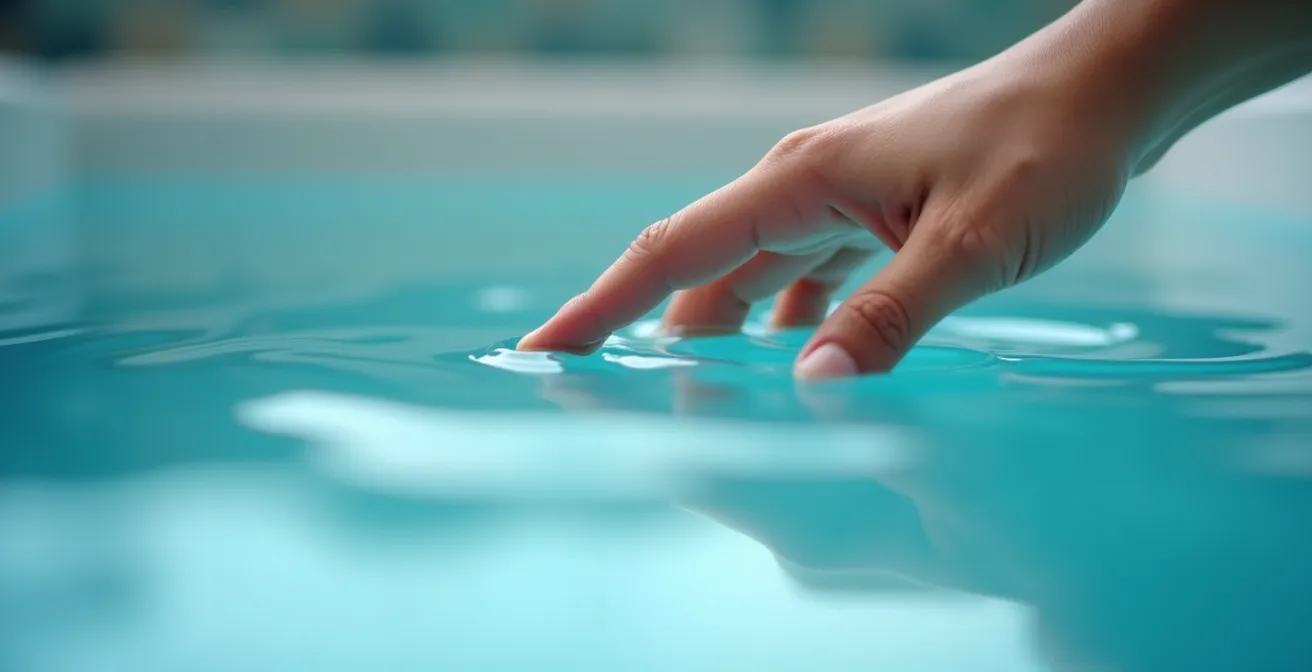
The feel of the tub’s surfaces is another critical indicator. The walls below the waterline should feel perfectly smooth. Any slimy or slippery texture is a sign of biofilm, a dangerous, well-established colony of bacteria that is highly resistant to sanitizers. Trust your sense of touch; it can detect hazards that are invisible to the eye. Use the following checklist as a non-negotiable pre-entry procedure.
Checklist: 5-Step Spa Sanitation Audit
- Sensory Cue Scan: Actively engage all senses. Listen to the pump motor, smell the air directly above the water, and look at the water’s clarity from multiple angles.
- Visual & Olfactory Inventory: Systematically scan for visible debris, hair, or suds. Note any pungent “chlorine” or musty odor, which signals the presence of chloramines or mold.
- Surface Integrity Test: Run your hand along the tub wall just below the waterline. Any slimy texture indicates the presence of biofilm, a definitive sign of an unsanitary environment.
- Clarity & Function Check: Assess the water. Is it crystal clear, or is it cloudy, foamy, or discolored? Listen to the equipment—a loud, straining pump often indicates clogged filters and poor circulation.
- Decision Point: If any single check on this list fails, make the disciplined decision not to enter. Your health is more important than a single recovery session. Report the findings to management immediately.
Steam or Sauna: Which is better for clearing sinuses after a dusty trail run?
Endurance athletes, particularly those competing on trails, often finish a race with significant sinus and respiratory tract congestion from inhaling dust, pollen, and other particulates. While both steam rooms and dry saunas offer recovery benefits, they are not interchangeable for this specific issue. When the goal is to clear the sinuses, the high-humidity environment of a steam room is unequivocally superior. The key difference lies in the way wet heat and dry heat interact with the mucous membranes and foreign particles.
A steam room operates at a lower temperature (around 110-120°F or 43-49°C) but with nearly 100% humidity. This moisture is the critical element. It directly adds warmth and water to the inhaled air, which helps to liquefy viscous mucus, making it easier to expel. Furthermore, the high humidity causes airborne dust particles trapped in your sinuses to agglomerate (clump together), become heavier, and clear out more effectively. A dry sauna, with its high heat (160-200°F or 71-93°C) and low humidity, can actually have the opposite effect, potentially dehydrating the mucous membranes and worsening congestion for some individuals.
The following table breaks down the key differences for this specific application, guiding you to the right choice for immediate post-race respiratory relief.
| Factor | Steam Room (Wet Heat) | Dry Sauna (Dry Heat) |
|---|---|---|
| Mucus Viscosity | Directly decreases viscosity for easier expulsion | Can dehydrate membranes, worsening congestion |
| Particle Removal | High humidity causes dust to agglomerate and clear | No agglomeration effect on particles |
| Temperature | 110-120°F with 100% humidity | 160-200°F with 5-10% humidity |
| Optimal Duration | 5-10 minutes | 15-20 minutes |
| Best For | Immediate sinus congestion relief | Systemic recovery benefits |
While the sauna has profound benefits for systemic and hormonal recovery, for the specific task of clearing your airways after a dusty run, a short session in the steam room should be your first port of call. Follow it with a gentle saline nasal rinse to fully flush the loosened debris.
The fluid error that causes headaches instead of relaxation after a spa day
One of the most frustrating outcomes for an athlete is finishing a recovery spa session with a throbbing headache, turning a restorative experience into a painful one. The immediate assumption is simple dehydration. While that’s part of the story, the more critical and often overlooked error is electrolyte depletion. Intense sweating in a sauna or hot tub expels not just water, but also crucial minerals like sodium, potassium, and magnesium, which are essential for regulating fluid balance and nerve function.
The common mistake is to rehydrate with large amounts of plain water. This can be counterproductive and even dangerous. By drinking plain water, you dilute the concentration of the remaining electrolytes in your bloodstream. This imbalance can lead to a condition called hyponatremia, where sodium levels become abnormally low. A primary symptom of this electrolyte imbalance is, ironically, a headache. As sports physiologist Dr. Joshua Kantor notes, the mechanism is more complex than simple water loss. As he states in the Chill Space NYC Marathon Recovery Guide, this dilution is a direct cause of post-spa headaches.
It’s not just dehydration, but electrolyte depletion through sweat. Drinking large amounts of plain water can dilute remaining electrolytes, potentially leading to hyponatremia, a direct cause of headaches.
– Dr. Joshua Kantor, Chill Space NYC Marathon Recovery Guide
Preventing this requires a proactive hydration strategy that focuses on replacing both fluids and minerals *before, during, and after* heat exposure. The goal is to maintain equilibrium, not just to pour water back into the system. Following a dedicated protocol is the only way to ensure your spa session remains purely beneficial.
Action Plan: Spa Hydration Protocol to Prevent Headaches
- Pre-load with 16-20oz (500-600ml) of an electrolyte drink 30-45 minutes before your first heat exposure to prime your system.
- During your spa session, consistently sip 4-6oz (120-180ml) of electrolyte-rich water every 15 minutes.
- Avoid plain water entirely during the session; opt for drinks specifically formulated with sodium, potassium, and magnesium.
- Limit individual heat sessions (sauna, steam, hot tub) to a maximum of 15-20 minutes to manage sweat loss.
- Cool down gradually between heat exposures to prevent sudden shifts in blood vessel dilation that can also contribute to headaches.
When to stop thermal cycles to ensure your core temperature drops for sleep?
Sleep is the single most important component of recovery, where the majority of tissue repair and hormonal regulation occurs. A key physiological trigger for initiating and maintaining deep sleep is a drop in core body temperature. Using saunas, hot tubs, or even intense contrast bathing too close to bedtime can elevate your core temperature and actively interfere with this crucial process, leaving you feeling restless and unrecovered despite your efforts.
From a physiological standpoint, your body has a natural circadian rhythm that includes a temperature cycle. Core temperature naturally peaks in the late afternoon and begins to drop in the evening, signaling to the brain that it’s time to prepare for sleep. Any thermal therapy that artificially raises your core temperature during this wind-down window can disrupt or delay sleep onset. Therefore, the timing of your final heat exposure is a critical variable in your recovery plan. It’s not just about what you do, but *when* you stop doing it.
Research and best practices in sports recovery suggest a clear buffer zone is needed. To allow for adequate cooling, studies indicate that all thermal therapies should end a minimum of 90-120 minutes before your intended bedtime. This gives your body enough time to dissipate the excess heat and begin its natural, sleep-inducing temperature descent. A gradual cool-down, rather than an abrupt stop, can further aid this process.

This managed descent of core temperature modulation is a non-negotiable part of a holistic recovery strategy. The goal is to use thermal stress to your advantage during the day, then consciously guide your body toward a restful state in the evening.
Action Plan: Evening Thermal Wind-Down Protocol
- Schedule your final heat exposure to end at least two hours before your planned bedtime (e.g., finish by 8 PM for a 10 PM bedtime).
- Conclude your final session with a 5-minute transitional shower, starting warm and gradually decreasing the temperature to lukewarm or cool, but not shockingly cold.
- Avoid intense cold plunges within three hours of sleep, as the associated adrenaline response can be stimulating and interfere with sleep onset.
- Pay attention to your body’s signals; when you get into bed, you should feel thermally neutral or slightly cool, not warm.
- If you still feel overheated an hour after your session, take another brief, cool (not cold) shower for 2-3 minutes to help dissipate residual heat.
Cryotherapy or Sauna: Which triggers better hormonal adaptation after endurance?
For the advanced athlete, recovery extends beyond simple muscle repair; it’s about optimizing the body’s entire adaptive response. Both cryotherapy (extreme cold) and sauna (extreme heat) are powerful forms of thermal stress that can act as potent hormonal triggers, but they serve different purposes and should be used at different times in the recovery cycle. Using the wrong one at the wrong time can actually blunt the very adaptations you trained so hard to stimulate.
Immediately after a marathon, your body is in a state of high inflammation. In this acute phase (the first 24-48 hours), cryotherapy or cold water immersion is the superior choice. The intense cold causes massive vasoconstriction, which helps to powerfully reduce swelling, numb pain signals, and mitigate exercise-induced muscle damage. It is a tool for damage control.
However, after the initial inflammatory wave has subsided (Day 3 onwards), the goal shifts from damage control to active repair and rebuilding. This is where the sauna becomes the more valuable tool. Exposure to high heat is a significant physiological stressor that has been shown to trigger a robust release of Growth Hormone (GH). GH is a critical anabolic hormone that plays a direct role in protein synthesis and tissue repair. Using the sauna in this later phase effectively signals to your body to accelerate its rebuilding processes. It’s also crucial to wait at least three hours post-exercise before any cold exposure, as some studies suggest immediate cold can blunt the signaling pathways for muscular adaptation.
Action Plan: Periodized Hormonal Trigger Protocol
- Phase 1 (Day 0-2 Post-Race): Prioritize cryotherapy or cold water immersion. Use these modalities for acute inflammation management and pain relief.
- Phase 2 (Day 3-7 Post-Race): Shift focus to repair. Implement 15-20 minute dry sauna sessions to stimulate the release of Growth Hormone and promote systemic repair.
- Timing Post-Exercise: On any training day, wait a minimum of 3-4 hours after your workout before any cold therapy to avoid blunting the desired adaptive signals from training.
- Listen to Your Body (Objectively): Use objective data like morning Heart Rate Variability (HRV) to guide your choice. A low HRV score suggests a need for gentle, inflammation-reducing recovery (cold), while a normalized or high score indicates readiness for an adaptive stimulus like a sauna.
- Avoid Overlapping Stressors: Never use both cryotherapy and sauna on the same day during the immediate post-marathon recovery week. They are powerful, distinct stressors, and combining them can overtax an already compromised system.
How external pressure aids venous return when your legs are dead?
After a marathon, that “dead legs” feeling is caused by a combination of muscle damage, inflammation, and the pooling of blood and lymphatic fluid in your lower extremities. Your circulatory system struggles to pump this fluid back up towards the heart, a process known as venous return. While compression socks are a common tool to assist with this, simple water immersion provides a far more powerful and uniform force: hydrostatic pressure.
Hydrostatic pressure is the force exerted by a fluid due to gravity. When you stand in water, the pressure is greatest at your feet and decreases as you get closer to the surface. This creates a natural pressure gradient that physically squeezes your lower limbs, pushing stagnant fluid out of your legs and back into central circulation. This effect is significant and measurable. Research on hydrotherapy shows that standing in chest-deep water creates a hydrostatic pressure of 72.4 mm/Hg at the feet. To put that in perspective, standard medical-grade compression stockings provide pressure in the range of 20-30 mm/Hg. The water itself is a more powerful compression device.
This pressure gradient aids not only venous return but also lymphatic drainage, helping to clear inflammatory byproducts more effectively. This is a purely mechanical benefit, independent of the water’s temperature. Of course, using cold water combines this powerful compressive force with the anti-inflammatory benefits of cold, creating a two-pronged attack on post-race leg swelling and soreness.
Action Plan: Graduated Water Immersion for Venous Return
- Begin with immersion to hip-depth for 5 minutes. This allows your body to acclimate and initiates the fluid displacement from the lower legs.
- Progress to chest-deep immersion. This is the optimal depth to create the maximum pressure gradient along the entire length of your legs.
- Maintain the water temperature in the optimal range for recovery, between 50-59°F (10-15°C), to gain the combined benefits of pressure and cold therapy.
- While immersed, perform gentle, slow movements like ankle circles or light knee bends to further enhance the muscle-pumping effect and aid fluid return.
- Remain immersed for a minimum of 10-15 minutes to allow sufficient time for the hydrostatic pressure to effectively reduce swelling and promote lymphatic drainage.
Key Takeaways
- Contrast water therapy (hot/cold cycles) acts as a circulatory pump to actively flush metabolic waste, accelerating recovery far more than passive rest.
- The timing of thermal therapy is critical; all heat exposure should end at least 90-120 minutes before bed to allow core temperature to drop, which is essential for deep sleep.
- Periodize your recovery: use cold therapy (cryo/ice baths) in the first 48 hours for inflammation control, and use heat (sauna) on subsequent days to trigger growth hormone for repair.
How to Combine High-Intensity Sport with Deep Holistic Recovery?
The modern endurance athlete understands that peak performance is born from a precise balance of intense stress and deep recovery. The principles we’ve discussed—metabolic flushing, hormonal triggers, and hydrostatic pressure—are not isolated tricks. They are components of a single, integrated system of active physiological management. The ultimate goal is to move from guessing what your body needs to objectively listening to it and responding with the correct protocol at the correct time.
This is where objective data, specifically Heart Rate Variability (HRV), becomes the cornerstone of a truly holistic recovery plan. HRV is a measure of the variation in time between each heartbeat and serves as a powerful indicator of the state of your autonomic nervous system. A high HRV generally signifies a body that is well-rested and ready to handle stress (training), indicating a dominance of the “rest-and-digest” parasympathetic branch. A low HRV signals fatigue, stress, and a dominance of the “fight-or-flight” sympathetic branch, telling you that more recovery is needed.
After a major endurance event, your nervous system is profoundly fatigued. Studies show that while parasympathetic indices may return to baseline 2 days post-ultra-marathon, the full subjective and systemic recovery can take much longer. By tracking your morning HRV, you can stop guessing and start tailoring your recovery. A low HRV in the days after a race is a clear signal to prioritize gentle, restorative modalities like cold therapy and compression. As your HRV begins to normalize and climb back to your baseline, it’s a sign that your body is ready for more intensive, adaptive stimuli like sauna sessions.
Action Plan: HRV-Guided Recovery Periodization
- Phase 1 (Immediate Post-Race, 0-48 hours): Your HRV will be suppressed. During this phase, prioritize recovery modalities that support the parasympathetic system: cold therapy, compression, and light mobility. Avoid intense heat.
- Phase 2 (Early Recovery, Day 2-7): Monitor your morning HRV. When it begins to trend back toward your personal baseline, you can introduce heat therapy (sauna) and more active recovery to promote repair and adaptation.
- Phase 3 (Return to Training, Week 2+): An HRV that is at or above your baseline is a green light, indicating your nervous system has recovered and is ready to handle training stress again. This is the time to use sauna sessions as an adaptive stimulus.
- Standardize Your Measurement: To get reliable data, take your HRV measurement every morning at the same time, in the same position (lying down is preferred), before getting out of bed or consuming caffeine.
- Let Data Guide Intensity: Use HRV as your daily guide. If you have a surprisingly low score on Day 5, opt for a gentler recovery day. If you have a high score, you have the capacity for a more intense recovery protocol or a return to light training.
Your body is the most sophisticated piece of technology you will ever own. By combining these evidence-based thermal protocols with objective data from your own physiology, you can move beyond the generic advice of the past and build a recovery system that is as personalized and high-performance as your training. Start implementing these strategies today to reduce your downtime and unlock your true potential.