

In summary:
- Downhill knee pain is a braking problem, not a strength problem. Your training must focus on controlled eccentric strength.
- Ankle mobility is non-negotiable. If your ankles can’t move, your knees are forced to absorb dangerous impact forces.
- Training specificity is key: single-leg exercises and drills performed with a weighted pack are far more effective than general gym work.
- A structured tapering period of 7-10 days before your trek is critical for arriving fresh and avoiding injury.
For a hiker who lives in a city, the anticipation of a mountain trek is a powerful motivator. You train, you plan, you dream of the summit. But there’s a quiet dread that often accompanies this excitement: the descent. Why is it that you can climb for hours but the walk down leaves your knees screaming? The common advice is to simply “strengthen your legs” with endless squats or to rely on trekking poles as a crutch. While well-intentioned, this approach misses the fundamental issue.
Downhill knee pain is rarely a sign of weak legs; it’s a sign of a poorly trained braking system. The forces involved in controlling your body weight with every downward step are unique and immense. Your muscles must lengthen under tension—an eccentric contraction—to absorb shock and maintain balance. Standard strength training often neglects this specific, crucial function. The true key to descending without pain lies not in more generalized strength, but in re-engineering your body’s entire kinetic chain, from the ground up.
This prescriptive guide moves beyond the platitudes. We will deconstruct the biomechanics of the descent, revealing why specific muscles matter more than others and how limitations in one joint can create a crisis in another. Over the next four weeks, you will learn not just what exercises to do, but precisely why they work, transforming your body into a resilient, shock-absorbing system ready for any mountain.
To navigate this conditioning journey effectively, this article is structured to build your understanding and ability layer by layer. The following sections break down the core principles and actionable steps you will take to bulletproof your knees.
Summary: A Prescriptive Plan for Downhill-Ready Knees
- Why walking down stairs backward strengthens the exact muscles needed for descent?
- Step-ups or Squats: Which carries over better to trail performance?
- How restricted ankles force your knees to take impact they shouldn’t?
- The training mistake that leaves your traps screaming on day 1
- When to stop heavy leg training to ensure you are fresh for the start?
- How to use your test results to build a 12-month training block?
- When to start leg blasters to prevent fatigue by 2 PM on your ski trip?
- How to Prevent Blisters on Multi-Day Treks with Wet Feet?
Why walking down stairs backward strengthens the exact muscles needed for descent?
To understand why walking backward is so effective, you must first understand the primary job of your muscles during a descent: braking. As you step down, your quadriceps, particularly the vastus medialis obliquus (VMO) just above your kneecap, must lengthen under load to control the speed of your descent and absorb impact. This is called an eccentric contraction. It is fundamentally different from the concentric (shortening) contraction used to push yourself up a hill. Most knee pain on descents stems from muscles that are strong concentrically but weak and unprepared for this demanding eccentric load.
Walking down stairs backward forces this exact eccentric action in a safe, controlled environment. Your body has no choice but to use the quads as brakes to lower your weight to the step below. It isolates the deceleration pattern without the high impact or momentum of a forward descent. This builds not only specific strength but also proprioceptive control, teaching your nervous system how to manage your knee’s position and stability under load. It’s a foundational exercise for re-educating your body’s braking mechanics.
Integrate this progressive protocol into your training:
- Weeks 1-2: Start by walking backward on a flat surface for 5 minutes daily. This develops the basic motor pattern and coordination without any load.
- Weeks 3-4: Progress to a gentle decline, like a 5-10 degree ramp or a small grassy hill. Perform 10-15 controlled backward repetitions.
- Weeks 5-6: Begin on actual stairs. Start with descending 2-3 flights backward, holding the handrail for support and balance.
- Weeks 7-8: Increase the volume to 5-10 flights without rail support. Focus intently on a slow, controlled 3-second descent for each step.
By mastering this movement, you are building the precise muscular endurance and control that forms the first line of defense against downhill knee pain.
Step-ups or Squats: Which carries over better to trail performance?
While bilateral squats build a crucial foundation of general strength, they do not adequately prepare you for the single-leg demands of hiking. On a trail, you are constantly balancing and absorbing force on one leg at a time. This is why exercises that mimic this unilateral (one-sided) pattern have a much higher carryover to trail performance and injury prevention. The clear winner for descent preparation is the single-leg step-down, an exercise that directly simulates the eccentric braking motion.
The step-down forces the stabilizing muscles around your hip and knee, particularly the gluteus medius and VMO, to work overtime to prevent your knee from collapsing inward. This reveals and corrects imbalances that a bilateral squat can easily hide. Step-ups are the next best thing, simulating the ascent, while squats remain a foundational but less specific tool. The hierarchy of specificity is clear.
Case Study: Specificity in Action
Betsy Youngman, a World Master’s Nordic Skiing Champion, possessed elite fitness but still experienced significant knee pain during downhill hiking. Her training was robust but not specific. After implementing single-leg step-down exercises with a small heel elevation to simulate downhill angles, she reported a dramatic improvement in her knee stability and completely eliminated the pain within just four weeks of this targeted training.
This table breaks down the application of each exercise within a training plan.
| Exercise Type | Trail Specificity | Injury Prevention | Best Use Phase |
|---|---|---|---|
| Single-Leg Step-Downs | 95% – Exact descent pattern | Reveals imbalances immediately | Functional Application (Weeks 5-8) |
| Step-Ups (12-18″ box) | 85% – Ascent simulation | Builds single-leg power | Strength Building (Weeks 3-6) |
| Bilateral Squats | 60% – General strength | Foundation building | Base Phase (Weeks 1-4) |
To perform the step-down correctly, focus on keeping your knee aligned over your second toe and control the descent slowly. The illustration below highlights the correct form.
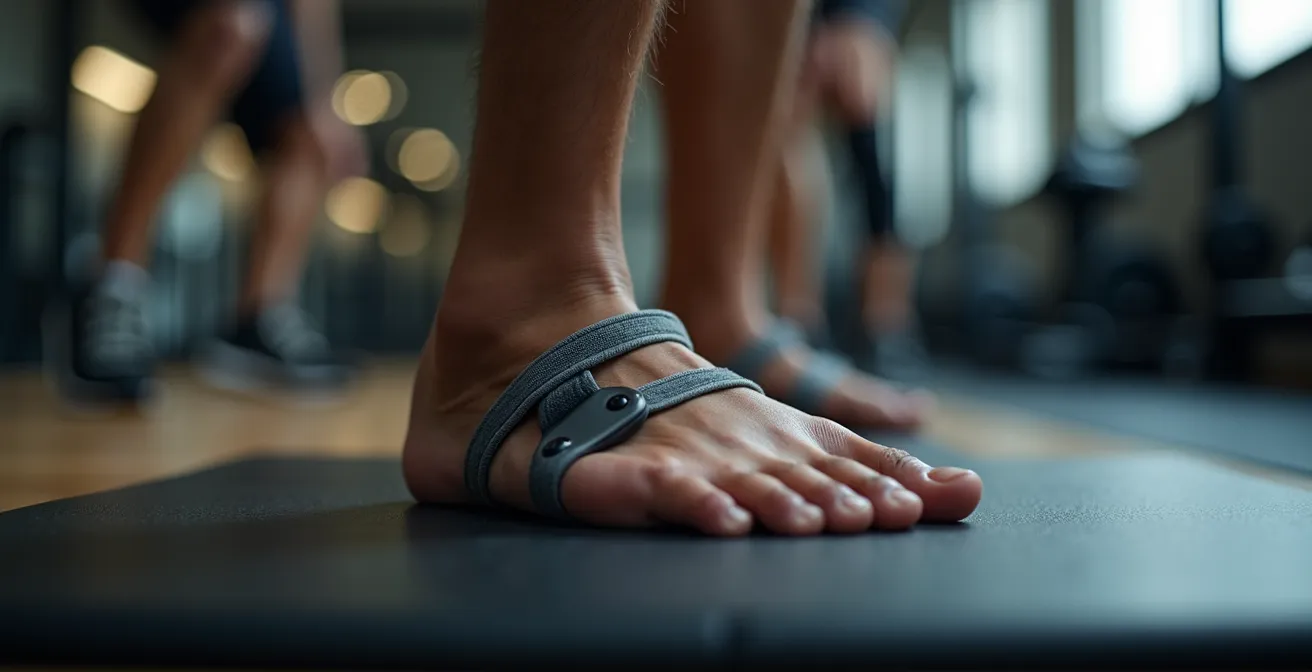
As you can see, the emphasis is on controlled movement and perfect alignment, which directly translates to stability and safety on an uneven trail.
Prioritizing single-leg work, especially the step-down, is the fastest way to build functional, trail-ready strength and leave knee pain behind.
How restricted ankles force your knees to take impact they shouldn’t?
Your body is a kinetic chain, where movement and force are transferred from one joint to the next. The foundation of this chain during hiking is the ankle. For your body to absorb the shock of a downhill step correctly, your shin must be able to move forward over your foot—a movement called dorsiflexion. When this motion is restricted, a cascade of disastrous compensations occurs. Research shows that forces on the knee joints can reach up to 8 times your body weight during a descent. Without adequate ankle mobility, that force has nowhere to go but directly into the knee joint and its surrounding soft tissues.
Imagine trying to squat with your feet bolted to the floor; you’d be forced to lean far forward and put immense stress on your knees and lower back. This is precisely what happens with every downhill step when you have poor dorsiflexion. Your knee is forced to travel too far forward past your toes, creating shearing forces and straining the patellar tendon. In essence, your knees are paying the price for your ankles’ lack of mobility. Before you do a single squat or lunge, you must assess and address your ankle mobility. It is the single most important factor in your body’s ability to act as an effective shock absorber.
Your Action Plan: The Knee-to-Wall Ankle Mobility Test
- Step 1: Stand facing a wall, barefoot. Place the toes of one foot about 10cm (4 inches) away from the wall’s base.
- Step 2: Keeping your heel firmly planted on the ground, drive your knee straight forward to try and touch the wall. Do not let your heel lift or your foot arch collapse.
- Step 3: If you successfully touch the wall, move your foot back 1cm (about half an inch) and repeat the process.
- Step 4: Your score is the maximum distance from the wall where your knee can still make contact without your heel lifting.
- Step 5: A distance of 10-12cm is the target for adequate dorsiflexion for hiking. Below 8cm indicates a significant restriction that requires daily mobility work.
If you fail this test, daily calf stretching and ankle mobilization drills are no longer optional; they are your highest training priority.
The training mistake that leaves your traps screaming on day 1
You’ve spent weeks strengthening your legs, but within the first hour of your trek, a burning pain develops in your shoulders and upper back (trapezius muscles). This is the classic sign of a critical training error: training your legs in isolation without a loaded pack. Hiking is a full-body activity. The weight of your pack fundamentally changes your center of gravity and demands constant stabilization from your core, hips, and upper back.
When you neglect to train with a load, your “chassis” is not prepared for the demand. Your core muscles fatigue quickly, your posture degrades, and your shoulders are forced to take on the burden of stabilizing the pack. This not only causes upper back pain but also has a direct, negative impact on your knees. As your upper body fatigues and slouches forward, your center of mass shifts, forcing your quads and knees to work even harder as brakes. It creates a vicious cycle of fatigue and strain throughout the entire kinetic chain. Training with a weighted pack is essential to build the structural integrity needed to carry a load efficiently and pain-free.
Incorporating loaded exercises like lunges, step-ups, and even simple walking with a pack teaches your body to function as an integrated system. Start with about 10% of your body weight and gradually increase it as you get closer to your trip. This ensures your entire support structure, not just your legs, is conditioned for the real demands of the trail. The results are significant, with a training study showing that hikers who performed exercises with weighted packs experienced 73% less upper back pain on multi-day treks.
This integrated approach is the difference between simply surviving a hike and comfortably enjoying it from the first step to the last.
When to stop heavy leg training to ensure you are fresh for the start?
After weeks of dedicated training, one of the biggest mistakes a hiker can make is to continue pushing hard right up until their departure day. The goal of training is to stimulate adaptation, but that adaptation only occurs during recovery. Arriving at the trailhead fatigued is a recipe for poor performance and injury. This is where a strategic tapering period becomes essential. Tapering is a progressive reduction in training volume (not intensity) to shed accumulated fatigue while retaining fitness gains.
For a demanding hike, a taper of 7 to 10 days is optimal. This doesn’t mean sitting on the couch. It means switching from heavy, muscle-damaging lifts like squats and deadlifts to lighter, bodyweight movements that focus on pattern reinforcement and mobility. The goal is to keep your nervous system primed while allowing your muscles, tendons, and ligaments to fully repair and super-compensate. Properly executed, this process can be remarkably effective. In fact, sports science research consistently demonstrates a 2-8% performance improvement in athletes after a well-structured 7-10 day taper.
Follow this 10-day pre-hike protocol to ensure you arrive at the start line feeling strong, fresh, and ready:
- Days 10-8 Before Trip: Your final heavy strength session. Perform your last squats or deadlifts, but at a reduced load of around 70% of your maximum.
- Days 7-5: Switch entirely to bodyweight exercises. Focus on light, crisp movement patterns like air squats, lunges, and mobility drills.
- Days 4-3: Active recovery. A gentle walk for 20-30 minutes, followed by dynamic stretching and foam rolling is ideal.
- Day 2: Almost complete rest. Very light yoga or a short mobility session is acceptable if you feel stiff.
- Day 1 (Travel Day): Focus on hydration and avoiding long periods of static sitting. Perform light stretching as needed.
Walking this fine line between fitness and freshness is the final piece of the puzzle, ensuring all your hard work translates into a successful and enjoyable trek.
How to use your test results to build a 12-month training block?
While a four-week program can create significant improvements, a truly resilient body is built over the long term. For the serious hiker, preparation isn’t a last-minute cram session; it’s a year-round process. The results from your assessments, particularly the Knee-to-Wall ankle mobility test, become the cornerstone of your long-term plan. A score below 8cm, for example, is a clear directive: your off-season must prioritize daily mobility work before you can safely layer on heavy strength training.
This long-term approach is known as periodization, where the year is divided into distinct phases, each with a specific focus. This prevents burnout, manages fatigue, and ensures you “peak” at the right time for your most important treks. A failure in one phase (e.g., skipping mobility work in the off-season) will inevitably compromise the next. This systematic approach is how professional guides maintain their durability year after year.
A professional guide’s success provides a powerful example. Ian Taylor, who has guided over 40 treks to Everest Base Camp, implements a structured 12-month block for his teams. Following assessments that revealed widespread ankle restrictions, his guides dedicated three months of their off-season to daily mobility work. The result, as documented on his trekking site, was zero knee injuries reported across 37 subsequent Kilimanjaro expeditions, a testament to addressing the root cause.
This is a typical structure for a 12-month periodized plan:
| Phase | Duration | Primary Focus | Weekly Volume |
|---|---|---|---|
| Off-Season Base | Months 1-3 | Mobility, general strength | 3-4 sessions |
| Pre-Season Build | Months 4-6 | Specific strength, power | 4-5 sessions |
| In-Season Peak | Months 7-9 | Trail specificity, endurance | 2-3 + hiking |
| Post-Season Recovery | Months 10-12 | Active rest, address weaknesses | 2-3 light sessions |
This professional framework shifts the goal from simply “getting ready for a hike” to building a body that is always ready for the mountains.
When to start leg blasters to prevent fatigue by 2 PM on your ski trip?
While this question mentions a ski trip, the principle applies universally to any demanding mountain sport, including hiking. The dreaded “2 PM fatigue”—where your legs turn to jelly, your form collapses, and every step becomes a chore—is a failure of muscular endurance. Your muscles may be strong, but they lack the capacity to repeatedly produce force for hours on end. This is where high-intensity conditioning circuits, famously known as “Leg Blasters,” become a game-changing tool.
Leg Blasters are a brutal but effective combination of bodyweight squats, lunges, and jumps performed with minimal rest. Their purpose is not to build maximum strength, but to push your muscles’ metabolic capacity. They train your body to tolerate high levels of lactate and to become more efficient at clearing it, which directly translates to staving off fatigue on a long day in the mountains. By stressing your system in this way during training, you increase your fatigue resistance on the trail.
Because they are highly demanding, they must be programmed intelligently. Starting them too late won’t allow for enough adaptation, and doing them too close to your trip will leave you sore and fatigued. For a major trek, you should begin integrating them 6 to 8 weeks out. This allows for a gradual increase in intensity and volume, followed by a taper.
Here is an example implementation schedule:
- 8-7 weeks before trip: Introduce one session per week. Perform 3 rounds of: 20 air squats, 20 alternating lunges, 10 jump squats. Rest as needed.
- 6-5 weeks before trip: Increase the eccentric tempo. Focus on a slow, 3-5 second lowering phase on each squat and lunge to build more control.
- 4-3 weeks before trip: Add a second Leg Blaster session per week and increase the volume to 4 rounds per session.
- 2 weeks before trip: This is the peak intensity week. Aim for 5 rounds, maintaining the slow eccentric focus.
- 1 week before trip: Taper. Perform only one light session early in the week as part of your final preparation.
This targeted conditioning is what builds the resilience to feel as strong on the last mile as you did on the first.
Key Takeaways
- Downhill hiking knee pain is primarily an eccentric “braking” problem, not a general strength issue. Training must be specific to this demand.
- Ankle mobility is non-negotiable. A restricted ankle forces the knee to absorb excessive and damaging impact forces.
- Training must be specific and integrated: prioritize single-leg exercises and always incorporate training with a loaded pack to build full-body structural integrity.
How to Prevent Blisters on Multi-Day Treks with Wet Feet?
It may seem disconnected, but the single most important component of knee health on a multi-day trek is foot health. Your feet are the foundation of your entire kinetic chain. The moment a blister forms, your entire biomechanics change. You alter your gait to avoid pain, which in turn causes unnatural stress on your ankles, knees, and hips. A simple hotspot on your heel can lead directly to debilitating knee pain by the end of the day. Therefore, a fanatical approach to foot care is not an optional luxury; it is a core component of injury prevention.
This is especially true in wet conditions, where skin softens and becomes incredibly susceptible to friction. The combination of knee fatigue from a long descent and poor footing from blister pain is a dangerous cocktail. In fact, safety research indicates that 75% of hiking falls occur during the descent, with knee fatigue and compromised foot care being major contributing factors. Protecting your feet is protecting your entire system.
Adopting a professional-grade daily foot care system is the only reliable way to prevent this cascade of failure. It is a non-negotiable ritual for any serious multi-day hiker.
- Morning Ritual: Before putting on socks, apply a lubricant like Trail Toes or Body Glide to all potential friction points (heels, toes, ball of foot). Then, apply a durable athletic tape like Leukotape P directly to your known hotspots. This creates a frictionless second skin.
- Mid-day Break: During your longest break (e.g., lunch), take off your boots and socks. Let your feet air dry for at least 10 minutes. Change into a fresh, dry pair of merino wool socks. This is the single most effective mid-hike intervention.
- Evening Recovery: At camp, the first priority is to wash your feet thoroughly. Dry them completely, especially between the toes. Apply a restorative salve or foot cream to help the skin recover overnight.
- Pre-Trek Toughening: For three weeks leading up to your trek, apply rubbing alcohol to the soles of your feet twice daily with a cotton ball. This helps to toughen the skin, making it more resistant to friction and moisture.
Your preparation starts now. Use the Knee-to-Wall test as your first diagnostic and begin building your body’s braking system today for a pain-free descent on all your future adventures.