

The key to unlocking the ocean’s stress-reducing power isn’t passive presence, but the deliberate application of science-backed environmental protocols.
- Auditory and visual stimuli from the coast actively synchronize brainwaves to quiet the brain’s “worry center” and lower stress hormones.
- Specific physical activities, when adapted correctly to the environment, can induce a powerful flow state, but require precise technique to prevent injury and mental friction.
Recommendation: Systematically apply the following protocols to consciously manage your transition from a “Red Mind” of high-stress to a “Blue Mind” of deep calm and enhanced focus.
In the life of a modern executive, the mind rarely rests. It operates in a state of high alert, a “Red Mind” characterized by a constant barrage of notifications, deadlines, and fragmented attention. The conventional prescription—a brief, mindless vacation—often fails to deliver true psychological restoration. You return to the office with the same underlying tension, the same cognitive load. The common advice to “just relax by the sea” misses the fundamental mechanism at play. It treats the ocean’s benefit as a matter of luck rather than a predictable outcome.
But what if the profound calm experienced near water wasn’t a passive gift, but an active neuro-cognitive state you could learn to engineer? The “Blue Mind” effect, a concept popularized by marine biologist Wallace J. Nichols, describes this state of mild meditation brought on by proximity to water. However, the true breakthrough for a stressed professional lies not in simply *being* there, but in *doing* specific things there. The difference between a fleeting moment of peace and a lasting reset of your nervous system is a protocol.
This article moves beyond the platitudes. It is a strategic guide to harnessing the coastal environment. We will not merely admire the view; we will deconstruct the sensory inputs—the sounds, the sights, the very air—and provide concrete, science-backed environmental protocols to systematically dismantle stress. You will learn to use the coastline as a high-performance tool for mental decompression, transitioning from a reactive “Red Mind” to a state of calm, creative, and focused “Blue Mind.”
To guide you through this process, this article is structured around specific environmental factors and activities. Each section provides a practical protocol to maximize the psychological benefits and build a robust toolkit for mental resilience.
Summary: A Protocol-Based Approach to Coastal Well-Being
- Why the sound of ocean waves synchronizes brain patterns for deep relaxation?
- How to adjust your running gait for soft sand to prevent Achilles strain?
- Sunrise or Sunset: When is the concentration of negative ions highest?
- The temperature mistake that leads to illness during coastal winter walks
- How to clean your electronics after 1 hour of exposure to sea air?
- Why walking in nature quiets the brain’s “worry center” better than TV?
- Glassy or Offshore: Which wind condition is safer for shallow reef surfing?
- How to Choose a Beachfront Resort That Satisfies Surfers and Sunbathers?
Why the sound of ocean waves synchronizes brain patterns for deep relaxation?
The soothing quality of ocean waves is not merely poetic; it is a neurological phenomenon. The rhythmic, non-threatening sound of waves washing ashore typically falls within a frequency range of 0.1 to 1 Hz, which overlaps with the brain’s alpha wave frequencies (8-13 Hz) associated with a state of calm alertness. This process, known as neural entrainment, is where the brain’s electrical activity begins to synchronize with the external rhythmic stimulus. Instead of the chaotic, high-frequency beta waves of a stressed “Red Mind,” the brain is gently guided into a more coherent, restful alpha state.
This is more than simple relaxation; it is a form of cognitive de-loading. The predictable, repetitive nature of the sound requires no analysis or prediction from the prefrontal cortex, allowing the brain’s “worry center” to stand down. Studies have confirmed the tangible physiological impact. For instance, in one study, cancer patients experiencing chronic pain who listened to 15 minutes of ocean wave sounds saw a 20 to 30 percent reduction in stress hormones like epinephrine and cortisol. Furthermore, dedicated research from the University of Surrey demonstrates that specific binaural beats, similar in principle to the layered sounds of the ocean, can significantly modulate brain wave patterns. This confirms that sound is not just background noise, but an active tool for state management.
To move from passive listening to active “Sensory Synchronization,” you can employ a specific environmental protocol to maximize this effect. Rather than just hearing the waves, you can consciously align your own physiology to them.
Action Plan: 5-Step Ocean Sound Entrainment Technique
- Positioning: Position yourself 10-15 feet from the waterline to capture the optimal mix of high and low-frequency wave sounds.
- Rhythm Identification: Close your eyes and consciously count 7-10 wave cycles to identify the natural rhythm of the break.
- Initial Synchronization: Begin synchronizing your exhale with the sound of each receding wave, typically a 4-6 second cycle.
- Cycle Extension: Once comfortable, gradually extend your breathing cycle to match every second wave, aiming for a slow 8-12 second breath.
- Alpha State Trigger: Maintain this synchronized breathing pattern for a minimum of 5 minutes to help initiate a shift towards alpha wave dominance.
This deliberate practice transforms a simple walk on the beach into a targeted neurological exercise, a foundational step in engineering your Blue Mind state.
How to adjust your running gait for soft sand to prevent Achilles strain?
Running on the beach presents a perfect opportunity to achieve a flow state, but it also introduces biomechanical challenges that can lead to injury if ignored. Soft sand is an unstable surface, forcing the small stabilizing muscles in your feet and ankles to work much harder. A common mistake is to maintain a “heel strike” gait, which is inefficient and places enormous strain on the Achilles tendon and calf muscles as your foot sinks. This creates physical stress that actively works against the “Blue Mind” you seek to cultivate.
The optimal technique is to adopt a midfoot or forefoot strike. This involves shortening your stride, increasing your cadence (steps per minute), and landing on the middle or ball of your foot directly underneath your center of gravity. This approach allows your foot’s natural arch to act as a spring, absorbing impact and providing a more stable platform for push-off. While barefoot running is often associated with this, it’s crucial to understand the forces involved. Paradoxically, the average loading rate more than doubled while running barefoot in some studies, highlighting the need for a gradual transition and impeccable form. The key is not the absence of shoes, but the correct mechanical adaptation.
Visualizing the proper form is essential for mastering this gait adjustment. The goal is to land lightly and spring off the sand, rather than digging into it.

As the image demonstrates, the foot lands flat and engaged, ready to distribute force evenly. This mindful exposure to the physical environment turns a simple run into a dynamic meditation, where focus on form quiets the internal chatter. By mastering this, you prevent the “Red Mind” state of pain and frustration and instead foster a “Blue Mind” flow state born from harmonious movement.
This protocol ensures your coastal workout becomes a source of mental clarity, not a cause of physical strain, reinforcing the principle of deliberate, engineered well-being.
Sunrise or Sunset: When is the concentration of negative ions highest?
The invigorating feeling of sea air is not just a placebo; it’s partly due to atmospheric chemistry. The crashing of ocean waves creates a natural aerosol, releasing microscopic water droplets into the air. This process, known as the Lenard effect, generates a high concentration of negatively charged ions. These ions are essentially oxygen atoms with an extra electron. When inhaled, they are believed to facilitate oxygen absorption and have a measurable biochemical effect.
Indeed, scientific research confirms that elevated levels of negatively charged ions at beaches can trigger the brain to release mood-enhancing serotonin and even reduce blood lactate levels, contributing to a feeling of both calm and energy. The highest concentration of these beneficial ions is found in the immediate vicinity of breaking waves, where the water is most turbulent. Therefore, the best time for “mindful exposure” to negative ions is not determined by sunrise or sunset per se, but by the tidal and wind conditions that produce the most energetic surf.
Generally, a rising tide combined with a light onshore wind will create the most consistent breaking waves close to the shore, maximizing your exposure. Walking right at the waterline during these periods becomes an active protocol for mood enhancement. This perspective shifts the question from a simple “morning or evening?” to a more strategic “When are the environmental conditions optimal for my neurological benefit?” It transforms a casual stroll into a deliberate act of biochemical optimization. This broader connection to the ocean’s health and our own is a cornerstone of the Blue Mind philosophy.
By encouraging people to feel empathy towards the Ocean, we know that people will feel inspired to help protect our blue planet more.
– Ocean Conservation Trust, Blue Mind Theory implementation report
By consciously seeking out these specific conditions, you are not just breathing air; you are actively inhaling an environment calibrated for mental wellness.
The temperature mistake that leads to illness during coastal winter walks
The benefits of “Blue Mind” are not exclusive to warm, sunny days. A brisk winter walk along a deserted coastline can offer a potent sense of clarity and solitude. However, it also introduces the risk of cold exposure, which, if managed incorrectly, can trigger a physiological stress response (“Red Mind”) and even lead to illness like hypothermia. The most common and dangerous mistake is focusing solely on the air temperature while ignoring the wind chill factor and humidity.
Coastal air is humid, and water conducts heat away from the body about 25 times faster than air. This means a 40°F (4°C) day with high humidity and a stiff ocean breeze can have the physiological effect of a much colder, drier inland day. Ignoring this can lead to a rapid drop in core body temperature. The key is a protocol-driven approach to layering and exposure management. Cold water immersion in lakes or rivers can provide similar “Blue Mind” benefits, but only when temperature management is impeccable; otherwise, the body’s parasympathetic (rest-and-digest) response is overridden by a sympathetic (fight-or-flight) stress reaction.
A proper cold exposure protocol involves several key steps to ensure the experience is restorative, not detrimental:
- Pre-walk Assessment: Always check the wind chill factor, not just the ambient temperature. Coastal humidity can make it feel 5-10°F colder.
- Strategic Layering: Employ a three-layer system: a moisture-wicking synthetic or wool base layer to pull sweat away from the skin, an insulating middle layer (like fleece), and a wind-resistant outer shell to block the breeze.
- Exposure Time Management: For beginners in sub-40°F (4°C) conditions, limit initial walks to a maximum of 20 minutes to gauge your body’s response.
- Post-walk Transition: The “after-drop” is a real danger. Upon returning indoors, remove any wet outer layers immediately and add a dry insulating layer *before* entering a very warm space or taking a hot shower.
- Gradual Rewarming: Wait at least 15 minutes before a hot shower. This prevents surface blood vessels from dilating too quickly, which can cause a further drop in core body temperature as cold blood from the extremities circulates back to the core.
By following this protocol, you can safely access the unique clarity of a winter coastline, making the “Blue Mind” a year-round resource for resilience.
How to clean your electronics after 1 hour of exposure to sea air?
For a stressed executive, the smartphone is both a lifeline and a primary source of the “Red Mind.” The salty, humid coastal air is notoriously corrosive to electronics, but the question of ‘how to clean them’ misses a more fundamental point. The most effective protocol is not about post-exposure cleaning; it’s about a pre-emptive digital detox to prevent exposure in the first place, thus enabling a true “Red Mind/Blue Mind Transition.”
The goal is to create a psychological firewall between your work-state and your restorative-state. Bringing your digital tether to the shoreline and using it frequently keeps your brain’s prefrontal cortex engaged in the high-alert, partial-attention mode that you are there to escape. The true value of the coastal environment is unlocked when you allow your brain to switch to its “default mode network,” a state of restful, introspective thought. As the originator of the Blue Mind theory, Wallace J. Nichols, explains:
That mindset, that default mode, opens us up to a whole toolbox of cognitive, emotional, psychological, and social skills that are not always available to us in our Red Mind mode.
– Wallace J. Nichols, Blue Mind neuroscience research
Therefore, the protocol isn’t for your device; it’s for you. It’s about consciously deciding to engage in mindful exposure to the natural world rather than digital distraction. This requires a clear plan before you even step onto the sand.
- Pre-Beach Containment: Before you leave your car or hotel, enable airplane mode on your phone and store it in a waterproof, sealed pouch. This creates a physical and digital barrier.
- The One-Photo Rule: If you wish to capture a memory, take a single, meaningful photograph upon arrival. Then, secure the device and be present.
- Analog Alternatives: For capturing thoughts or ideas that arise, use a waterproof notepad and a pencil. The physical act of writing engages the brain differently and more slowly than typing.
- Emergency Protocol: In case of accidental exposure to spray or sand, the immediate action is key. Wipe the device thoroughly with a microfiber cloth slightly dampened with distilled water (not tap water, which contains minerals).
- Post-Beach Maintenance: Once away from the coast, use a soft, dry brush to gently clean all ports and openings. Allow the device to air dry for at least two hours before attempting to charge it.
By managing your technology, you are not just protecting a device from corrosion; you are protecting your mind from the very stress you came to the ocean to dissolve.
Why walking in nature quiets the brain’s “worry center” better than TV?
The human brain evolved over millennia in natural landscapes, not in cubicles. Our sensory systems are hardwired to process the “soft fascination” of nature: the gentle sway of dune grass, the fractal patterns of waves, the expansive horizon. These stimuli engage our attention without demanding it, allowing the brain’s “worry center,” the subgenual prefrontal cortex (sgPFC), to quiet down. This brain region is associated with rumination and repetitive negative thoughts, and its activity decreases significantly during exposure to natural environments.
In contrast, watching television or scrolling through social media bombards the brain with directed, often stressful, information that requires constant analysis and emotional response, keeping the sgPFC highly active. The visual input from the coast is particularly potent. The vast, uncluttered horizon provides a sense of visual expansion, a powerful antidote to the literal and metaphorical confinement of an office. This is not just a feeling; it is a neurological reset. The lack of sharp angles and threatening stimuli reduces cognitive load, facilitating the shift from a vigilant “Red Mind” to a contemplative “Blue Mind.”
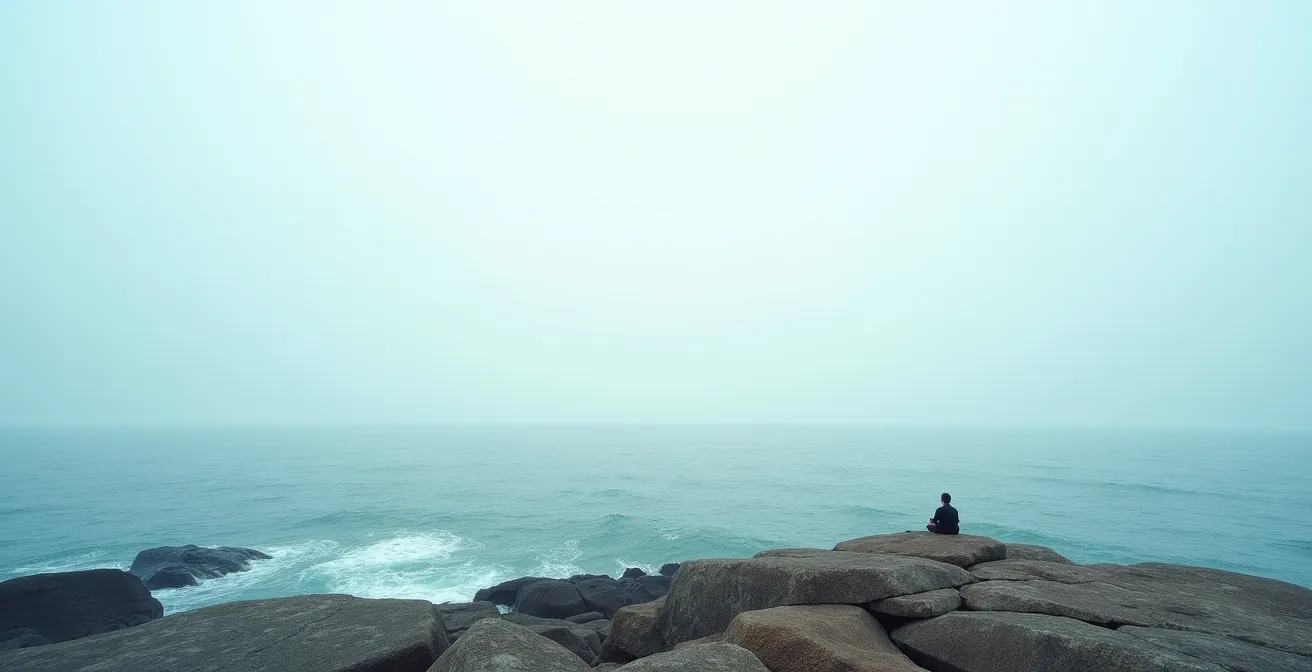
Furthermore, the “blue” of the ocean and sky seems to have a unique psychological advantage. While green spaces are undeniably beneficial, the evidence for blue spaces is compelling. In a landmark 2016 study, it was found that increased views of blue space were significantly associated with lower levels of psychological distress, a result that did not hold true for green space. The sheer scale and simplicity of a coastal vista allow for a profound sense of cognitive de-loading that is difficult to replicate elsewhere.
Choosing a walk on the beach over screen time is not an act of escapism, but a data-supported strategy for actively down-regulating the neural circuits of anxiety.
Glassy or Offshore: Which wind condition is safer for shallow reef surfing?
For an activity like surfing, achieving a “Blue Mind” flow state is the ultimate goal. This state of complete immersion, where action and awareness merge, is heavily dependent on environmental predictability. While safety over a shallow reef is a primary concern, the mental state impact of wind conditions is just as crucial for a restorative experience. The choice between glassy (no wind) and offshore (wind blowing from land to sea) conditions is a strategic one that balances risk and reward.
An offshore wind acts like a groomer, holding the wave’s face up longer and creating a clean, predictable surface to ride. This consistency reduces the cognitive load required to read the wave, making it easier to anticipate its movement and enter a flow state. Conversely, glassy conditions can be deceptive. While they appear calm, the lack of wind can lead to long lulls followed by sudden, less organized sets of waves, demanding heightened, anxious alertness. Onshore winds create chaotic, unpredictable conditions that often trigger a “Red Mind” stress response. The ideal condition is a light offshore wind (3-7 knots), which provides predictability without creating dangerously steep or difficult-to-catch waves.
This relationship between wind, wave predictability, and mental state can be systematically evaluated.
| Condition | Wave Predictability | Mental State Impact | Blue Mind Score |
|---|---|---|---|
| Glassy (No Wind) | Variable – long lulls with sudden sets | Heightened alertness required | 6/10 |
| Light Offshore (3-7 knots) | Consistent – clean wave faces | Flow state conducive | 9/10 |
| Onshore (8+ knots) | Chaotic – multiple peaks | Stress response activation | 3/10 |
| Strong Offshore (10+ knots) | Challenging – late takeoffs | Requires intense focus | 5/10 |
This analytical approach is confirmed by qualitative data from elite athletes who have mastered the ocean environment.
Case Study: Surfers’ Flow State Optimization
Professional surfers consistently report achieving their optimal “Blue Mind” and flow states in light offshore conditions. Research by Wallace J. Nichols on ocean-based flow states documents that the wave face grooming in 3-7 knot offshore winds creates highly predictable patterns. This predictability allows the conscious, analytical part of the mind to relax, enabling the surfer to rely on reactive capability and intuition, which is the hallmark of a deep flow state.
By selecting your session based on this environmental protocol, you are not just waiting for a good wave; you are engineering the conditions for peak psychological experience.
Key Takeaways
- The “Blue Mind” state is not a passive accident; it is an active, engineered state achieved through deliberate protocols.
- Synchronizing your internal physiology (breathing, movement) with external ocean rhythms (waves, wind) is the core mechanism for reducing cognitive load.
- Effectively managing environmental factors—including temperature, technology, and location—is as crucial to the process as simply being present.
How to Choose a Beachfront Resort That Satisfies Surfers and Sunbathers?
The final protocol is environmental selection. For a stressed executive planning a restorative coastal trip, the choice of a resort is not a matter of luxury, but of strategic alignment with “Blue Mind” principles. A resort can either facilitate or obstruct the transition from a “Red Mind” to a “Blue Mind.” Satisfying the needs of both an active surfer and a passive sunbather requires a location designed with an understanding of psychological space, sensory input, and zoning.
Instead of focusing on standard amenities, an executive should apply a “Blue Mind” filter to the selection process. This involves assessing the resort’s ability to deliver the key sensory and environmental inputs we’ve discussed. It’s about ensuring the physical space is engineered to promote cognitive de-loading and mindful exposure. This requires a checklist that goes beyond the star rating.
A truly effective resort will have considered the following:
- Acoustic Assessment: Does the resort offer rooms where the sound of the ocean is dominant? Inquire about rooms where nighttime ambient sound levels from waves exceed 45 dB, ensuring the therapeutic sounds aren’t drowned out by resort noise.
- Strategic Zoning: A well-designed resort provides clear separation between high-activity zones (like direct surf access points or family pool areas) and designated quiet zones (such as secluded sunrise meditation areas or adults-only beaches).
- Biophilic Design: Look for evidence of design that incorporates nature. The use of natural materials like wood and stone, the presence of living walls, and the integration of water features in common areas all contribute to a passively restorative environment.
- Orientation and Views: Prioritize resorts with rooms oriented for optimal “Blue Mind” activation. East-facing rooms are ideal for morning light and energy, while north or south-facing rooms can offer expansive, non-glare ocean views all day.
- Psychological Space: Inquire about the resort’s policy on beach density. A policy that implicitly or explicitly ensures a low density, such as a maximum of one person per 50 square feet of private beach, guarantees the psychological space needed for mental unwinding.
This deliberate selection process is the final step in engineering your escape. It ensures that the environment you invest in will deliver the profound neurological and psychological returns you seek. As the South Carolina Aquarium aptly puts it in their guide:
Take that trip to Folly Beach, Sullivan’s Island, Isle of Palms or your favorite ocean hideaway. Go for a boat ride on a river, kayak on your local lake or paddle board through the saltmarsh. Let your mind relax to the tune of endless waves, nature’s sound machine.
– South Carolina Aquarium, Blue Mind Mental Health Guide
Your next trip to the coast shouldn’t be left to chance. By applying these protocols—from how you breathe to where you sleep—you transform a simple vacation into a powerful, predictable, and profoundly effective strategy for peak mental well-being.