
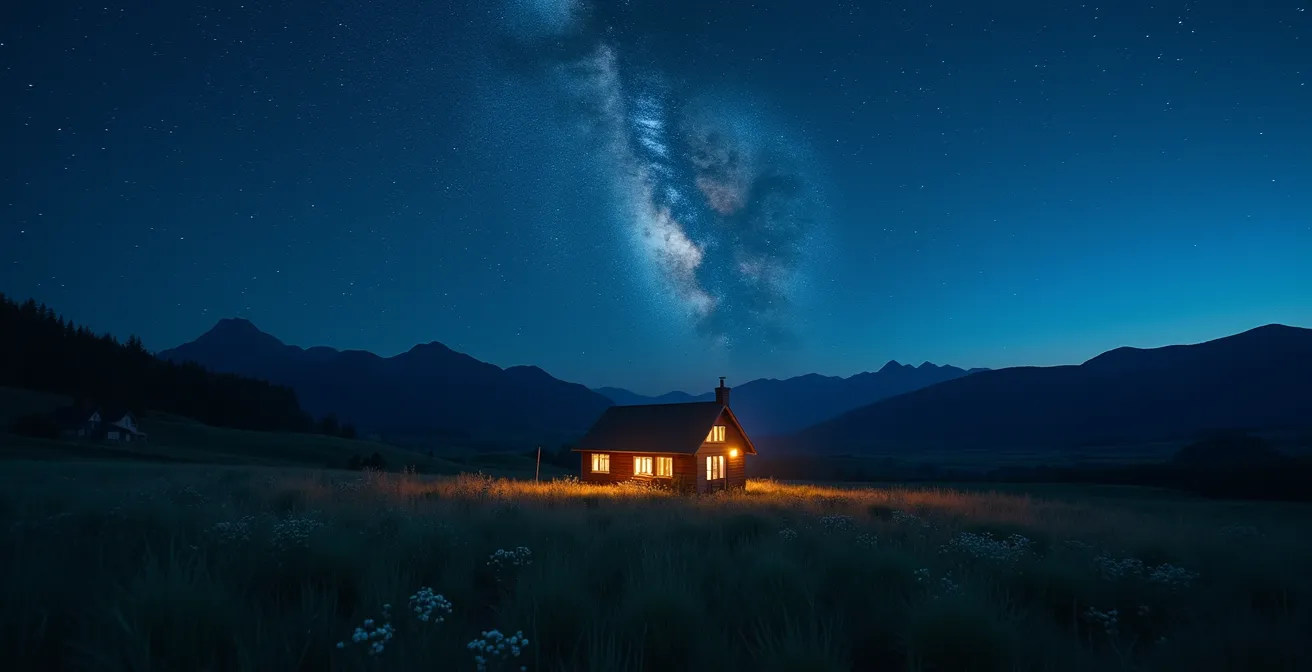
A successful rural retreat is not a passive escape, but an active protocol to recalibrate your biology.
- Absolute, uninterrupted darkness for at least three nights is non-negotiable to reset melatonin production.
- True disconnection requires a pre-planned “digital airlock” and firm professional boundaries before you even leave.
Recommendation: Stop searching for “relaxing vacations” and start engineering a systematic “sensory reset” by verifying your location’s authenticity and preparing for intentional friction.
For the tech worker, the blue glow of a screen is a constant companion, a source of both productivity and profound fatigue. The resulting insomnia and mental chatter aren’t just signs of a long week; they are symptoms of a dysregulated biological system. The common advice is to “take a break” or “find a quiet place,” but these vague notions rarely address the root cause of digital-era exhaustion. Many attempt a digital detox only to find themselves aimless, anxious, and checking their phone “just in case” within hours, negating the entire purpose of the trip.
The problem is that we treat disconnection as a simple on/off switch. We believe that merely changing our location will change our mental state. But if the true key to deep, restorative sleep wasn’t just about escaping noise, but about systematically recalibrating your body’s core hormonal and neurological functions? This isn’t about a simple vacation; it’s about executing a deliberate protocol designed to dismantle the stressors of a hyper-connected life. It requires understanding the science of light, the psychology of boredom, and the practical steps to create an impenetrable boundary between you and your digital world.
This guide provides that protocol. We will move beyond platitudes and explore the specific, evidence-backed strategies needed to engineer a retreat that genuinely resets your system. From the physiological impact of absolute darkness to the critical pre-trip preparations that determine success or failure, you will learn how to transform a simple getaway into a powerful tool for biological and mental restoration.
Summary: A Protocol for Engineering a Restorative Rural Retreat
- Why 3 nights without artificial light resets your melatonin production?
- How to verify if a “Farm Stay” actually produces its own food?
- Silence or Guidance: Which is more effective for an overstimulated brain?
- The connectivity mistake that ruins the psychological benefits of a retreat
- How to prepare your vehicle for unpaved access to remote lodges?
- The boundary mistake that negates 80% of the vacation’s mental benefits
- Why boredom is the first necessary step to resetting your reward system?
- Why Digital Detox Retreats Lower Cortisol Levels in 48 Hours?
Why 3 nights without artificial light resets your melatonin production?
Your struggle with sleep is not a personal failing; it is a predictable biological response to an unnatural environment. Your body’s sleep-wake cycle, or circadian rhythm, is primarily governed by light exposure, which dictates the production of melatonin, the hormone that signals “night” to your brain and body. For millennia, the setting of the sun provided an unambiguous cue to begin this process. Today, indoor lighting, screens, and even streetlights create a state of perpetual twilight, confusing this ancient mechanism.
The science is clear on the disruptive power of artificial light, particularly the blue-enriched light from electronic devices. It is a powerful melatonin suppressant. In fact, research shows a significant 3-hour circadian shift caused by blue light, which is double the impact of less disruptive green light. This delays the onset of sleep, shortens its duration, and degrades its quality. To reverse this, you need to provide your body with an overwhelming signal of true darkness.
A single night is not enough to undo months or years of disruption. A biological recalibration requires sustained exposure to natural light cycles. A minimum of three consecutive nights in an environment with zero artificial light allows your system to fully purge the confusing signals. On the first night, your body begins to adjust. By the second, your melatonin production starts to normalize its timing and peak. By the third night, the rhythm is typically re-established, allowing you to experience the deep, restorative sleep that your biology is designed for. This is the non-negotiable foundation of any effective retreat.
How to verify if a “Farm Stay” actually produces its own food?
Achieving the necessary darkness and quiet requires finding a truly remote location. Many places market themselves as “farm stays” or “rural getaways,” but this label can be misleading. A property that simply has a rustic aesthetic but sources its food from a commercial supplier will not provide the same holistic, grounding experience as one that is genuinely self-sufficient. Verifying this authenticity is a critical step in your planning, a process we can call establishing “proof-of-source.”
An authentic farm stay connects you to the land not just visually, but through your meals. This connection to a natural food cycle is a powerful part of the sensory reset. To ensure you’re booking the real deal, you must become an investigator. Look for evidence that contradicts the marketing. A static, year-round menu is a major red flag; a real farm’s offerings are dictated by the season. Be direct in your inquiries before booking.

Visual verification is your most powerful tool. As seen in the image above, a working farm has visible infrastructure: distinct crop rows, greenhouses, and areas for livestock. You can use free tools like Google Maps’ satellite view to cross-reference the property’s claims. Don’t be shy about asking for recent photos of their gardens or farming operations. An authentic host will be proud to share them. The goal is to find a place where the rhythm of life is dictated by the sun and soil, not by a delivery truck.
Key Questions for Your Farm-to-Table Audit:
- “What percentage of the ingredients for meals served during [your dates] comes directly from your land?”
- “Could you share some photos of your current garden, greenhouse, or livestock operations?”
- “Does your menu change based on what is currently being harvested?”
- “Is it possible for guests to participate in any small way, such as collecting eggs or harvesting herbs?”
- “Do you hold any farm certifications, and are there photos of your actual farming work on your website or social media?”
Silence or Guidance: Which is more effective for an overstimulated brain?
Once you’ve secured a genuinely remote location, the next question is what to do with your time. For a brain accustomed to a constant barrage of information, the sudden absence of stimulus can be jarring. This brings up a crucial choice in your retreat protocol: should you embrace complete, unstructured silence, or should you follow a guided program? The answer depends on your personal stimulus threshold and your experience with mindfulness.
Complete silence is a powerful tool for self-directed individuals who already have a meditation or mindfulness practice. It forces you to confront the internal chatter head-on, without distraction. However, for a first-timer, this can amplify anxiety. The “sound of silence” can be deafening, and the lack of structure can feel more stressful than relaxing. A guided program, on the other hand, provides an external framework—scheduled yoga, guided meditations, or nature walks—that can help ease the transition away from digital dependency. It lowers the cognitive load required to manage your own time, which can be a relief in itself.
A third path, nature immersion, offers a middle ground. It involves unstructured time spent in nature, where the environment provides a “soft fascination.” The gentle sounds of wind or birds and the subtle movements of leaves engage the mind without overwhelming it, promoting a natural state of flow and allowing the nervous system to gradually unwind. Understanding which approach best suits your current mental state is key to preventing your retreat from becoming another source of stress.
This decision is a critical component of your retreat design. As a comparative analysis of retreat styles shows, each approach has distinct effects on stress and recovery.
| Aspect | Complete Silence | Guided Programs | Nature Immersion |
|---|---|---|---|
| Best For | Self-directed individuals | First-time retreaters | Overstimulated minds |
| Stress Response | Can amplify anxiety initially | Structured comfort | Gentle ‘soft fascination’ |
| Cognitive Load | Requires mental discipline | External structure provided | Natural flow state |
| Recovery Time | 24-36 hour adjustment | Immediate engagement | Gradual unwinding |
The connectivity mistake that ruins the psychological benefits of a retreat
The single greatest mistake that negates the benefits of a rural retreat is a failure to establish a complete and total “digital airlock.” This mistake isn’t just about checking your email; it’s the psychological tether of knowing your phone is accessible. The mere presence of a connected device in your bag or drawer prevents your brain from fully disengaging. It keeps your nervous system in a state of low-grade alert, anticipating the next notification and undermining the entire process of deep rest.
The goal of a retreat is to immerse yourself in an environment free from artificial stimuli, both digital and physical. This is why seeking out locations with zero light pollution is so critical. In our modern world, true darkness is a disappearing resource; DarkSky International reports that 80% of people in North America cannot see the Milky Way from their homes. Escaping to a place where the night sky is fully visible is a profound experience, but it is rendered meaningless if you bring the glow of a small screen with you.

Creating a true digital airlock is a non-negotiable protocol. It is not enough to simply turn your phone off. The process must be deliberate and symbolic, signaling a clear transition to your brain. This means physically separating yourself from the device in a way that creates friction to access it. Sealing it in an envelope and leaving it in your car or a lodge safe creates the necessary psychological distance. This act of commitment is what allows your mind to finally let go of the “what if” anxiety and surrender to the present moment.
Your Digital Airlock Protocol: 5 Steps to True Disconnection
- Define Boundaries (T-48h): Set a detailed out-of-office message with a strict emergency contact protocol and brief one designated person on what constitutes a true crisis.
- Purge Devices (T-36h): Delete all social media, news, and work-related email applications from your phone to remove the temptation.
- Go Analogue (T-12h): Transfer all essential information for your trip, such as directions and confirmation numbers, to a physical notebook or paper.
- Seal the Connection (T-6h): Switch your phone to airplane mode and place it inside a sealed, marked envelope labeled “Emergency Only.”
- Commit on Arrival: Leave the sealed phone in your vehicle’s glove compartment or a lodge safe for the duration of your stay. Do not keep it in your room.
How to prepare your vehicle for unpaved access to remote lodges?
The journey to a place with zero light pollution is often a journey away from paved infrastructure. The unpaved, sometimes challenging roads that lead to the most remote lodges are not an inconvenience; they are the first stage of your disconnection. This is intentional friction—a necessary obstacle that breaks the pattern of effortless convenience that defines modern life. Preparing your vehicle for this friction is part of the mental and logistical preparation for the retreat itself.
Arriving at your destination stressed from a preventable vehicle issue is the worst possible start to a restorative retreat. A basic check and a simple preparation kit can turn potential anxiety into a feeling of quiet competence and self-reliance. This begins with understanding your vehicle’s capabilities, particularly its ground clearance, and ensuring your tires, including the spare, are properly inflated. Downloading offline maps for the area is essential, but true preparedness means having a non-digital backup: physical maps or at least handwritten GPS coordinates for the final leg of the journey.
As the experience at remote locations like the Dark Sky Retreat in Wyoming’s mountains shows, “remote access enhances the dark sky experience.” The effort required to get there filters out the casual visitor and ensures the environment remains pristine. Your preparation is a tribute to that principle.
Your Remote Access Vehicle Kit:
- Navigation Backup: Physical maps of the final 20 miles, downloaded offline maps for the region, and GPS coordinates written on paper.
- Tire & Traction Essentials: A portable tire inflator, a reliable pressure gauge, traction boards for mud or snow, and a folding shovel.
- Emergency Supplies: A container holding at least 5 gallons of water, high-energy non-perishable food for 72 hours, and emergency blankets.
- Communication Backup: For extremely remote areas with no service, a satellite communicator or personal locator beacon (PLB) is a wise investment.
- Vehicle Health: Before leaving, verify your spare tire’s pressure is adequate, top off all essential fluids (oil, coolant, washer fluid), and check your ground clearance specifications.
The boundary mistake that negates 80% of the vacation’s mental benefits
You can find the darkest sky and the quietest corner of the world, but if a single email from your boss can reach you, your nervous system remains on high alert. The most common boundary mistake is ambiguity. Leaving your status as “reachable for emergencies” without strictly defining what an emergency is creates a loophole that your mind—and your colleagues—will exploit. It keeps you psychologically tethered to your work, preventing the deep mental rest you are trying to achieve.
This mental tether has a direct physiological consequence. Being “on call” means your brain never fully enters a state of rest, which can interfere with the very hormonal processes you’re trying to heal. As a research team at Brigham and Women’s Hospital noted in the Journal of Clinical Endocrinology & Metabolism, the mechanism of disruption is incredibly sensitive.
Exposure to room light before bedtime strongly suppresses melatonin levels, leading to an artificially shortened melatonin duration and disruption of the body’s biological signal of night.
– Research team at Brigham and Women’s Hospital, PMC Journal of Clinical Endocrinology & Metabolism
Just as a sliver of light from a hallway can disrupt melatonin, a sliver of work responsibility can disrupt psychological rest. The solution is to create a “boundary contract” before you leave. This is a clear, written protocol that defines your unavailability, delegates authority, and sets firm expectations with your team. It replaces ambiguity with clarity, allowing you to fully and justifiably disengage. It is a critical part of your pre-retreat digital airlock.
Elements of a Pre-Retreat Boundary Contract:
- Define “Emergency”: Work with your supervisor to create a short, specific list of scenarios that would qualify as a true emergency requiring contact.
- Establish a Chain of Command: Create a decision tree for your team. “If X happens, contact Person Y first. Only contact me if criteria Z are met.”
- Set Unambiguous Expectations: Use clear language in your out-of-office message and team communications: “I will be completely unreachable from DATE to DATE for health and wellness reasons.”
- Delegate Specific Authority: Formally assign decision-making power for predictable issues to a designated colleague to prevent bottlenecks.
- Schedule a Re-Entry Buffer: Block off the first full day on your calendar after you return for catching up. Do not accept any meetings for this day.
Why boredom is the first necessary step to resetting your reward system?
After successfully navigating to your remote lodge and sealing your digital airlock, you will inevitably face your greatest challenge: boredom. For a brain conditioned by the constant dopamine hits of notifications, news feeds, and endless content, the sudden absence of stimulus feels less like peace and more like withdrawal. This restlessness is not a sign of failure; it is the first, necessary step toward resetting your over-stimulated reward system.
Your brain has become accustomed to a high level of input. When that input is removed, it goes into a state of seeking. This manifests as restlessness, anxiety, and an almost physical urge to “do something.” It is crucial to understand that this is a chemical process. You must simply sit through this “boredom hump.” Participants in immersive dark retreats report that the first 24 to 36 hours often involve significant restlessness before a breakthrough to clarity and calm occurs. You must allow your neurochemistry to down-regulate from its frantic pace.
This process of sensory deprivation allows your mind to become sensitive again. Just as your eyes adjust to darkness, your mind adjusts to quiet. You start to notice subtle details: the texture of a leaf, the sound of your own breathing, the gradual shift of light. This is where the reset happens. Your brain learns to find reward not in external pings, but in internal states and the richness of the natural world. It is a recalibration that is simply impossible when even minute external stimuli are present. After all, if light levels as low as 6 lux can suppress melatonin, imagine what a single notification can do to a fragile state of peace.
Key Takeaways
- Light Is the Enemy: Even dim artificial light (as low as 6 lux) disrupts melatonin production. Your primary goal is to find and maintain absolute, sustained darkness for at least three nights.
- Verify Authenticity: Do not trust marketing terms. Use satellite imagery and direct, specific questions to ensure a “farm stay” is a truly self-sufficient operation and not just a rustic-themed hotel.
- Protocol Is Everything: A successful retreat is not improvised. It depends entirely on a strict, pre-planned protocol for establishing both a digital airlock and firm professional boundaries before you depart.
Why Digital Detox Retreats Lower Cortisol Levels in 48 Hours?
The feeling of being “wired and tired” that plagues so many tech workers is a direct symptom of elevated cortisol. This is your body’s primary stress hormone, and a constantly connected lifestyle keeps the tap open, flooding your system and disrupting everything from sleep to digestion. The ultimate goal of a digital detox retreat is not just to feel rested, but to physiologically lower these cortisol levels. This is not a vague wellness concept; it is a measurable biological event with a clear timeline.
Your body’s stress response system, the HPA (Hypothalamic-Pituitary-Adrenal) axis, is what triggers cortisol release in response to perceived threats—a category that, in the modern world, includes the incessant ping of an email or a stressful news alert. Removing these digital stressors is the first step to closing the tap. According to circadian rhythm research, the body’s stress axis requires a minimum of 48 hours without digital stressors to begin the process of down-regulating. This is why a single-day escape often feels insufficient; the system simply doesn’t have enough time to start its reset.
During this 48-hour period, as your cortisol levels begin to fall, you will notice distinct changes. The feeling of mental agitation starts to subside. Your ability to focus on a single, simple task (like watching a sunset) improves. Your sleep becomes deeper and less fragmented. This is the tangible proof that your biological recalibration protocol is working. You are not just escaping your routine; you are actively healing the physiological damage caused by a chronically over-stimulated life. This measurable reduction in stress hormones is the ultimate return on investment for your retreat.
Your next step is to move from passive interest to active planning. Begin by auditing your calendar and identifying a three-to-four-day window where you can implement this biological recalibration protocol. The path to deep sleep and mental clarity is not found by chance, but engineered with intention.