
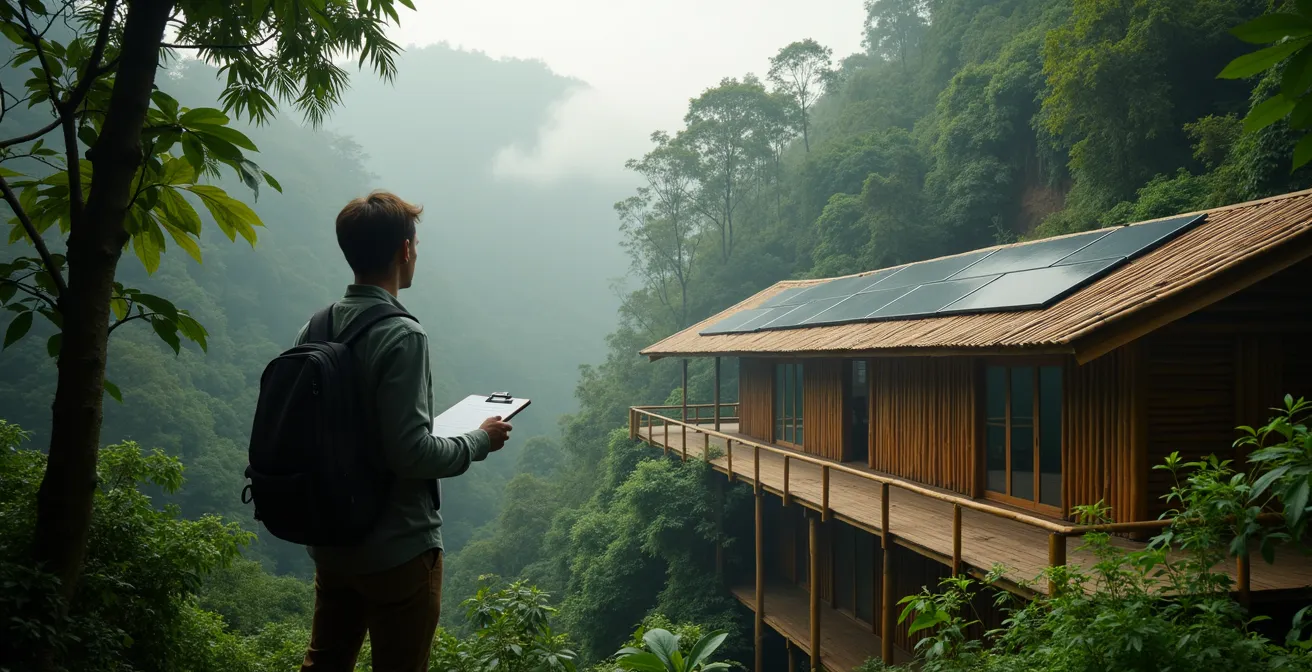
The ultimate test of a sustainable lodge isn’t its marketing claims, but its operational reality—a reality you can audit by asking the right, incisive questions.
- Energy is non-negotiable: A lodge’s reliance on diesel generators reveals its true commitment, regardless of solar panels.
- Hidden systems matter most: True sustainability is found in unglamorous essentials like on-site sewage treatment and fair, year-round labor practices.
Recommendation: Adopt an auditor’s mindset. Stop trusting labels and start verifying claims about energy, water, food, and labor before you book.
The image is perfect: a secluded cabin, lush jungle, and the promise of a “guilt-free” escape. You’re a conscious traveler, willing to invest more for an experience that aligns with your values. Yet, a nagging question remains: is this lodge genuinely sustainable, or are you paying a premium for clever marketing? This fear of being duped by “greenwashing”—the practice of making misleading claims about environmental benefits—is paralyzing. A recent study confirms you’re not alone; while research shows 80% of global travellers believe sustainable travel is important, the path to authentic choices is often obscured.
Most advice encourages looking for certifications or browsing a lodge’s “sustainability” page. While these are starting points, they are insufficient. Certifications vary wildly in rigor, and websites are curated marketing tools. This is where greenwashing thrives, alongside its quieter cousin, “greenhushing,” where genuinely sustainable businesses fail to communicate their efforts effectively. To navigate this complex landscape, you don’t need another checklist of vague symbols to look for. You need to change your entire approach.
This guide abandons the passive role of a tourist and places you in the driver’s seat of an eco-certification auditor. The core principle is simple: verification, not trust. True sustainability is not in the visible solar panel but in the documented energy audit. It’s not in the “organic” menu label but in the transparent food supply chain. It’s in the systems the lodge doesn’t advertise, like wastewater treatment and fair labor contracts. We will equip you with the critical, targeted questions to probe these hidden operational realities, empowering you to distinguish a deeply committed eco-lodge from a shallow, green-painted facade.
This article provides the investigative framework to audit a property’s claims. Each section tackles a critical pillar of sustainability, arming you with the precise questions needed to uncover the truth. The following summary outlines the key areas of inquiry we will explore.
Summary: How to Identify Genuine Sustainable Lodges vs. Greenwashing?
- Why a lodge running on diesel generators cannot be considered truly “Eco”?
- How to ask about sewage treatment before you book a stay in a remote area?
- New Build or Renovation: Which structure has a lower carbon debt?
- The sourcing contradiction where “organic” food is flown in from 2000km away
- What are the 3 questions to ask staff to verify fair labor practices?
- How to verify if a “Farm Stay” actually produces its own food?
- Why “biodegradable” soap still pollutes water sources if used incorrectly?
- How to Find Rural Retreats with Zero Light Pollution for Deep Sleep?
Why a lodge running on diesel generators cannot be considered truly “Eco”?
The presence of solar panels is the most common visual cue for an “eco” lodge, but it’s often a red herring. The single most revealing question an auditor can ask is not about renewable energy production, but about its opposite: diesel generator usage. A remote lodge that runs a diesel generator for several hours a day, or even as a primary power source with solar as a mere backup, carries an enormous energy burden. The “eco” label becomes meaningless when the operation is fundamentally reliant on a highly polluting fossil fuel.
The numbers are stark. From a systemic view, the emissions from constant generator use can easily negate any benefits from other green initiatives. According to energy sector analysis, diesel generators emit around 0.79 Metric Tons of CO2 per MWh, often more than double the greenhouse gas impact of a standard power grid. This doesn’t even account for the noise pollution that disrupts local wildlife or the environmental risks of transporting and storing fuel in a pristine environment. A true eco-lodge prioritizes reducing consumption first, then meeting that reduced demand with renewables. A generator should be for emergencies only, not daily operations.
To cut through the marketing, you must inquire about the operational reality. Ask for specifics:
- “What percentage of your total energy consumption comes from renewable sources on an annual basis?”
- “On average, how many hours per day or week does your diesel generator operate?”
- “Do you have a documented energy audit showing your solar-to-diesel power ratio?”
- “Can you show me your renewable energy installation and explain how it powers the lodge during peak and off-peak hours?”
A transparent and genuinely sustainable lodge will welcome these questions and have ready, detailed answers. Hesitation or vague responses are a significant red flag, indicating that the solar panels may be more for show than for power.
How to ask about sewage treatment before you book a stay in a remote area?
In a remote, ecologically sensitive area, no system is more critical—or less glamorous—than wastewater management. A lodge that pipes untreated or poorly treated sewage into the ground, a river, or the ocean is not an eco-lodge; it’s a polluter. The term “septic system” is often used, but its effectiveness varies dramatically. An undersized or poorly maintained septic tank in porous soil can contaminate groundwater and local water bodies. A truly sustainable lodge invests in advanced on-site treatment that cleans wastewater before returning it to the environment.
One of the most effective and elegant solutions is a constructed wetland. This nature-based system uses a series of gravel beds and aquatic plants to naturally filter and purify greywater (from showers and sinks) and blackwater (from toilets). These systems are incredibly effective. As an example of best practice, a study on their use in hospitality shows that constructed wetlands can achieve removal efficiencies of 83-95% for biological oxygen demand (BOD) and 78-96% for suspended solids, effectively turning wastewater into clean water that can be used for irrigation.
This image illustrates the natural filtering process at the heart of a constructed wetland system, showcasing how roots and substrate work together to purify water.

When you inquire about a lodge’s water treatment, listen for these signs of a robust system. Don’t be shy about asking direct questions before booking: “Could you describe your wastewater treatment system? Is it a standard septic tank, or do you use a more advanced system like a bio-digester or a constructed wetland?” A proud, sustainable operator will be thrilled to explain their investment in protecting the local watershed. A vague answer like “We have an eco-friendly system” is insufficient. Ask for the details.
New Build or Renovation: Which structure has a lower carbon debt?
The sustainability of a building begins long before the first guest arrives. Every structure has an “embodied carbon” footprint—the total greenhouse gas emissions generated from manufacturing materials, transporting them to the site, and the construction process itself. A common greenwashing tactic is to promote a new building’s operational efficiency (e.g., LED lights, good insulation) while ignoring the massive carbon debt incurred by its construction. Renovating and retrofitting an existing structure is almost always the more sustainable choice, as it preserves the embodied carbon of the original building.
When a new build is necessary, a genuine eco-lodge will obsess over minimizing this carbon debt. This involves sourcing local, low-impact, or recycled materials (like reclaimed wood, bamboo, or recycled steel), using construction techniques that minimize waste, and designing for a long, adaptable lifespan. The ultimate goal is a positive Life Cycle Analysis (LCA), where the building’s long-term efficiency and eventual deconstruction are factored in from day one. This systemic view is the hallmark of a truly committed project, not one that simply adds a few green features to a conventional building.
As an auditor, your questions should probe this deeper level of commitment. Move beyond “Is your building green?” and ask for proof of a sustainable process:
- “Was this an existing structure that was renovated, or a new build? If new, what steps were taken to minimize embodied carbon?”
- “Do you have a Life Cycle Analysis (LCA) for the building that shows its embodied carbon versus its projected operational carbon savings?”
- “Can you provide chain of custody certification for your primary building materials, especially timber?”
- “What percentage of your building materials were sourced locally, for instance, within a 200km radius?”
A project that has genuinely grappled with its carbon debt will have clear, proud answers to these questions. A blank stare is a sign that “sustainability” was an afterthought, not a founding principle.
The sourcing contradiction where ‘organic’ food is flown in from 2000km away
A menu boasting “organic” ingredients can be a powerful greenwashing tool. While the organic production method is commendable, it’s only half the story. If that organic quinoa or asparagus is air-freighted from another continent, its transportation footprint can dwarf the benefits of forgoing pesticides. This is the food sourcing contradiction: prioritizing a trendy “superfood” over a less exotic but locally grown conventional option can often be the less sustainable choice. True eco-gastronomy is rooted in hyper-local and seasonal sourcing.
An authentic eco-lodge designs its menu around what the immediate bioregion provides. This means celebrating local produce, even if it’s not certified organic, over ingredients with high food miles. The pinnacle of this philosophy is an on-site garden that supplies the kitchen directly. Interestingly, some of the most sustainable businesses are also the most humble. Research from the UK’s Peak District National Park revealed that small rural tourism businesses often communicate only a fraction of their sustainability efforts, highlighting the need for travelers to ask specific questions rather than assume.
This decision matrix helps clarify the trade-offs between production method and transport distance. An auditor’s job is to understand where a lodge’s priorities lie.
| Food Type | Distance | Production Method | Environmental Impact |
|---|---|---|---|
| Local Conventional | <100km | Standard farming | Lower transport CO2, potential pesticide use |
| Regional Organic | 100-500km | Certified organic | Moderate transport, no pesticides |
| Air-freighted Organic | >2000km | Certified organic | Very high transport CO2, no pesticides |
| Hyper-local | On-site | Garden/foraging | Minimal impact, highest sustainability |
To verify a lodge’s claims, go beyond the menu description. Ask the chef or manager: “What percentage of your menu ingredients are sourced from within a 50km radius?” or “Can you tell me about some of your local farm partners?” A lodge with a genuine farm-to-table ethos will have passionate stories to tell about its producers.
What are the 3 questions to ask staff to verify fair labor practices?
The “eco” in eco-tourism must extend to the social ecosystem, which means fair and ethical treatment of staff. A lodge that exploits its local workforce is not sustainable, no matter how many solar panels it has. This is one of the hardest areas for a traveler to audit, as you can’t ask to see payroll records. However, you can ask strategic questions—both to management and, if appropriate, to staff—that reveal the underlying employment culture.
Surface-level indicators, like staff being from the local community, are a good start but insufficient. True social sustainability involves providing stable, year-round employment, opportunities for advancement, and meaningful community benefit-sharing. Seasonal work with no off-season support can create instability, while a lack of internal promotion suggests a glass ceiling for local employees. The goal is to determine if the lodge is a partner in the community’s long-term prosperity or simply an extractor of cheap labor.

Here are three critical questions designed to move beyond surface appearances and probe the reality of a lodge’s labor practices:
- The Career Path Question (to management): “Can you provide specific examples of current senior staff who started in entry-level positions and were promoted internally?” This tests for genuine investment in employee development.
- The Off-Season Question (to staff, if the context feels right): “Is your employment here year-round, or is it seasonal? What kind of support or training is available during the low season?” This reveals the stability of the employment.
- The Community Ownership Question (to management): “Are local community members actual shareholders in this business, or is there a formal, transparent benefit-sharing arrangement in place?” This distinguishes true partnership from simple charity.
The answers—and the confidence with which they are delivered—can tell you volumes about whether a lodge’s commitment to its “local partners” is a marketing line or an operational principle.
How to verify if a ‘Farm Stay’ actually produces its own food?
The “Farm Stay” label evokes a powerful image of pastoral authenticity: waking up to the smell of fresh bread and eating a breakfast made from eggs collected that morning. Unfortunately, this label is unregulated and often abused. Some establishments are little more than rural hotels that buy their food from the same industrial suppliers as a city restaurant. A true farm stay is an agricultural operation first and a hospitality business second. Verifying this requires a bit of pre-trip research and on-site observation.
The key is to test the chain of custody from their land to your plate. A genuine farm will be deeply connected to the cycles of the seasons and can speak with passion and detail about its production. They won’t have every type of fruit and vegetable available year-round. Their menu will be a direct reflection of what is currently ripe for harvest. This limitation is not a flaw; it is the most reliable sign of authenticity. An “anything, anytime” menu is a major red flag.
Before you even arrive, you can begin your audit. Once there, your questions can confirm your initial findings. A lodge that is proud of its agricultural roots will be delighted to share the story of its food.
Your Action Plan: Verifying Farm Stay Authenticity
- Research Seasonality: Before booking, do a quick search for “seasonal produce in [region] in [month]” and ask the host what’s currently being harvested from their property. Their answer should align with your research.
- Request a ‘Farm-to-Table Trace’: Pick an item on their menu and ask for its story. “These tomatoes are delicious! Were they grown here on the farm?” Genuine producers have passionate, detailed stories.
- Ask about Value-Added Production: Inquire about secondary products. “Do you make your own jams, cheeses, cured meats, or preserves on-site from your own produce?” This indicates a deeper level of agricultural activity.
- Assess Cultivation Area: When you arrive, match their claims with physical reality. If they claim to be self-sufficient in vegetables, you should see a significant and well-tended cultivation area, not just a small decorative herb garden.
By applying this simple verification framework, you can easily distinguish a working farm that welcomes guests from a hotel that is merely borrowing a rustic aesthetic for marketing purposes.
Why ‘biodegradable’ soap still pollutes water sources if used incorrectly?
The term “biodegradable” is one of the most misunderstood in eco-tourism. Many travelers believe that using biodegradable soap or shampoo directly in a lake or river is harmless. This is a dangerous misconception. Biodegradable means that a substance can be broken down into natural elements by microorganisms, but this process requires a specific environment: soil. It needs time, oxygen, and the complex biome of healthy topsoil to work. When introduced directly into an aquatic ecosystem, these soaps cause significant harm.
Even plant-based soaps can disrupt the delicate surface tension of water, which is critical for aquatic insects. They also introduce a sudden burst of phosphates and nitrates, acting as a fertilizer that can trigger algal blooms. These blooms consume oxygen as they decompose, suffocating fish and other aquatic life. The scale of the problem is significant, as a study in *Sustainability* notes that greywater accounts for 50-80% of total wastewater volume from domestic-like activities, making responsible washing practices essential.
The correct protocol, advocated by organizations like Leave No Trace, is to treat all soaps as a potential contaminant. The principle is to let the soil act as the filter, not the water source itself. This applies not just to soaps but to sunscreen and insect repellent as well, which can contain chemicals harmful to aquatic life.
A truly responsible eco-lodge will not only provide biodegradable amenities but will actively educate its guests on the correct way to use them. This includes following a strict washing protocol:
- Always carry water at least 200 feet (about 60 meters) away from any lake, river, or stream before washing yourself or your dishes.
- Use the absolute minimal amount of soap necessary.
- Scatter the soapy “greywater” broadly on the ground so it can be filtered by the soil. Never pour it in one spot.
- Choose mineral-based sunscreens (like those with zinc oxide) over chemical-based ones, as they are far less harmful to aquatic ecosystems.
When you see “biodegradable” amenities, your auditor question should be: “What is your protocol for guest education on using these products responsibly near local water sources?”
Key takeaways
- True sustainability is an operational reality, not a marketing claim. Your job is to verify, not trust.
- The most telling indicators of commitment are often hidden: energy audits, wastewater systems, and labor contracts reveal more than visible solar panels.
- Adopt an auditor’s mindset by asking specific, evidence-based questions about energy, water, construction, food sourcing, and community impact.
How to Find Rural Retreats with Zero Light Pollution for Deep Sleep?
In our modern world, true darkness is a disappearing resource, and with it, the potential for profoundly deep, restorative sleep. Artificial light at night disrupts our circadian rhythms and suppresses melatonin production. For travelers seeking a true retreat from urban life, finding a location with zero light pollution is the ultimate luxury. However, many “rural” lodges inadvertently spoil their own night skies with poorly designed outdoor lighting—unshielded, overly bright, and blue-toned fixtures that create glare and light trespass.
The gold standard for finding pristine night skies is to look for properties located in or near an area certified by the International Dark Sky Places program. This rigorous, science-based certification is awarded to parks, reserves, and communities that have demonstrated an exceptional commitment to preserving the natural night environment. According to the program, over 160,000 square kilometers of land and night skies are currently certified, providing a reliable guide for astrotourists and wellness travelers alike. A lodge that advertises its proximity to a certified Dark Sky Park is making a verifiable and credible claim.
If a lodge isn’t near a certified park, you can still conduct your own light audit. Your goal is to find a place that practices responsible outdoor lighting: fully shielded (pointing light down, not up), using warm-toned bulbs (under 3000K), and only lighting what is necessary for safety. This not only preserves the view of the stars but also protects nocturnal wildlife.
Use this checklist to verify a property’s dark sky quality before you book:
- Check the Maps: Use an online light pollution map (like lightpollutionmap.info) to check the baseline darkness of the lodge’s location. Look for areas in the blue, grey, or black zones.
- Ask About Fixtures: Ask the management, “Is your outdoor lighting fully shielded and directed downward?” and “What is the color temperature of your outdoor bulbs? Are they 3000K or below?”
- Look for Certification: Check if the property is in or near an International Dark Sky Park or Reserve.
- Plan for the Moon: For the absolute darkest skies, check a moon calendar and book your stay during the New Moon phase.
A lodge that can answer these questions with knowledgeable detail is one that truly understands and values the precious resource of a dark night sky.
Ultimately, becoming a conscious traveler is about shifting your perspective from passive consumer to active investigator. By adopting an auditor’s mindset, you empower yourself to support the businesses that are genuinely investing in a sustainable future and to confidently sidestep those that are merely painting their operations green. Your thoughtful questions not only protect your investment but also send a powerful market signal that true commitment matters.