

In summary:
- Maintaining muscle on the road requires targeted intensity and strategic nutrition, not hours in a gym.
- A minimal toolkit of three resistance bands can effectively replicate a full-body gym workout.
- Timing your workouts (morning when traveling east, afternoon when west) can significantly reduce jet lag.
- Focus on hitting a 3g leucine threshold at breakfast by prioritizing eggs and protein to trigger muscle synthesis.
- Use pro performance centers for recovery and data-driven assessments to turn travel into a fitness advantage.
For the frequent flyer, the cycle is brutally familiar: weeks of disciplined training and nutrition, followed by a packed business trip that erases hard-won progress. You return feeling deflated, weaker, and a step behind. The conventional advice—”do some push-ups,” “find a local gym”—is well-meaning but fundamentally misunderstands the problem. It fails to account for unpredictable schedules, crippling jet lag, and the sheer lack of time and equipment.
The solution isn’t to try and replicate your home routine in a hostile environment. That approach is destined for failure. The key is to shift your mindset from volume to precision. It’s about applying the minimum effective dose of the right stimulus to send a powerful anabolic signal to your body, telling it to preserve muscle tissue at all costs. This isn’t about compromise; it’s about strategic, efficient adaptation.
This guide abandons the platitudes. Instead, we will focus on the non-negotiable principles and tactical protocols that work in the real world of business travel. We’ll deconstruct how to achieve muscular failure with nothing but a towel, identify the exact nutrition mistakes to avoid at the continental breakfast buffet, and even explore how to leverage professional performance centers to hack your recovery. This is your new operational playbook for staying strong on the road.
This article provides a complete framework for the business traveler dedicated to preserving their physique. Explore the sections below to master each component of a successful travel fitness strategy.
Summary: A Strategic Guide to Maintaining Muscle While Traveling
- How to reach muscle failure using only your bodyweight and a towel?
- What are the 3 bands you need to replicate a full gym workout?
- Morning or Evening: Which combats jet lag better for workout adherence?
- The breakfast mistake at continental buffets that kills muscle synthesis
- How to check a trainer’s credentials in a country with different regulations?
- When to schedule outdoor HIIT sessions during unstable spring weather patterns?
- How to spot a coach who empowers kids vs. one who just barks orders?
- How Can Amateurs Use Pro Performance Centers to Hack Their Fitness?
How to reach muscle failure using only your bodyweight and a towel?
The primary reason hotel room workouts fail is a lack of intensity. Doing endless, easy repetitions sends an endurance signal, not a muscle-building one. To maintain mass, you must challenge your muscles to the point of failure. The good news is that you don’t need heavy iron to do this. The key is to manipulate leverage, tempo, and tension. A simple hotel towel can become a surprisingly effective tool for intensity replication.
The goal is to create maximum isometric and eccentric tension. Isometrics (static holds) recruit the largest motor units, while eccentrics (the “negative” or lowering phase of a lift) are responsible for much of the micro-trauma that signals growth and maintenance. By combining these with mechanical drop sets—moving from a hard variation of an exercise to an easier one without rest—you can achieve true muscular failure.
For example, you can perform towel rows by looping the towel around a sturdy door handle. Lean back and pull, focusing on a slow, controlled 5-second eccentric phase on every rep. The towel isn’t just a handle; it’s a tool for creating opposing force. For a push-up, you can loop it across your back and have a partner pull on it, or use it to create self-resistance in a pressing motion. Research shows that even two weeks without traditional training results in minimal muscle loss if you can create sufficient stimulus, so these intense, short sessions are more than enough to bridge the gap.
By focusing on these techniques, you shift the workout from a box-ticking exercise to a potent anabolic signal. The towel becomes your portable tool for generating the high tension necessary to command your body to hold onto its muscle.
What are the 3 bands you need to replicate a full gym workout?
While bodyweight training is a powerful tool, resistance bands are the ultimate travel fitness hack. They are lightweight, versatile, and allow for progressive overload and resistance through a full range of motion, something bodyweight exercises can struggle with for movements like pulling. However, not all bands are created equal. A strategic selection of just three types of bands—the “Traveler’s Trinity”—is all you need to replicate nearly any exercise from a commercial gym.
This minimalist setup provides the necessary tools for activation, compound movements, and isolated push/pull exercises. The light loop band is critical for pre-workout activation, particularly for the rotator cuffs and glutes, which helps prevent injury when training fatigued from travel. The heavy loop band is the workhorse for mimicking major compound lifts like squats and deadlifts. Finally, the handled tube band with a door anchor is your solution for chest presses, rows, and core work like the Pallof press, providing constant tension that free weights cannot.
The Iron Bull Strength travel fitness study provides compelling evidence for this approach. Their protocol demonstrated that business travelers using a three-band system could maintain 95% of their strength levels during 4-week trips. The key was efficiency: participants performed two full-body sessions per week, completing the workouts in under 30 minutes in their hotel rooms by using antagonist supersets (e.g., a set of band-resisted push-ups followed immediately by a set of band rows). This proves that with the right tools, maintaining strength is not only possible but highly efficient.
This table breaks down the specific function of each band in the Traveler’s Trinity, providing a clear guide for building your travel-ready gym. It’s a minimal investment for maximum return, as confirmed by the data on strength maintenance.
| Band Type | Resistance Range | Primary Function | Key Exercises |
|---|---|---|---|
| Light Loop Band | 5-15 lbs | Activation & Rotator Cuff | Band pull-aparts, face pulls, lateral raises |
| Heavy Loop Band | 30-50 lbs | Compound Movements | Banded squats, good mornings, deadlifts |
| Handled Tube Band with Door Anchor | 15-35 lbs | Push/Pull Movements | Chest press, rows, Pallof press |
Morning or Evening: Which combats jet lag better for workout adherence?
The battle against jet lag is central to any successful travel fitness plan. It’s not just about feeling tired; it’s about a complete desynchronization of your internal clock, or circadian rhythm, which impacts everything from hormone levels to workout motivation. The timing of your workout can be your most powerful tool for resetting this clock, but the optimal time depends entirely on your direction of travel.

The science of chronobiological alignment is clear. Light is the primary signal that sets our internal clock. Exercise acts as a secondary, but still potent, signal. When you travel east, you need to advance your body clock. A morning workout, especially when combined with exposure to natural light, does exactly this. In fact, chronobiology research suggests morning workouts can reduce jet lag duration by up to 50%. Conversely, when you travel west, you need to delay your body clock. A late afternoon or early evening workout helps push your internal clock later, aligning you with the new time zone.
Therefore, a one-size-fits-all approach like “always train in the morning” is inefficient. An adaptive strategy is required. For the first three days in a new time zone, your workout schedule should be a non-negotiable part of your acclimatization protocol. If an evening-only session is your only option when traveling east, it’s better to focus on low-intensity mobility or light cardio to avoid sending a conflicting signal to your body clock.
This directional protocol transforms your workout from just another task on your to-do list into a strategic weapon against jet lag, directly improving both your well-being and your ability to adhere to your fitness plan.
The breakfast mistake at continental buffets that kills muscle synthesis
You’ve crushed your hotel room workout, but the most critical part of the muscle maintenance equation happens at the breakfast table. The typical continental buffet is a minefield of sugary pastries, low-quality cereals, and fruit juices—a combination that spikes insulin and does virtually nothing to preserve muscle. The single biggest mistake travelers make is underestimating the specific protein requirement needed to initiate Muscle Protein Synthesis (MPS), the process by which your body repairs and builds muscle tissue.
It’s not just about “getting enough protein” throughout the day; it’s about hitting a specific threshold in a single meal. Think of it as an on/off switch. Consuming a small amount of protein does very little. To flip the MPS switch to “ON,” you need a sufficient dose of the amino acid leucine. As nutrition research confirms, a minimum of 3g of leucine is required per meal to robustly trigger muscle protein synthesis.
This is where the continental buffet becomes a strategic challenge. A croissant, a banana, and a coffee provide almost no leucine. To hit your 3g target, you must be deliberate. Your first priority should be the egg station. Four whole eggs will get you very close to the threshold. If Greek yogurt is available, it’s another excellent, high-leucine source. If your only options are carbs and fat, you are better off using your backup plan: a single scoop of travel-sized whey protein powder mixed with water. This guarantees you hit the leucine threshold and kickstart MPS, making your earlier workout effective.
Navigating the buffet isn’t about restriction; it’s about a targeted mission. Identify your high-leucine protein sources, build your plate around them, and ignore the rest. This single decision can be the difference between maintaining your muscle mass and watching it disappear.
How to check a trainer’s credentials in a country with different regulations?
For a frequent traveler, hiring a local trainer for a one-off session can be an effective way to get access to a good facility and receive expert guidance. However, fitness certification standards vary wildly from country to country. A “certified trainer” in one location might have undergone rigorous scientific training, while in another, they may have completed a weekend course. Placing your trust—and your body—in the hands of an unqualified individual is a significant risk.
You need a quick, reliable system for vetting a potential trainer that cuts through the noise of local certifications. Your vetting process should be a multi-step digital investigation before you ever make contact. Start by looking for globally recognized credentials like the NSCA-CSCS, ACSM, or NASM. These are gold standards and indicate a high level of foundational knowledge. However, the absence of these doesn’t automatically disqualify a coach, as they may hold an excellent local equivalent.
The next step is to become a digital detective. Scrutinize their social media, particularly Instagram. Are they posting videos of themselves and their clients performing exercises with crisp, safe form? Are the testimonials from real people with tangible results? A professional LinkedIn profile that shows a consistent career history adds another layer of credibility. Once you make contact, your questions should be designed to test their thinking. Ask them how they would adapt a workout for jet lag or how they approach programming (periodization). A good coach can explain their ‘why’; a poor coach just tells you ‘what’.
Your 5-Step International Trainer Vetting Protocol
- Verify Global Certifications: Look for top-tier credentials first (e.g., NSCA-CSCS, ACSM, NASM) as a baseline of quality.
- Conduct a Digital Investigation: Review their professional social media (Instagram, LinkedIn) for high-quality form videos and authentic client testimonials.
- Assess Professional History: Check for a consistent and logical career progression on platforms like LinkedIn. Gaps or inconsistencies can be a red flag.
- Run a Consultation Test: During an initial chat, ask targeted questions about their approach to periodization, client assessment, and adapting to variables like jet lag.
- Perform a Red Flag Check: Be wary of trainers who promise rapid, unrealistic results or focus solely on pushing you to exhaustion rather than educating you on movement and principles.
When to schedule outdoor HIIT sessions during unstable spring weather patterns?
While hotel gyms and band workouts offer consistency, sometimes the need for fresh air is overwhelming. For the traveler who prefers training outdoors, spring presents a unique challenge: unstable weather. A planned outdoor High-Intensity Interval Training (HIIT) session can be derailed by a sudden downpour. However, an adaptive approach can turn this variable into a non-issue.
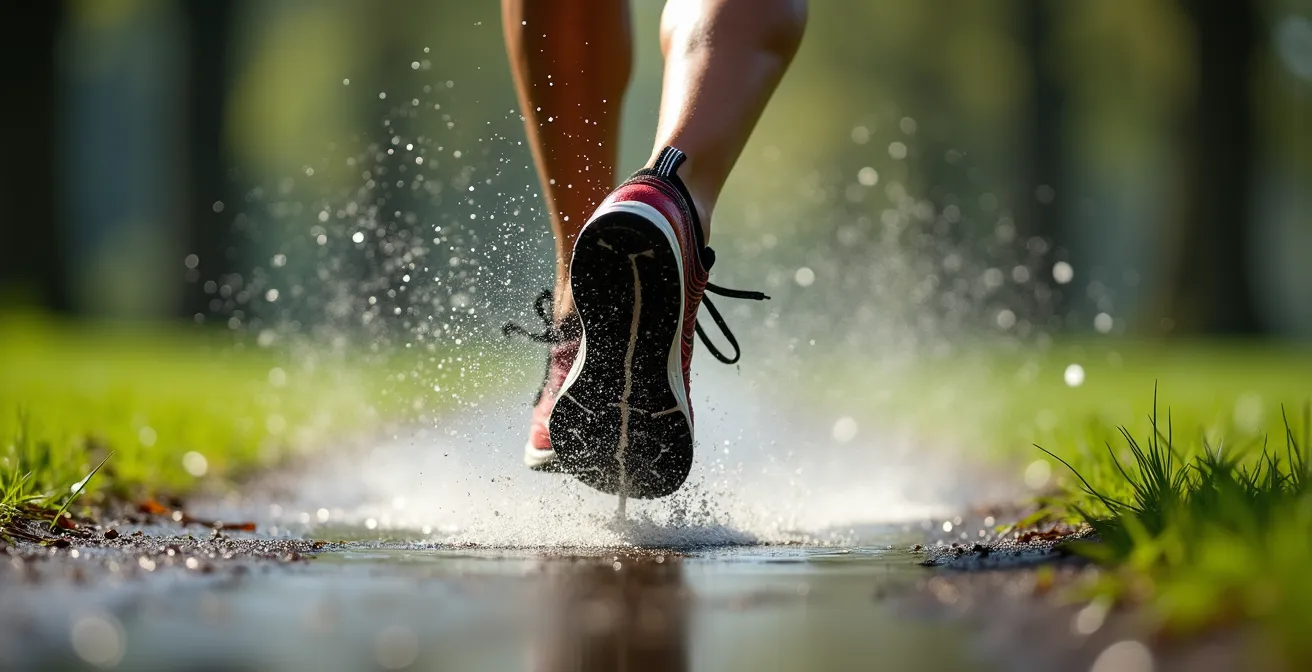
The key is to remove decision fatigue and have a flexible, pre-defined strategy. First, leverage technology. Don’t rely on a general forecast; use hyper-local weather apps (like Dark Sky or AccuWeather’s MinuteCast) that can predict rain with down-to-the-minute accuracy, allowing you to identify a 15-20 minute dry window for a quick sprint session. Second, schedule your workouts at the “bookends” of the day—early morning or early evening—when weather patterns are often more stable.
The most robust strategy is to maintain an A/B workout plan. Plan A is your outdoor HIIT session (e.g., hill sprints in a local park). Plan B is an equally intense indoor alternative that requires no setup (e.g., circuits in the hotel stairwell). The decision between A and B should be made no more than 20 minutes before the session is due to start. This eliminates hours of weather-watching anxiety. Finally, you can adopt a mindset of mental toughness: unless there is a risk of lightning, a light rain can be embraced as an added resistance variable, cooling you down and sharpening your focus.
By having these adaptive strategies in place, the weather ceases to be a barrier and simply becomes another variable to be managed, ensuring your training remains consistent regardless of the conditions.
How to spot a coach who empowers kids vs. one who just barks orders?
While you may not be hiring a coach for a child, the dynamic between a youth coach and their athlete provides the clearest possible model for identifying effective versus ineffective coaching—a lesson directly applicable when you’re vetting a trainer for a single session on the road. The difference lies in one core concept: empowerment versus instruction. A coach who just “barks orders” creates dependency. A coach who empowers teaches principles that you can own and use long after the session is over.
The most telling sign is the type of language they use. An ineffective coach uses internal cues (e.g., “Squeeze your glutes,” “Tighten your core”). These cues focus your attention inside your own body, which can be inefficient and often counterproductive to fluid movement. An empowering coach, however, overwhelmingly uses external cues (e.g., “Push the ground away from you,” “Imagine you’re splitting the floor apart”). These cues focus your attention on the outcome of the movement in the environment, which allows your body’s motor system to self-organize more effectively.
This isn’t just theory; it’s backed by data. A recent analysis of coaching methods revealed a powerful insight directly relevant to travelers working with temporary coaches. The study found that coaches who consistently use external cues improve their clients’ performance and learning. In fact, one analysis highlighted that empowering coaching methods improve performance by up to 23% compared to dictatorial styles. A good coach’s goal is to make you better, not just to make you tired. They should provide educational context for why you’re doing an exercise and offer 1-2 specific, actionable takeaways at the end of the session.
When you’re paying for an hour of someone’s time in a new city, listen carefully to their language. If you hear a stream of external, outcome-based cues, you’ve likely found a coach who can provide real value. If all you hear is a series of internal commands, you’ve found a rep-counter, not a coach.
Key takeaways
- Intensity is King: Muscle maintenance requires high tension, achievable through techniques like slow eccentrics and isometric holds, even with minimal equipment.
- Strategic Nutrition Signaling: It’s not just about eating protein; it’s about hitting the ~3g leucine threshold per meal to activate Muscle Protein Synthesis.
- Adapt, Don’t Replicate: Use travel-specific variables like jet lag and weather as strategic elements to plan around, rather than seeing them as obstacles.
How Can Amateurs Use Pro Performance Centers to Hack Their Fitness?
The final and most underutilized strategy for the serious traveler is to leverage professional sports performance centers. Once the exclusive domain of elite athletes, many of these facilities now offer their services to the public on a pay-per-session basis. For a business traveler, a single, targeted visit can provide benefits that far exceed a standard gym workout. This is about “hacking” your fitness by accessing tools and expertise you can’t find elsewhere.
Your primary goal at a pro center shouldn’t be a generic workout. Instead, focus on two key areas: recovery and assessment. After a long-haul flight, your body is in a state of inflammation and stress. Booking a session with recovery tools like NormaTec compression boots or utilizing contrast-immersion baths can dramatically accelerate your recovery from jet lag. In fact, recent performance center studies show that professional recovery tools can reduce travel-induced inflammation by 40%. This allows you to be ready for an intense workout much sooner.
On the assessment front, these centers provide access to gold-standard testing like DEXA scans for body composition or VO2 max tests for cardiovascular fitness. While you won’t do these on every trip, scheduling a one-off assessment can provide invaluable baseline data to guide your training for months to come. You can also use the expert coaching staff for a single skill-intensive session to master a complex movement like a kettlebell swing or a snatch, a skill you can then take with you.
Using a pro center is a strategic investment. It reframes a travel day from a liability into an opportunity to access elite-level tools that can accelerate your recovery, provide critical data, and deepen your training knowledge. For the traveler committed to their fitness, it’s the ultimate environmental hack.
Stop letting travel dictate the terms of your fitness. By implementing these efficient, adaptive, and science-backed protocols, you can take control, turning every business trip into a strategic challenge you are fully equipped to win. The next step is to integrate these methods into your pre-travel planning.