
True eco-trekking isn’t about following a list of rules; it’s about adopting a strict auditor’s mindset to dismantle greenwashing and verify every impact you make.
- Your “eco” gear and soap are meaningless without a rigorous audit of their use, disposal, and lifecycle.
- Genuine support for local economies requires verifying fair wages and working conditions, not just paying a tour fee.
Recommendation: Shift from being a passive tourist to an active, informed auditor of your own environmental and social footprint on every journey.
The image of a responsible trekker is often one of a person meticulously packing out their own trash, leaving a campsite exactly as they found it. This principle, the core of the “Leave No Trace” ethic, is a valuable and necessary baseline for modern outdoor recreation. However, in an era of explosive tourism growth and sophisticated greenwashing, simply “taking your trash” is no longer a sufficient standard for true ecological and social responsibility. It addresses the most visible symptom but often ignores the deeper, systemic impacts of our presence in fragile places.
The uncomfortable truth is that many well-intentioned actions, from using “biodegradable” products to booking “eco-lodges,” can cause significant harm if not subjected to scrutiny. True eco-trekking requires an evolution in mindset: from a passive rule-follower to an active sustainability auditor. It demands that we question marketing claims, verify supply chains, and understand the second-order effects of our choices. This is not about guilt, but about empowerment. It’s about wielding a new set of tools to ensure our adventures contribute positively, or at the very least, cause the absolute minimum harm.
This guide provides the framework for that audit. We will move beyond the superficial to dissect the real impact of our gear, our money, and even our social media posts. You will learn to identify deceptive marketing, verify ethical practices, and make choices that align with a deeper, more rigorous definition of sustainability. It is a call to hold ourselves, and the industry that serves us, to a much higher standard.
This article provides a detailed audit of the common pitfalls in eco-trekking and presents concrete, verifiable actions for a truly minimal impact. The following sections will equip you with the knowledge to make informed decisions on your next adventure.
Summary: A Framework for Auditing Your Trekking Footprint
- Why “biodegradable” soap still pollutes water sources if used incorrectly?
- How to ensure your trekking fees actually reach the local porters and families?
- Solo or Group: Which leaves a smaller physical footprint on fragile trails?
- The social media habit that destroys fragile ecosystems within months
- How to repair your existing boots instead of buying “eco-friendly” new ones?
- How to verify if a “Farm Stay” actually produces its own food?
- How much to tip the stable hand who actually cares for the horse?
- How to Identify Genuine Sustainable Lodges vs. Greenwashing?
Why “biodegradable” soap still pollutes water sources if used incorrectly?
The term “biodegradable” is one of the most misunderstood and misused labels in the outdoor industry. It creates a false sense of security, leading trekkers to believe they can use these soaps in or near streams and lakes without consequence. This is a critical error. Biodegradable soaps are designed to be broken down by bacteria found in soil, not in water. When introduced directly into an aquatic environment, they fail to decompose properly and act as pollutants, harming fish and other aquatic life by breaking down their protective mucus layers.
The issue is one of cumulative impact. While one isolated use might seem negligible, the New Hampshire Department of Environmental Services highlights that repeated use by numerous visitors can overwhelm a water body’s natural ability to process foreign substances. This leads to lasting ecosystem damage. The only correct method is to treat all soap, regardless of its label, as a pollutant. Proper disposal requires carrying water well away from its source— a minimum distance of 200 feet is required by Leave No Trace principles—and allowing the used “grey water” to filter through soil.
To conduct a proper soap impact audit, follow a strict protocol:
- Step 1: Carry water in a container at least 70 adult steps (approximating 200 feet) away from any lake, river, or stream.
- Step 2: Use only a few drops of soap. Modern concentrates are extremely powerful.
- Step 3: Dig a “cathole” 6-8 inches deep to wash yourself or your gear over.
- Step 4: Pour all grey water into this hole, allowing soil bacteria to begin the decomposition process.
- Step 5: Fill the hole with the original soil and disguise it with natural materials to restore the area.
This methodical approach moves beyond the marketing claims on a bottle and focuses on the verifiable scientific process of decomposition, ensuring no harm comes to the water sources you depend on.
How to ensure your trekking fees actually reach the local porters and families?
One of the great promises of eco-trekking is that it provides sustainable livelihoods for local communities. However, the reality is often one of economic leakage, where the majority of tourist money flows to international companies or urban-based operators, leaving guides, porters, and rural families with a tiny fraction of the revenue. Simply booking a trek is not enough; a true sustainability audit requires you to investigate where your money is actually going and what conditions it supports.
Ethical operators are transparent about their practices. For example, Trekup India’s model focuses on hiring local staff at all levels—not just in low-wage roles—and sourcing supplies directly from village shops. This creates a resilient local economy rather than one dependent on handouts. They demonstrate that fair wages and direct community investment are not just possible, but are the bedrock of a truly sustainable business. Your role as an auditor is to seek out such companies by asking pointed questions *before* you book.
Refusing to ask these questions makes you complicit in a system that often exploits the very people and culture you have traveled to appreciate. Vague claims of “supporting the community” on a company website are insufficient. Demand proof.
Your Pre-Trek Porter Ethics Audit: 5 Questions to Ask
- Ask directly: ‘What percentage of my trek fee goes directly to the porters and local guides versus company overhead and marketing?’
- Request documentation: ‘Can you provide evidence of porter wages and show how they compare to the official local living wage standards?’
- Inquire about safety nets: ‘Do your porters have health insurance, and what is your documented procedure if one of them is injured on a trek?’
- Verify representation: ‘Are your porters part of a workers’ union or a cooperative that actively protects their rights and negotiates their pay?’
- Check load limits: ‘What is the maximum weight limit your porters are allowed to carry, and how do you enforce this rule on the trail?’
Solo or Group: Which leaves a smaller physical footprint on fragile trails?
The conventional wisdom often suggests that a solo trekker, moving quietly and alone, inherently has a smaller impact than a large group. This is a dangerous oversimplification. When viewed through an auditor’s lens, a well-managed group often leaves a significantly smaller cumulative footprint on a fragile trail than the same number of individuals hiking separately. The key lies in understanding the difference between concentrated and dispersed impact, especially as outdoor recreation continues to grow. For instance, recent industry data shows a 4% growth in outdoor participation, putting unprecedented pressure on trail systems.
A solo hiker makes individual choices at every step, potentially widening the trail by avoiding a puddle or creating a new “social trail” to a viewpoint. When multiplied by hundreds of other solo hikers, this leads to widespread erosion and habitat destruction. A disciplined group, conversely, follows a single path dictated by an experienced guide who understands the terrain’s sensitivities. This concentrates the impact on a durable, existing surface.
This table breaks down the core factors of this counter-intuitive reality:
| Impact Factor | Solo Trekking | Group Trekking |
|---|---|---|
| Trail Widening | Multiple solo hikers create dispersed impact through individual route choices | Concentrated impact on single trail when properly managed |
| Resource Efficiency | Each hiker carries full gear set (stove, filter, shelter) | Shared equipment reduces per-capita manufacturing footprint |
| Wildlife Disturbance | Repeated individual encounters throughout day | Single disturbance event for wildlife |
| Knowledge Transfer | Limited awareness of sensitive areas | Guide expertise prevents damage to cryptobiotic soil and breeding grounds |
The discipline of a group is paramount. When hikers walk single-file and follow their guide’s lead, they protect the delicate vegetation and soil on either side of the path. This is the visual representation of responsible, concentrated impact.
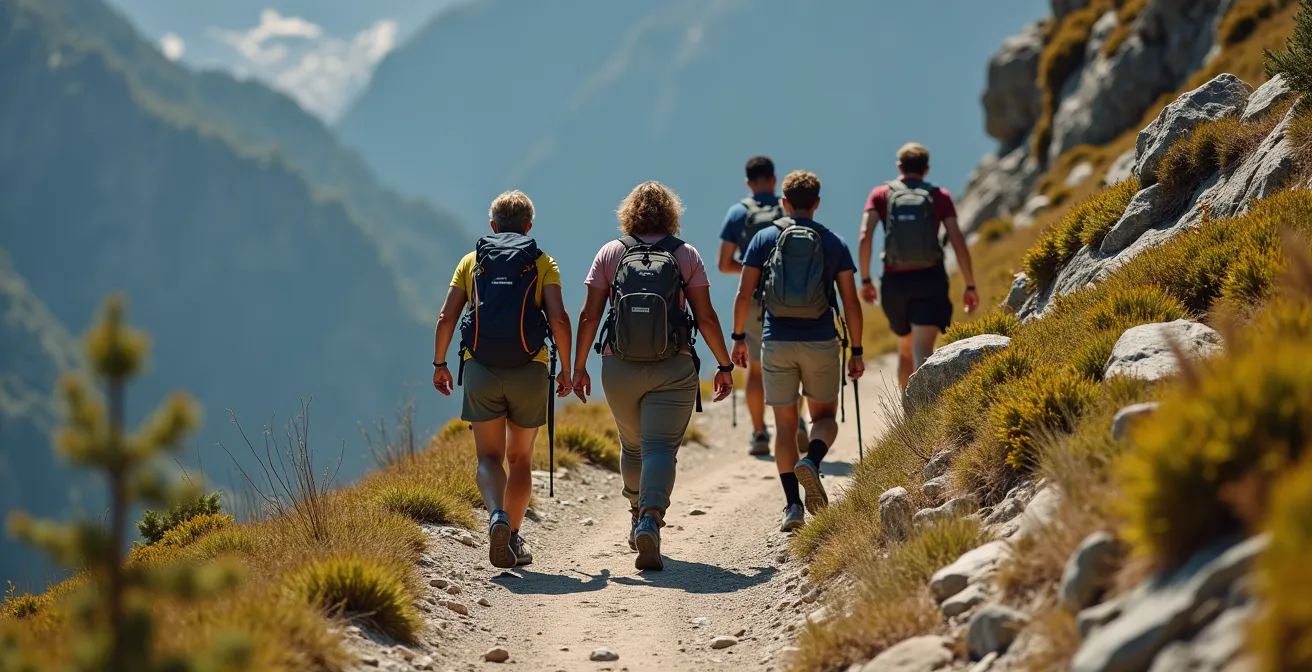
Ultimately, the choice is not about the number of people, but about behavior and management. A disciplined, educated group that shares resources and follows expert guidance will almost always have a lower total impact—both physical and in terms of resource consumption—than an equivalent number of uncoordinated individuals.
The social media habit that destroys fragile ecosystems within months
The original “Leave No Trace” principles were conceived for a world without smartphones. Today, the most destructive trace we can leave is often digital. The act of geotagging a specific location on social media—pinpointing a pristine waterfall, a hidden wildflower meadow, or a fragile rock formation—is the modern equivalent of carving your name into a tree. It acts as a digital map, inviting crowds to ecologically sensitive areas that cannot handle the traffic. This phenomenon has a predictable and devastating lifecycle: a beautiful, unknown spot is shared, it goes viral, and within months it is trampled, eroded, and polluted.
Practicing a “Digital Leave No Trace” ethic is a fundamental responsibility of the modern trekker. It requires a shift in focus from “look where I was” to “look what I experienced.” The goal is to share the feeling and the lessons of a place without turning it into the next over-touristed casualty. This is not about gatekeeping nature; it is about protecting it from the destructive power of mass, unmanaged attention.
An auditor’s mindset requires you to evaluate every post for its potential impact. Before you share, apply this strict code of conduct:
- Never geotag specific locations of sensitive, remote, or lesser-known natural sites. Use a general region, like the name of the national park or a nearby town, if you must tag a location.
- Avoid posting photos with distinctive, easily identifiable landmarks that can serve as a visual treasure map for others to find the exact spot.
- Share the experience, not the coordinates. Focus your caption on the journey, the feeling of being there, the wildlife you saw (from a distance), and the importance of conservation.
- If you post about popular, well-established trails, use the opportunity to include a reminder about Leave No Trace principles in your caption.
- Actively report harmful behavior you see online. If you see posts promoting illegal camping, off-trail hiking in sensitive zones, or wildlife harassment, report it to the platform and, if possible, the relevant park authorities.
Your digital footprint is as real as your physical one. Managing it with discipline is a core tenet of true eco-trekking.
How to repair your existing boots instead of buying “eco-friendly” new ones?
The most sustainable piece of gear is the one you already own. The marketing push for “eco-friendly” new products often masks a fundamental truth: manufacturing and shipping a new pair of hiking boots, no matter the recycled content, has a far greater consumption footprint than repairing and maintaining your current pair. An impact audit reveals that extending the life of existing gear is the single most effective way to reduce your environmental impact from a consumption standpoint.
Before you even consider a new purchase, you must perform a thorough audit of your existing boots. Most common points of failure—separating soles, splitting seams, and worn tread—are highly repairable with the right tools and techniques. Embracing repair is not just an ecological choice; it’s a craft that connects you more deeply to your gear.

Use this decision tree to guide your boot repair audit:
- If a seam is splitting: Clean the area thoroughly and apply a flexible adhesive like Seam Grip. Let it cure for a full 24 hours before stressing the joint.
- If the sole is separating from the rand: Use a strong polyurethane adhesive such as Freesole. Apply it into the gap, then clamp the boot tightly overnight to ensure a permanent bond.
- If the tread is worn down: This often requires professional help. A certified cobbler can replace the entire sole for a fraction of the cost of new boots ($40-$80 vs. $150+), giving your trusted uppers a new life.
- If the leather is dry or cracking: This is a maintenance issue. Apply a quality leather conditioner monthly during the hiking season and a waterproofing treatment before wet conditions.
- If the inner lining is badly torn: This is one of the few issues that may signal retirement. Before discarding, check if the brand has a recycling program (e.g., Nike Grind).
When a boot is truly beyond repair, the next best option is not new, but used. Programs like REI’s used gear marketplace sell boots that were returned for sizing issues and are practically new, drastically reducing manufacturing demand.
How to verify if a “Farm Stay” actually produces its own food?
“Farm-to-table” has become a powerful marketing buzzword, leading to a rise in “aesthetic farm stays” that are little more than rural-themed hotels with manicured lawns and a few token chickens. These establishments often source their food from the same industrial supply chains as any city restaurant, a clear form of greenwashing. A genuine farm stay is a working agricultural operation where you are a guest. Verifying this distinction is a classic Greenwashing Litmus Test for any eco-trekker.
The difference between a working farm and an aesthetic one becomes immediately apparent when you know what to look for. A real farm has a certain functional disorder: tools are in use, paths are muddy, and the menu is dictated by the season, not by guest preference. An aesthetic farm is pristine, Instagram-ready, and can mysteriously provide strawberries in winter.
This table provides a quick audit checklist to distinguish reality from marketing:
| Indicator | Genuine Working Farm | Aesthetic ‘Farm’ Stay |
|---|---|---|
| Property condition | Functional disorder: tools in use, soil on paths | Manicured, Instagram-ready at all times |
| Menu variety | Limited, changes with the seasons | Extensive, non-seasonal options year-round |
| Staff knowledge | Passionate details about crops and challenges | Vague, scripted responses about farming |
| Morning activity | Early harvest, animal feeding routines visible | No agricultural activity before guest breakfast |
To conduct your on-the-ground audit, go beyond passive observation. Engage with your hosts using these verification tactics:
- Upon arrival, request a spontaneous tour of the garden or fields. A genuine farmer will be proud to show you their operation, while a greenwasher may deflect or offer a curated, limited tour.
- Look for signs of active work. Are there active compost piles? Muddy boots by the door? Well-used, dirty tools? The absence of these is a major red flag.
- Ask specific, knowledgeable questions. Instead of “Do you grow your own food?”, ask “What pest control methods do you find most effective for your brassicas?” or “What variety of tomato grew best for you this season?” A real farmer will have a detailed answer.
- Observe the morning routine. On a true working farm, agricultural activity like harvesting or animal care begins at dawn, long before guests are served breakfast.
How much to tip the stable hand who actually cares for the horse?
On any equestrian trek, there is often a hierarchy of visibility. The lead guide is the face of the operation, while the stable hands who feed, groom, and care for the animals—the very foundation of your experience—remain largely invisible. A core principle of a social impact audit is to identify and directly reward this invisible labor. Handing a large tip to the lead guide with the instruction to “share it with the team” is an unreliable method that is highly susceptible to the same economic leakage that affects porters.
Your ethical obligation is to ensure your gratuity directly reaches the person responsible for the animal’s welfare. This requires a deliberate, personal effort. Furthermore, the amount should not be arbitrary; it should be based on an assessment of the animal’s condition and a respect for local wage standards. A well-cared-for horse—with a healthy coat, no saddle sores, and a good disposition—is a direct reflection of a dedicated stable hand’s work, and that work deserves direct and fair compensation.
Use this protocol for fair and effective tipping:
- Calculate a fair base tip. A good starting point is the equivalent of one to two hours of the local average hourly wage for each day you ride. This grounds your tip in the local economy.
- Find the stable hand directly. Make the effort at the end of the trek to seek out the individual(s) who care for the horses and give the tip to them personally. Do not give it to the tour operator or lead guide.
- Consider practical gifts alongside cash. If appropriate and culturally sensitive, small, high-quality items that are expensive or hard to find locally—like quality work gloves, a durable hoof pick, or a multi-tool—can be highly valued.
- Present the tip discreetly and personally. This is not a public transaction, but a personal acknowledgment of their crucial and often overlooked labor.
–Assess horse welfare as a metric. If the animals are in excellent condition, be generous. If you notice signs of neglect, this is a serious issue that should be addressed with the operator, and your tip should reflect that.
This direct approach bypasses intermediaries and ensures your gratitude translates into tangible economic benefit for the person most deserving of it.
Key Takeaways
- Verification over trust: The foundation of true eco-trekking is to actively audit claims, not passively accept green marketing.
- The most sustainable item is the one you already own: Prioritize repair and maintenance of existing gear over purchasing new “eco-friendly” products.
- Economic justice is paramount: True support for local communities means ensuring fair wages and direct compensation for all labor, especially that which is “invisible.”
How to Identify Genuine Sustainable Lodges vs. Greenwashing?
As the ecotourism market grows, so does the incentive for greenwashing. With projections suggesting the global ecotourism market will exceed $330 billion by 2026, hotels and lodges are increasingly using vague terms like “eco-friendly,” “green,” and “sustainable” without substantive proof. Your final impact audit as a trekker is to apply a rigorous Greenwashing Litmus Test to your accommodation, ensuring your stay supports genuine conservation and community development, not just a clever marketing department.
A genuinely sustainable lodge integrates its principles into every aspect of its operation, from waste management and energy sources to staffing and supply chains. This is often invisible from the guest-facing areas. An auditor must look behind the curtain. Vague policies or a sign asking you to reuse your towel are low-effort gestures common to greenwashers. Real sustainability is systemic and transparent.
Before and during your stay, use this verification checklist to conduct your audit:
- Request a back-of-house tour. This is the most telling test. A truly sustainable lodge will be proud to show you their waste sorting systems, composting areas, rainwater harvesting tanks, and water treatment facilities. A refusal or deflection is a major red flag.
- Check for credible, third-party certifications. Look for rigorous, internationally recognized certifications like those recognized by the Global Sustainable Tourism Council (GSTC), B Corp status, or Fair Trade Tourism. Be wary of self-made “eco” badges.
- Examine the staffing structure. Are local community members employed in management and decision-making roles, or are they confined to service positions like cleaning and cooking? Equitable employment is a cornerstone of social sustainability.
- Apply the single-use plastic test. The presence of single-use plastic water bottles, miniature toiletries, or plastic straws is an immediate indicator that the lodge’s commitment to sustainability is superficial.
- Verify energy and water sources. Don’t just take their word for it. Ask to see the solar panels, inquire about the capacity of the rainwater tanks, or ask about specific energy efficiency measures like LED lighting and heat-pump water heaters.
This final audit synthesizes the entire philosophy of this guide: question, verify, and demand transparency. It is the last, crucial step in ensuring your entire journey, from trail to lodge, aligns with a deep and meaningful commitment to ecological and social responsibility.
Your next trek is an opportunity not just to see the world, but to hold yourself and the industry to a higher standard. The principles of a true impact audit—questioning, verifying, and prioritizing real impact over marketing claims—are your most powerful tools. Begin applying them today.