
Your high-altitude hiking experience is a liability in the jungle, not an asset.
- The jungle’s extreme humidity neutralizes your body’s primary cooling mechanism (sweat evaporation), leading to faster dehydration and heat exhaustion than in a dry desert.
- Constant moisture turns your feet into a breeding ground for fungi and bacteria, making proactive care, not tough boots, your number one priority for mobility.
Recommendation: Shift your mindset from conquering terrain to managing your body’s biological equilibrium within a living, hostile system.
You’ve scaled scree slopes at 4,000 meters and navigated arid canyons with a heavy pack. You know your gear, your body’s limits, and how to manage water. So, a hot, humid trek through the Amazon or Borneo should be a walk in the park, right? Wrong. That confidence, born from dry, high-altitude environments, is the single greatest threat to your safety in the jungle. The rules you’ve learned about hydration, foot care, and even vision don’t apply here. This isn’t just a different type of trail; it’s a different planet, governed by a set of unforgiving biological laws.
Most guides will tell you to pack quick-dry clothes and use insect repellent. That’s baseline advice. It won’t save you when your body’s core systems start to fail. The jungle wages a form of biological warfare on the unprepared. It attacks your ability to regulate temperature, compromises the integrity of your skin, and uses its dense, uniform greenness to disorient your senses. Surviving, and actually enjoying a jungle expedition, requires a fundamental paradigm shift. You must stop thinking like a mountaineer who conquers a static obstacle and start thinking like a biologist who adapts to a living, breathing, and often hostile ecosystem.
This guide isn’t a packing list. It’s a strategic manual for the experienced hiker entering this new arena. We will dissect the unique environmental pressures—from the thermodynamics of sweat in 99% humidity to the microbial assault on your feet—and provide the counter-strategies needed to maintain your body’s equilibrium. We’ll explore why your shelter choice is more about ground-level threats than comfort, how to see the invisible trails the jungle hides, and why a local guide’s perception is a tool you cannot afford to be without.
To help you navigate these critical concepts, this article breaks down the essential knowledge needed to adapt your skills. The following sections will guide you through the jungle’s most relentless challenges, transforming your mountain expertise into a true survival advantage.
Contents: A Tactical Guide to Jungle Survival
- Why you dehydrate faster in the jungle than in the desert despite the shade?
- How to keep your feet healthy when they are wet for 8 hours a day?
- Hammock or Tent: Which keeps you safer from crawling insects and damp ground?
- The signal mistake that leaves trekkers lost under dense foliage
- What are the 3 plants you must never touch while clearing a path?
- Day or Night: When is the jungle truly alive with activity?
- What are the 3 steps to ensure water is virus-free in developing countries?
- Why a Local Guide Finds Wildlife You Would Miss 90% of the Time?
Why you dehydrate faster in the jungle than in the desert despite the shade?
In the desert, the sun is your enemy, and sweat is your savior. Every drop that evaporates from your skin carries away life-sapping heat. In the jungle, this fundamental law of physics is repealed. The air is already saturated with water—often reaching 99% humidity—meaning your sweat has nowhere to evaporate. It simply pours off you, offering almost zero cooling effect while draining your body of precious water and salts. This is the great deception of the jungle: you’re standing in the shade, drenched, yet you’re overheating and dehydrating at an alarming rate. Your body becomes a “wet machine,” working furiously to cool itself but failing, leading to a dangerous spiral of heat exhaustion and hyponatremia (low sodium levels from excessive sweating).
This is not an exaggeration. The physiological demand is immense, and according to research on jungle dehydration, jungle trekkers lose significant amounts of fluids and salts simply because high humidity prevents sweat from doing its job. A mountain hiker accustomed to managing sweat through layers and pacing is unprepared for this. In the jungle, hydration isn’t just about drinking water; it’s a constant battle to replace the electrolytes being jettisoned by your non-functional cooling system. Proactively consuming electrolyte powders or tablets isn’t a suggestion; it’s a core survival discipline. You must fuel the machine even when you don’t feel thirsty, because by the time you do, you’re already deep in a deficit.
How to keep your feet healthy when they are wet for 8 hours a day?
For a mountain hiker, “wet feet” are a problem to be solved with waterproof boots and gaiters. In the jungle, “wet feet” are a permanent state of being. Your boots will be soaked within the first hour from a stream crossing, a sudden downpour, or simply the overwhelming ambient moisture. The waterproof membranes that serve you so well on a snowy peak become prisons in the jungle, trapping water inside. The real enemy isn’t the water itself, but what it does to your skin. After hours of saturation, the outer layer of your skin becomes soft, white, and fragile—a condition called skin maceration. This waterlogged tissue loses its structural integrity, making it incredibly susceptible to blisters, fungal infections like athlete’s foot, and bacterial cellulitis.
Your strategy must shift from prevention of wetness to management of its consequences. This begins with your sock system. Experienced jungle trekkers often use a two-sock strategy: a thin, synthetic liner sock that wicks moisture away from the skin, worn under a breathable, non-cotton hiking sock. This combination minimizes the friction that causes blisters on waterlogged skin. But the real battle is won at camp. The moment you stop for the day, your wet boots and socks must come off. An essential evening foot care routine is non-negotiable:
- Thoroughly wash and dry your feet with a dedicated towel.
- Apply an anti-fungal powder or a hydrophobic balm to create a protective barrier.
- Immediately switch to open-toed camp shoes, like sandals or Crocs, to allow your feet to air out and dry completely.
- Elevate your feet for at least 30 minutes to help reduce the swelling accumulated during the day.
This nightly ritual isn’t about comfort; it’s about rebuilding your primary asset for the next day’s trek. A trekker with compromised feet is not just slow, they are a liability to the entire expedition.
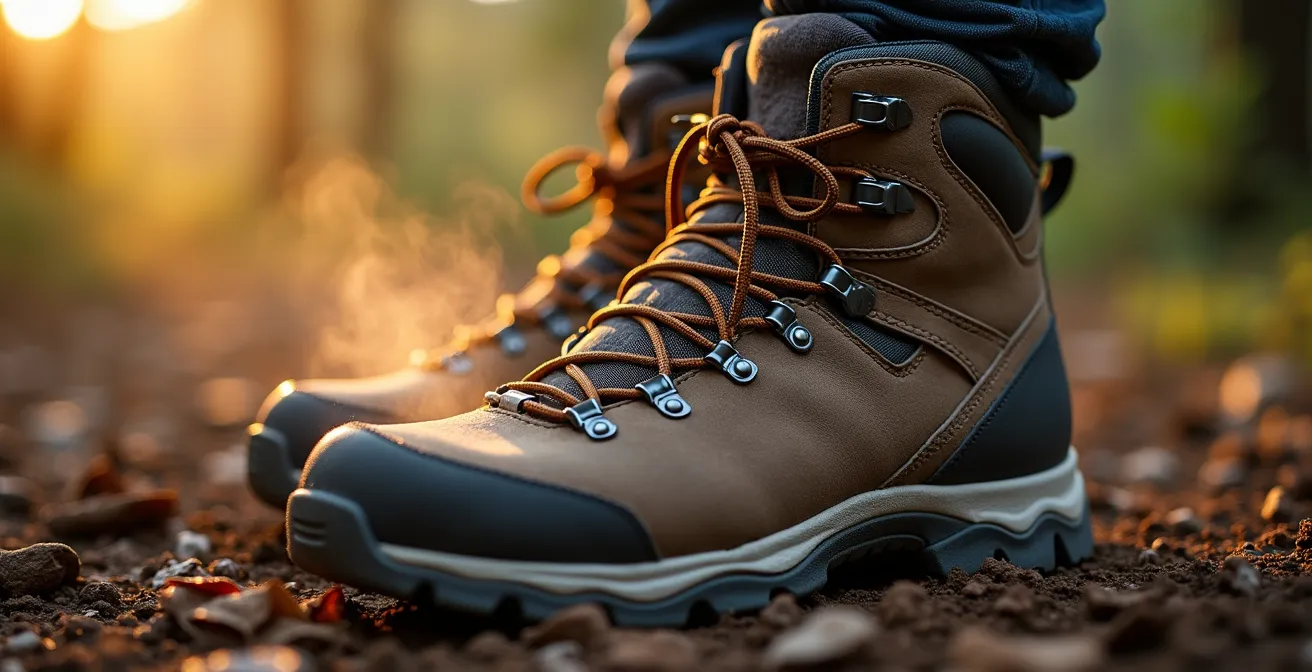
As shown in the image, this end-of-day process should be a deliberate, almost meditative act. It’s the moment you reverse the biological assault your feet have endured, ensuring they are functional and ready for another day in the wet machine. Neglecting this for even one night can lead to problems that are difficult, if not impossible, to reverse on the trail.
Hammock or Tent: Which keeps you safer from crawling insects and damp ground?
On a mountain, a tent is a fortress against wind and cold. In the jungle, it can become a stuffy, humid prison on the most dangerous piece of real estate: the forest floor. The ground is a superhighway for ants, spiders, scorpions, and snakes. It’s also a giant sponge, perpetually damp and radiating moisture that condenses inside your tent, making everything clammy. While a tent with a good footprint offers some protection, it still places you in direct contact with this high-traffic, waterlogged zone. This is where the jungle hammock, a tool often overlooked by mountain trekkers, reveals its strategic superiority.
A hammock elevates you above the dampness and the vast majority of crawling threats. Combined with an integrated bug net, it creates a personal sanctuary suspended in a cocoon of moving air. This superior ventilation is a massive advantage for both comfort and health, allowing your body and gear to dry more effectively overnight. However, it’s not a perfect solution. Hammocks require sturdy trees and are less protective against severe storms than a sealed tent. The choice depends entirely on the specific environment and your priorities.
To make an informed decision, consider this direct comparison of safety and comfort factors. The data, sourced from a comparative analysis of jungle shelters, highlights the critical trade-offs.
| Factor | Hammock | Tent |
|---|---|---|
| Ground Insects/Snakes | Excellent protection (elevated) | Moderate (ground contact) |
| Airflow & Cooling | Superior ventilation | Limited, can be stuffy |
| Terrain Adaptability | Works on slopes/uneven ground | Requires flat, clear area |
| Setup Complexity | Requires practice & trees | Simpler for beginners |
| Weather Protection | Needs robust tarp system | Better inherent coverage |
Ultimately, as guides in the Amazon basin report, the choice is situational. In flooded forests or areas with high snake activity, the hammock is the undisputed king. In managed campsites or high-altitude cloud forests where torrential rain and privacy are bigger concerns, a tent may be preferable. For the versatile trekker, understanding both systems is key.
The signal mistake that leaves trekkers lost under dense foliage
In the mountains, you navigate by sight. You spot a distant peak, a ridge, or a lake, and you orient yourself against these large, stable landmarks. In the jungle, your primary sense for navigation is taken away. The dense, multi-layered canopy creates a “green-out” effect, reducing visibility to as little as 10-20 meters. Every direction looks the same: a wall of leaves. Trails that seem clear can vanish in an instant, and your GPS signal will often be blocked or rendered wildly inaccurate by the thick foliage. Relying solely on technology is the single mistake that leads most trekkers to become dangerously lost.
To navigate the jungle is to learn to see again, using different cues. It requires a return to fundamental, non-digital techniques that rely on interpreting the subtle language of the terrain. You must learn to identify “handrails”—natural linear features like streams or small ridges—and follow them. You must establish “baselines”—larger, unmissable features like a major river or a known road—that you can aim for if you become disoriented. More importantly, it requires constant situational awareness. You must frequently stop, turn around, and memorize what the trail looks like on the return journey. It will look completely different, and failing to recognize it is a classic trap.
Your Jungle Navigation Audit: 5 Steps to Stay Found
- Identify Handrails & Baselines: Before you start, look at your physical map. What streams can you follow (‘handrails’)? What major road or river will stop you if you go too far (‘baseline’)? Mark them.
- Collect Visual Data: At every trail junction or significant turn, stop and look back. Take a mental photograph of what the path home looks like. It will be your only guide.
- Verify with Natural Cues: Does your compass reading make sense with the sun’s position (even diffused) or the general flow of water in the area? Always cross-reference.
- Create Deliberate Markers: Don’t just rely on natural features. At a confusing fork, place two sticks in a clear ‘X’ on the path you did NOT take. This is an unambiguous signal for your return.
- Calibrate Your Backup: In a safe area near camp, practice navigating for 1km using only your map and compass. Then, check your position with your GPS. This confirms your skills and your tech’s limitations under the canopy.
This disciplined, active approach to navigation is your lifeline. The jungle doesn’t forgive passive trekking; it demands constant engagement with your surroundings. Losing focus for even a few minutes can be the difference between a great day and a survival situation.
What are the 3 plants you must never touch while clearing a path?
The jungle is not a passive backdrop; it’s an environment armed with formidable defensive systems. While stories of man-eating plants are fiction, the reality of flora that can incapacitate a trekker is very real. When pushing through dense undergrowth, the urge to grab or push aside plants is natural, but it can be a disastrous mistake. You don’t need to be a botanist to stay safe, but you do need to recognize three universal archetypes of dangerous plants that are found in jungles worldwide. These are patterns of defense that your brain must be trained to spot instantly.
According to jungle safety experts who have categorized plant hazards, these archetypes are your primary “do not touch” list. First, beware of any plant, leaf, or seed pod covered in fine, hair-like spines. These tiny needles, often called glochids, are designed to detach on contact, embed themselves in your skin, and cause intense, persistent irritation that can last for days. Second, be extremely cautious of any plant that exudes a milky white or colored sap when a leaf or stem is broken. This sap is often highly toxic or caustic, capable of causing severe chemical burns, rashes, or even blindness if it gets in your eyes. Many of the most infamous plants, like the Manchineel tree, use this defense.
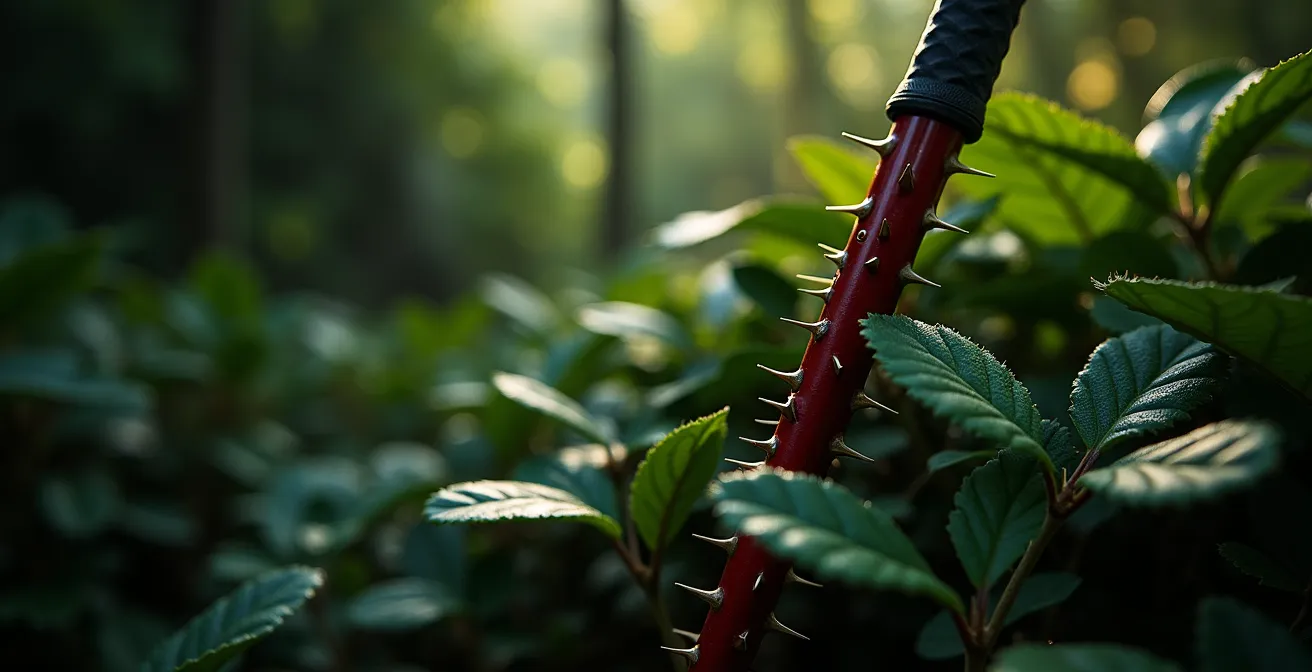
The third and perhaps most insidious archetype is the family of vines and rattans known as “wait-a-while” vines. These plants are covered in sharp, backward-facing thorns or hooks. They don’t just prick you; they snag your clothing and skin, and the more you struggle, the more entangled and torn you become. The only way to free yourself is to stop, back up carefully, and unhook yourself, one thorn at a time. Learning to recognize the tell-tale textures and shapes of these three plant types is a critical visual skill that allows you to move through the jungle with purpose, rather than blundering into its defenses.
Day or Night: When is the jungle truly alive with activity?
During the day, the jungle can feel strangely quiet and empty. The oppressive heat forces many animals into a state of lethargy, hidden in the cool shadows. A trekker moving at midday might see little more than insects and the occasional bird. The true pulse of the jungle is not found in the heat of the day or the dead of night, but in the transitional hours. The periods of dawn and dusk, known as crepuscular hours, are when the jungle’s activity peaks. This is when the diurnal (day-active) creatures are finishing their foraging and the nocturnal (night-active) animals are just beginning to stir. This overlap creates a brief but intense window of maximum wildlife visibility.
However, to experience the other half of the jungle’s life, you must venture out after the sun drops. A night trek reveals a completely different ecosystem, one dominated by sound and smell rather than sight. As soon as the sun disappears, a deafening chorus of frogs and insects erupts, a symphony that is the true soundtrack of the jungle. Your powerful white-light headlamp will blind you to this world, destroying your night vision and scaring off most creatures. The key is to use a headlamp with a red-light mode. Red light is largely invisible to most nocturnal animals and preserves your own night vision, allowing your eyes to adjust and your ears to become your primary tool for detection. You learn to listen for the snap of a twig, the rustle of leaves, or the specific call of a night bird, building a new sensory map of your surroundings.
What are the 3 steps to ensure water is virus-free in developing countries?
In a pristine mountain environment, a simple filter that removes bacteria and protozoa like Giardia is often sufficient. In the jungles of many developing countries, this assumption is dangerously incomplete. Water sources, even those that look clear and fast-flowing, can be contaminated with human or animal waste from settlements upstream. This introduces a threat that most basic filters cannot handle: viruses, such as Hepatitis A and Norovirus. Ensuring your water is safe requires a multi-barrier approach that assumes all water is contaminated with all three types of pathogens: protozoa, bacteria, and viruses.
The gold standard is a robust, three-step purification protocol. First, you must perform mechanical filtration. A hollow-fiber filter (like a Sawyer Squeeze or a Lifestraw) is excellent for removing the larger organisms—protozoa and bacteria. This is a crucial first step. Second, you must follow up with viral purification. This involves treating the filtered water with either chemical purifiers like chlorine dioxide tablets or with a UV sterilizer. This second stage is non-negotiable and specifically targets the viruses that slipped through the filter. Third, you must apply source intelligence. Always choose clear, flowing water over stagnant pools. If possible, collect water from side streams before they join a larger river, and always be aware of any potential upstream contamination sources.
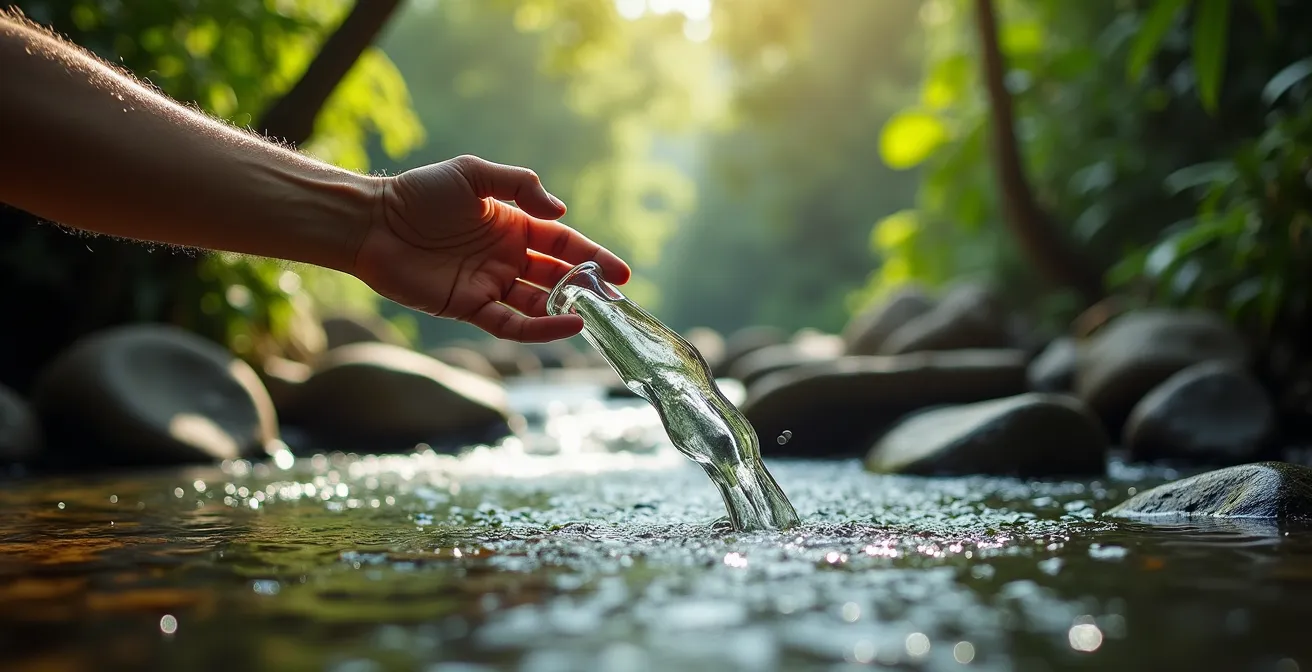
The choice of viral purification method in step two involves trade-offs between speed, weight, and taste. A comparison of viral purification methods can help you decide which is best for your specific needs.
| Method | Pros | Cons |
|---|---|---|
| UV Light Sterilizer | Fast (90 seconds), no taste change | Requires batteries, fragile |
| Chlorine Dioxide Tablets | Lightweight, reliable, no power needed | 30-minute wait time, affects taste |
| Iodine Tablets | Compact, effective | Strong taste, not for pregnant women |
By layering these three steps—Filter, Purify, and Choose Wisely—you create a redundant system that provides the highest possible level of protection, ensuring that your water source doesn’t end your expedition prematurely.
Key Takeaways
- Master Humidity, Not Just Heat: Jungle survival is about managing your body’s inability to cool itself. Prioritize electrolyte replacement over simple water intake.
- Your Feet Are Your Life: Adopt a non-negotiable nightly foot care ritual. Dryness and airflow are more important than the most expensive waterproof boots.
- Think Like a Predator (and Prey): Learn to see the jungle’s patterns—the plant archetypes to avoid, the timing of animal activity, and the subtle anomalies in the environment.
Why a Local Guide Finds Wildlife You Would Miss 90% of the Time?
An experienced mountain hiker is trained to scan the horizon for large, moving objects—a deer on a ridgeline, a bear in a meadow. This visual strategy is almost useless in the jungle. Animals are masters of camouflage, and the dense environment means you’re looking for a tiny patch of fur or a single feather in a chaotic visual field of a million leaves. You could be staring directly at a sloth or a vine snake and never see it. This is why a local guide seems to have superhuman vision. But they aren’t seeing the animal; they are seeing the *absence of the normal*.
A local guide has spent a lifetime subconsciously internalizing the sensory baseline of their environment. They know the normal way a branch sways, the typical pattern of leaves on the forest floor, the background hum of insects. As one expert on jungle tracking techniques explains, they detect wildlife through anomalies against this baseline. It might be a single, unnaturally swaying branch that indicates a monkey moving in the canopy. It could be a sudden silence in the insect chorus, signaling a nearby predator. They see a patch of ground that is slightly too disturbed or hear the specific alarm call of a ‘tattletale’ bird species that always announces the presence of a snake.
A guide’s brain is subconsciously tracking the jungle’s normal state – they don’t spot the animal, they spot the anomaly.
– Wildlife Observation Expert, Jungle Navigation and Wildlife Tracking
Hiring a guide is not just about safety or finding the trail. It is about hiring a finely tuned sensory instrument that has been calibrated over decades. They see, hear, and even smell the subtle deviations from the jungle’s equilibrium that you, with your mountain-trained eyes, are completely blind to. This is why they will find wildlife you would miss 90% of the time, transforming your trek from a simple walk in the woods into a profound immersion in the life of the rainforest.
By shifting your mindset from conquering physical challenges to understanding and adapting to a complex biological system, you can turn your jungle trek from a grueling ordeal into the adventure of a lifetime. The first step is acknowledging that the mountain is not the jungle, and your preparation must reflect that reality.