
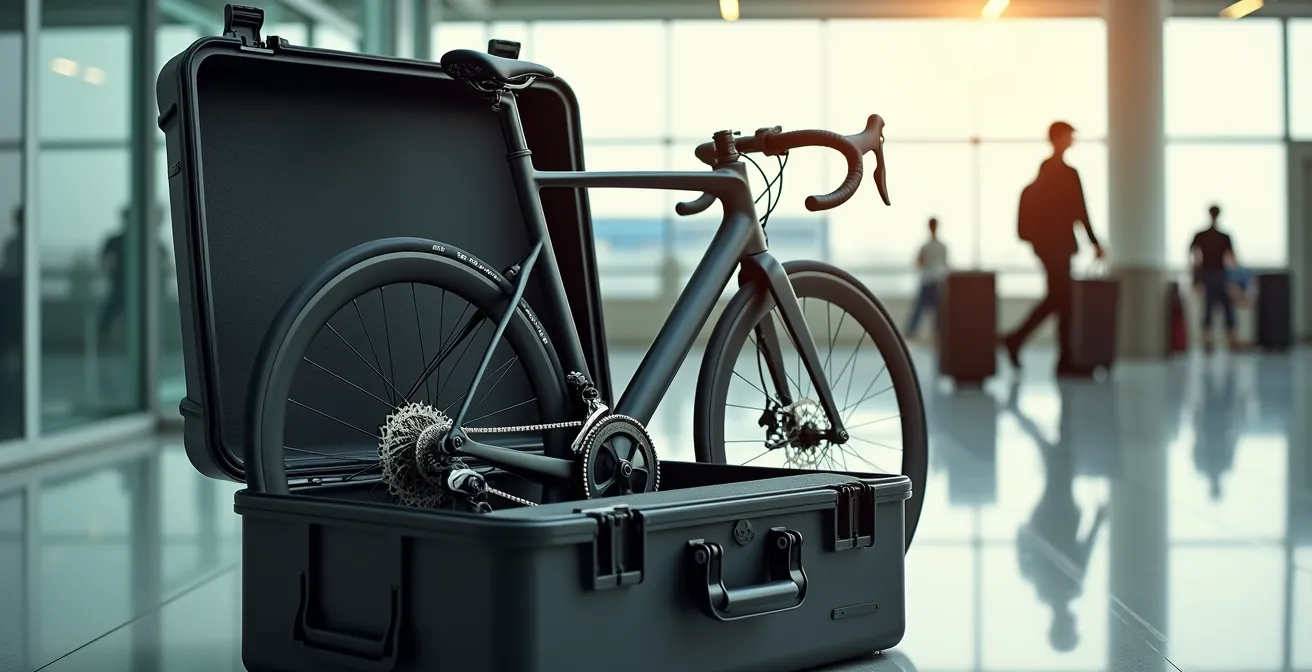
The greatest threat to your high-end carbon bike isn’t a careless baggage handler; it’s an incomplete risk management plan that overlooks the crucial on-the-ground realities of your destination.
- Flight protection is only the first step; mechanical contingencies and security at your destination are equally critical for a successful trip.
- Small, bike-specific spare parts and a working knowledge of local infrastructure are your most valuable, and often overlooked, assets.
Recommendation: Adopt a systems-based approach, treating your entire trip as an integrated logistical challenge to fully protect your investment and your experience.
For a dedicated cyclist, the sound of your bike case hitting the luggage carousel is a moment of pure anxiety. You picture the worst: a cracked top tube, a crushed stay, your ten-thousand-dollar dream machine and meticulously planned trip ruined before it even begins. The internet is full of basic advice—pad your frame, deflate your tires, cross your fingers. But this advice misses the point entirely. True protection for a high-value carbon bike isn’t just about surviving the flight; it’s a holistic system of risk mitigation that extends far beyond the airport.
This expert approach treats the entire journey as a single logistical challenge. It means anticipating failure points not just in transit, but also on the unfamiliar roads, in the foreign hotel, and even during a mid-ride mechanical. It’s about understanding that a bent derailleur hanger in a remote French village is as trip-ending as a cracked frame on the tarmac. This is not just about packing; it’s about comprehensive contingency planning to safeguard your investment and, most importantly, your irreplaceable time on the bike.
This guide will walk you through that complete system. We will cover the essential choices for air travel, but more importantly, we will dive into the on-the-ground intelligence that separates a seamless cycling vacation from a logistical nightmare. From navigating foreign traffic laws to securing your bike overnight, you will learn to think like a logistics pro and protect your entire cycling experience.
Summary: A Systems Approach to Protecting Your High-End Carbon Bike Abroad
- Hard Case or Soft Bag: Is the extra weight worth the crush protection?
- How to interpret “right of way” rules in Italy vs. the USA?
- Rent or Bring: At what trip duration does bringing your own bike become cheaper?
- The tiny part oversight that ends your trip if your bike falls over
- How to find water in rural France when shops are closed for siesta?
- Why a dedicated mudroom/garage is the #1 feature to look for?
- Why bringing your own gear might cost more than the resort rental fee?
- How to Transition to Gravel Biking Without Buying a New Bike Immediately?
Hard Case or Soft Bag: Is the extra weight worth the crush protection?
The primary decision point for any traveling cyclist is the choice between a hard case and a soft bag. The conventional wisdom is simple: hard cases offer maximum crush protection, while soft bags are lighter and easier to store. However, for the owner of a high-value carbon bike, the decision must be framed within your entire trip’s logistical chain. A fortress-like hard case is reassuring on the plane, but can become a significant piece of logistical friction—a challenge to fit in a rental car, haul onto a train, or store in a small hotel room.
The key is to weigh the superior crush protection of a hard case against the real-world convenience of a soft bag. A well-padded, structured soft bag can provide more than adequate protection if packed correctly, while saving you significant weight on airline fees and hassle at your destination. This comparative analysis, based on data from a comprehensive travel guide, breaks down the critical factors:
| Feature | Hard Case | Soft Bag |
|---|---|---|
| Weight | 10-15kg empty | 3-5kg empty |
| Protection Level | Maximum crush protection | Moderate with proper padding |
| Storage When Not in Use | Difficult – requires dedicated space | Easy – foldable/collapsible |
| Transportation at Destination | Challenging in taxis/trains | More manageable |
| Price Range | $400-800 | $150-400 |
| Airline Acceptance | Generally accepted without waiver | May require damage waiver |
Regardless of your choice, meticulous packing is non-negotiable. Use shipping spacers in your dropouts and brake calipers. Remove your pedals, seat post, and handlebars. Crucially, unscrew the entire derailleur hanger from the dropout, don’t just remove the rear mech. This tiny component is the frame’s sacrificial weak point. Wrapping tubes in pipe insulation or pool noodles creates a vital buffer zone against impacts.
How to Interpret “Right of Way” Rules in Italy vs. the USA?
Once your bike has arrived safely, the next phase of protection begins: safeguarding yourself on foreign roads. One of the most disorienting challenges is adapting to different traffic cultures. The written rules may appear similar, but their real-world application can vary dramatically. This is a critical part of your “environmental acclimatization.” For instance, the “right of way” is interpreted very differently in Italy compared to the United States.
In Italy and much of Southern Europe, there is an unwritten hierarchy based on assertive, predictable flow. Drivers expect cyclists to confidently claim their space. It’s a culture of negotiation and fluid movement rather than rigid rule adherence. In contrast, the American road system often treats cyclists as obstacles to vehicle flow, forcing a more defensive and cautious posture. Understanding this cultural nuance is more important than memorizing the specific vehicle code. You must adapt your riding style to match local expectations to remain safe.
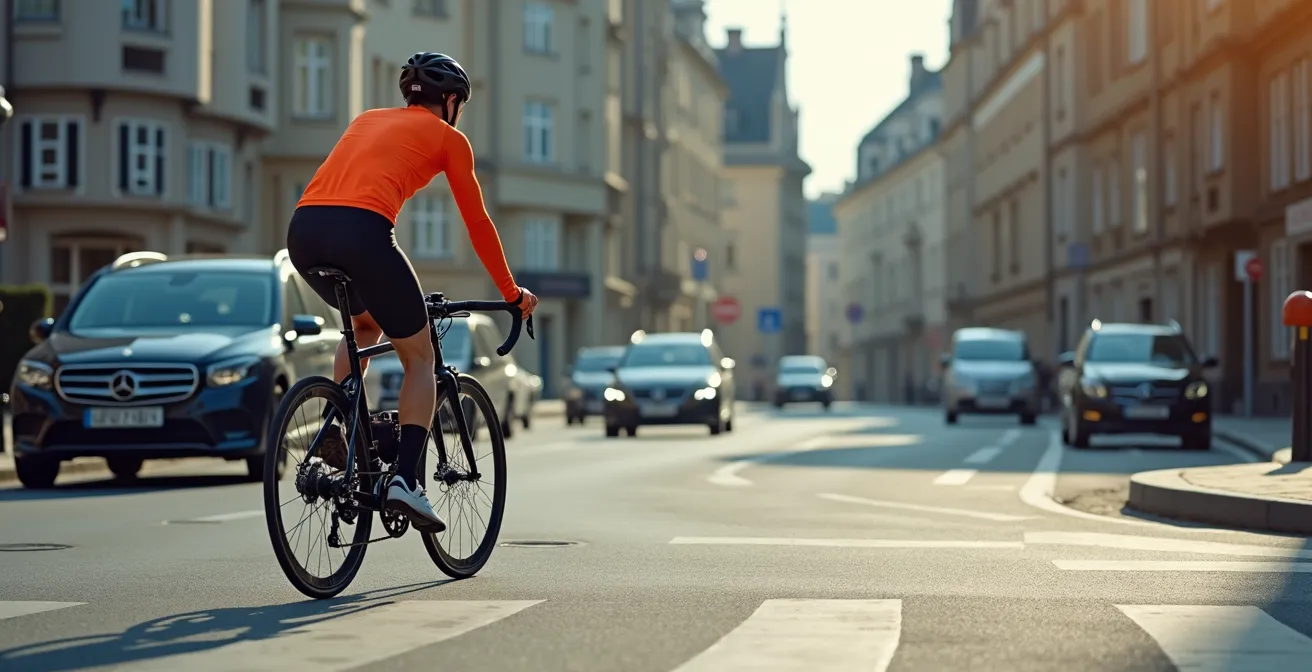
This difference is most apparent in roundabouts. A touring cyclist must know that navigating a French roundabout operating on “priorité à droite” (priority to the right) is fundamentally different from a UK roundabout where you give way to traffic already on the roundabout. Assuming the rules are the same as back home is a recipe for disaster. The savvy cyclist researches not just the laws, but the local cycling culture to understand how to integrate safely and predictably. This is active risk mitigation for the rider.
Rent or Bring: At what trip duration does bringing your own bike become cheaper?
The question of renting versus bringing your own bike is a financial component of your risk mitigation plan. For a casual tourist, renting is often a simple, cost-effective solution. However, for a dedicated cyclist with a $10,000 machine, the equation is more complex. You are not just renting a piece of equipment; you are sacrificing the perfect fit, familiar handling, and optimized performance of your own bike. The “cost” is measured in comfort and confidence, not just euros or dollars.
From a purely financial perspective, the break-even point is a function of trip duration. With European rental rates for a quality road bike ranging from €75 to €275 per week, the cost quickly adds up. Factor in round-trip airline fees for your own bike (often several hundred dollars), and you can calculate a rough break-even point. Generally, for any trip longer than a week, bringing your own bike becomes the more economical option. For shorter trips, the convenience of renting might outweigh the cost, but only if you can find a high-quality rental that meets your standards.
However, the calculation must include hidden costs and qualitative factors:
- Rental “Add-ons”: Insurance, damage deposits, and charges for swapping to your own pedals or saddle can inflate the daily rate.
- Fit and Performance: No rental bike will ever feel like your own. For a trip focused on long, challenging rides, the comfort and efficiency of your personal setup is invaluable.
- Availability: Finding a high-performance, 58cm carbon frame with electronic shifting in a small European town can be next to impossible.
For the serious cyclist, the question is less “Is it cheaper?” and more “Can I afford the performance compromise of a rental?” For most, the answer is no, making the logistics of travel a necessary part of the plan.
The Tiny Part Oversight that Ends Your Trip if Your Bike Falls Over
The most catastrophic failures on a cycling trip rarely come from dramatic crashes. They come from small, mundane oversights. The single most critical piece of contingency planning for any carbon bike owner is packing a spare derailleur hanger. This small, inexpensive piece of alloy is designed to be the weakest link—it bends or breaks upon impact to save your expensive carbon frame from damage. A simple tip-over in a parking lot or a bump during transport can be enough to bend it.
The problem is that derailleur hangers are almost always model-specific, with hundreds of different designs on the market. The chance of a local bike shop in rural Tuscany having the exact hanger for your specific Cervélo or Canyon model is virtually zero. Without a spare, a slightly bent hanger means poor shifting at best, and a destroyed rear derailleur and wheel at worst. Your multi-thousand-dollar trip is over because of a $20 part you left at home.
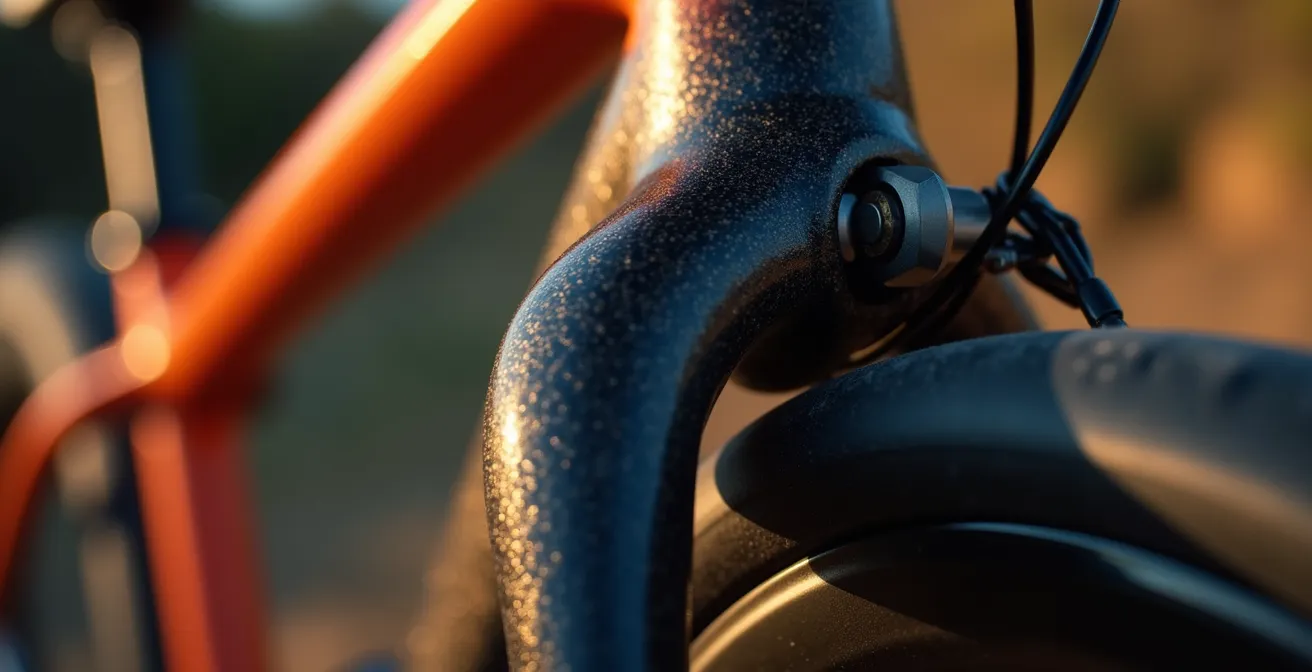
This is the essence of a robust risk mitigation system: identify single points of failure and pack the solution. Your travel kit should be a curated collection of trip-saving components.
- Spare Derailleur Hanger: The number one priority. Buy two and keep one in your travel case.
- Thru-Axle: While more robust, losing or damaging a proprietary thru-axle can be difficult to replace on the road.
- Electronic Drivetrain Spares: The specific charging cable for your Di2, AXS, or EPS system is essential.
- Proprietary Brake Pads: Don’t assume you’ll find the exact pads for your disc brake calipers everywhere.
Thinking like a team mechanic means you’re not just preparing for the ride; you’re preparing for the inevitable small failures that happen along the way.
How to Find Water in Rural France When Shops are Closed for Siesta?
Protecting your trip also means protecting your own performance and well-being. A classic mistake for cyclists touring in countries like France, Spain, or Italy is misjudging the local rhythm of life. You can’t rely on a 24/7 convenience store culture. In many rural areas, shops, cafes, and even gas stations close for a two-hour (or longer) siesta, typically from 12:00 to 14:00. On a hot day, getting caught without water during these hours can quickly become a serious situation.
This is where local knowledge and “environmental acclimatization” become survival skills. GPS apps are helpful, but they won’t tell you if the “epicerie” they’re directing you to is closed for the next three hours. Experienced cyclists develop a different set of strategies for finding water, relying on public infrastructure that has existed for centuries.
- Cemeteries: A reliable, if slightly macabre, source. Most cemeteries in Europe have a public water spigot, often marked with a sign saying ‘eau potable’ (drinking water).
- Churches and Town Squares: Look for public fountains or taps, which are common fixtures in the center of older towns.
- GPS Points of Interest: When searching your mapping app, look for keywords like ‘fountain’, ‘park’, ‘stadium’, or ‘cemetery’ as potential water sources.
- Ask a Local: Don’t be shy. Most residents will happily fill your bottles if you ask politely. Knowing the simple phrase, “Excusez-moi, pourrais-je remplir ma bouteille d’eau, s’il vous plaît?” can be a lifesaver.
The ultimate form of self-reliance is carrying water purification tablets or a portable filter. This makes you completely independent of local business hours and ensures you can safely hydrate from any public fountain or tap you find.
Why a dedicated mudroom/garage is the #1 feature to look for?
Your risk mitigation plan must extend to where you sleep. After a long day of riding, the security of your bike is paramount. Leaving a $10,000 carbon bike in a hotel hallway, a shared courtyard, or even locked to a rack in a public area is an unacceptable risk. Bike thieves are bold, and your investment is an attractive target. When booking accommodation, your number one priority should be finding a place with a private, lockable storage space like a garage, a dedicated bike room, or a mudroom you control.
The security benefits are immense. According to Rick Steves’ travel guidance, even rental bikes require strong locks on permanent racks, as bike thieves can be brazen. Hotels with dedicated private bike storage report dramatically fewer theft incidents compared to those relying on communal areas. A private space eliminates the single greatest risk factor: access by other guests or the public. It provides peace of mind that allows you to fully recover for the next day’s ride, knowing your investment is secure.
Furthermore, a secure, private space is not just for storage; it’s your field workshop. It provides the clean, well-lit environment needed for essential daily maintenance, which is crucial when riding on unfamiliar and potentially rough terrain. A quick daily audit is key to preventing mechanical failures.
Your Daily Bike Maintenance Audit Plan
- Inspect Frame & Stays: Check the chain stays, seat stays, and top tube for any new dings or paint chips from road debris or transport.
- Clean & Check Drivetrain: Clear any debris from the chain, cassette, and derailleurs after riding on unfamiliar or gravel roads.
- Verify Bolt Torque: Use a torque wrench to check critical bolts (stem, seatpost) for any loosening, especially after riding on cobblestones.
- Inspect Brake System: Clean disc rotors with isopropyl alcohol to remove contaminants and check brake pads for wear.
- Check Tires: Verify tire pressure and carefully inspect the tread for any embedded glass, thorns, or debris before your next ride.
Key Takeaways
- The choice between a hard and soft bike case is a logistical decision about the entire trip, not just the flight.
- On-the-ground risk mitigation, such as carrying a spare derailleur hanger, is more critical than worrying about common flight myths.
- True protection involves a holistic system that covers mechanical contingencies, financial risks, and acclimatization to foreign environments.
Why bringing your own gear might cost more than the resort rental fee?
At first glance, this seems counter-intuitive. We’ve established that for a serious cyclist on a longer trip, bringing your own bike is usually cheaper than renting. However, the “cost” of bringing your own bike isn’t just in airline fees. The real, and potentially much higher, cost lies in the financial risk of damage during transit. This is where many cyclists make a critical error in their planning: assuming the airline will cover them.
The hard truth is that many airlines accept bicycles as checked baggage only with a significant liability waiver. In-depth analysis of airline contracts reveals that there is often no liability acceptance from some airlines for damage to sports equipment. You are often flying at your own risk. If your carbon frame arrives with a crack, you are on your own, facing an average repair bill of $400-500, and that’s if it’s even repairable. The financial downside is significant, and this risk must be actively managed.
Airlines are often not responsible for damage that occurs during transit. Consider purchasing luggage insurance for your trip, especially if traveling with an expensive carbon bike.
– TrainerRoad Editorial Team, How To Fly With Your Bike: The Ultimate Guide
This is why the cost of “bringing your own gear” must include a crucial line item: dedicated travel or luggage insurance that specifically covers your sporting goods for their full replacement value. Standard travel insurance may not suffice. This additional expense is the price of mitigating the catastrophic financial risk of transit damage. When you factor in airline fees plus the cost of proper insurance, the total expense of bringing your bike can indeed approach or exceed the cost of a high-end rental for a shorter trip. It’s a calculated investment to protect your primary investment.
How to Transition to Gravel Biking Without Buying a New Bike Immediately?
Part of a holistic travel strategy is adaptability. Your cycling trip might take you over pristine tarmac one day and onto a stretch of Tuscan “strade bianche” the next. The rise of gravel riding has created a desire for versatility, but it doesn’t mean you need to buy a dedicated gravel bike for one trip. With a few savvy modifications, your trusted carbon road bike can become a capable “all-road” machine, allowing you to adapt to the terrain you find.
Case Study: The All-Road Roubaix
Cyclists have successfully proven that a standard carbon endurance road bike can handle light touring and gravel. One rider documented using an older Specialized Roubaix for a bikepacking trip. By fitting the maximum tire clearance of 28mm and utilizing a wide-range cassette, the bike comfortably handled both road and light gravel surfaces while carrying 20lbs of gear. This demonstrates that frame adaptation is often more effective than buying a whole new bike.
The transition is about increasing compliance, grip, and gearing range. It’s a simple, cost-effective way to expand your bike’s capability without a major new investment. Here are the key steps to convert your road machine for gravel duty:
- Maximize Your Tires: This is the single most important change. Fit the widest tires your road frame and fork can safely accommodate. For most modern endurance frames, this is typically between 28c and 32c. This provides more cushion and a larger contact patch for grip.
- Expand Your Gearing: Foreign climbs can be steeper and longer than what you’re used to. Swap your cassette for one with a larger big cog (a 32t or 34t) to give you a much-needed climbing gear for steep, loose surfaces.
- Dampen the Vibration: Add a second layer of handlebar tape (double-wrapping) to significantly reduce road buzz and hand fatigue on rough sections.
- Consider Your Pedals: If you anticipate sections where you might need to walk, switching to mountain bike pedals and shoes (like Shimano SPD) will make navigating unrideable terrain far easier than with road cleats.
This approach allows you to protect your primary bike investment while expanding the scope of your cycling adventures, embodying the savvy and adaptive mindset of an expert traveling cyclist.
Your next step is to audit your entire travel plan not just for packing, but for every potential point of failure. By adopting this holistic risk mitigation mindset, you transform anxiety into confidence, ensuring your focus remains where it belongs: on the ride ahead.
Frequently Asked Questions About Cycling in France
How do I ask for water in French?
Say ‘Excusez-moi, pourrais-je remplir ma bouteille d’eau, s’il vous plaît?’ Most locals will be happy to help you.
What does ‘eau potable’ mean?
It means ‘drinking water’. Look for signs with this phrase at public fountains and taps to ensure the water is safe to drink.
When are French shops typically closed?
In rural areas, many small shops and bakeries close for a long lunch break, often from 12:00 PM to 2:00 PM or even later. Many are also closed all day on Sunday, so plan your supply stops accordingly.