

The key to a successful multi-generational vacation isn’t finding one ‘perfect’ destination, but engineering a trip with strategically designed zones for adventure, safety, and rest.
- Prioritize “adventure” over “sightseeing” to capture a teen’s interest and leverage their need for autonomy and challenge.
- Adopt a “hub-and-spoke” travel model, using a stable resort or rental as a base for varied day trips, to balance a toddler’s need for routine with a teen’s desire for novelty.
Recommendation: Shift your planning mindset from finding a single location to building a flexible itinerary that includes non-negotiable downtime and separate-but-proximate activities for each age group.
The quiet dread of planning a family vacation is a feeling many parents know intimately. How do you possibly find one place on Earth that will satisfy the eye-rolling ennui of a 14-year-old tethered to their screen and the boundless, chaotic energy of a 4-year-old who needs naps, snacks, and a strictly enforced safety perimeter? The default advice often points towards sprawling all-inclusive resorts or the logistical whirlwind of a theme park, promising “something for everyone.” Yet, this one-size-fits-all approach frequently results in a compromise where no one is truly happy.
The common wisdom tells us to alternate activities—a museum for you, a playground for the little one, and maybe the teen will deign to join for pizza. This transactional approach, however, misses the opportunity to create shared memories. But what if the solution wasn’t about finding the perfect destination, but about adopting a new strategic framework for planning? The secret lies in consciously engineering your trip to create overlapping zones of satisfaction, where the teen’s need for autonomy and the toddler’s need for security can coexist and even complement each other.
This guide moves beyond destination lists and instead provides a research-backed model for making decisions. We will explore why adventure trumps sightseeing for teens, how to rigorously audit a kids’ club for safety, and how to structure your days to balance group time with the sacred need for personal space. It’s time to stop planning a trip of compromises and start designing an experience of connections.
Before we dive into the strategic planning of your next family trip, let’s take a brief detour into the world of extraordinary design. The following video explores a unique and fascinating concept, offering a moment of pure visual curiosity that stands apart from our practical advice.
To help you navigate this new approach, this article is structured to address the most pressing questions parents face. The following summary outlines the key strategies we’ll cover, from understanding teen psychology to ensuring peace of mind on the ground.
Summary: A Framework for Multi-Generational Vacation Success
- Why “adventure” works better than “sightseeing” to get teens off screens?
- How to audit the safety protocols of a resort’s kids’ club before dropping them off?
- Resort or Road Trip: Which is less stressful with a toddler and a baby?
- The hospital proximity oversight that can turn a minor injury into a crisis
- How to turn a snorkeling trip into a marine biology lesson without them knowing?
- What to look for in a resort spa to keep the non-surfer happy for 3 hours?
- How to balance group activities with private downtime in a shared space?
- How to Choose a Beachfront Resort That Satisfies Surfers and Sunbathers?
Why “adventure” works better than “sightseeing” to get teens off screens?
For a teenager, a vacation is often viewed through the lens of social currency and personal growth. Passive sightseeing—looking at old buildings or landscapes—rarely competes with the dynamic, interactive world of their digital lives. It lacks challenge, narrative, and, most importantly, “peer-worthy” content. Adventure, on the other hand, speaks directly to the adolescent brain’s craving for novelty, risk, and reward. It’s an active experience, not a passive observation.
The goal is to reframe activities as missions or challenges rather than tours. This taps into their developing sense of identity and competence. Research into youth travel motivations supports this; adventure tourism statistics show that for many young travelers, the draw isn’t just seeing a new place but overcoming a challenge within it. In fact, a significant portion are motivated by thrill and excitement, with 36% of adventure tourists seeking thrill and another 29% looking for physical challenges. This desire for an adrenaline rush is a powerful tool for parents.
To leverage this, consider these strategies:
- Frame activities as skill-building: Learning to surf, navigating a trail, or mastering a stand-up paddleboard is far more engaging than walking through a historic district.
- Grant autonomy in the choice of adventure: Offer a choice between two or three pre-vetted, high-excitement activities, like zip-lining or ATV touring. This gives them a sense of control over their experience.
- Emphasize the story: Highlight the “epic” photo or video opportunities. Framing an activity around its potential for creating great social media content can be a surprisingly effective motivator.
By shifting from a sightseeing to an adventure mindset, you’re not just providing a fun activity; you’re giving your teen a story to tell and a genuine sense of accomplishment, making the vacation feel like *their* experience, too.
How to audit the safety protocols of a resort’s kids’ club before dropping them off?
For a parent of a toddler, the promise of a kids’ club is the promise of precious, worry-free solo time. But that peace of mind is only possible if you have absolute confidence in the club’s safety and professionalism. A glossy brochure isn’t enough; a thorough, pre-emptive audit is a non-negotiable step before you hand over your child. This process is about verifying protocols, not just accepting them at face value.
Start by looking for tangible proof of a commitment to safety. A well-run facility will be transparent and forthcoming with this information. Inquire about everything from staff qualifications to emergency plans. A facility’s willingness—or reluctance—to answer detailed questions is a major indicator of its operational standards. The goal is to move beyond the surface-level “fun” and assess the underlying safety infrastructure that makes that fun possible.
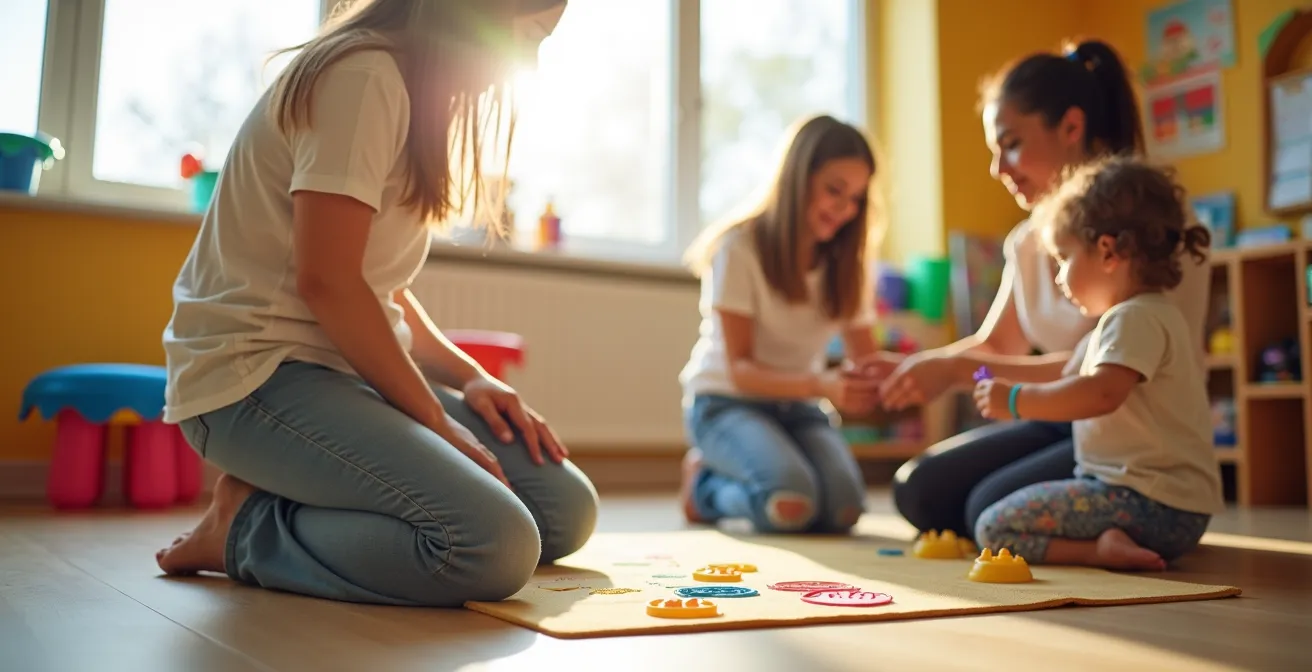
As the image above illustrates, a quality kids’ club environment is organized, clean, and designed with a child’s perspective in mind, featuring visible safety measures and engaged staff. But the most important safety features are often invisible policies and procedures.
Case Study: Club Med’s Industry-Leading Safety Standards
Leading resort chains like Club Med set a high bar for safety that can serve as your benchmark. Their protocols include employing qualified early childhood professionals as managers, mandating specific certifications like the Blue Card, and conducting twice-daily temperature checks for staff. Their facilities feature controlled access points, dedicated security personnel, and established partnerships with local medical providers, demonstrating a comprehensive, multi-layered approach to child safety that goes far beyond basic supervision.
Your Pre-Drop-Off Kids’ Club Safety Checklist
- Verify Ratios and Certifications: Ask for the specific staff-to-child ratio for your child’s age group and confirm it meets or exceeds local regulations. Inquire if all lead staff members are certified in pediatric CPR and First Aid.
- Probe Emergency Procedures: Don’t just ask if they have a plan. Ask *what* it is. Inquire about their specific protocols for medical emergencies, fire evacuation, and natural disasters.
- Review Allergen Management: For children with food allergies, this is critical. How do they prevent cross-contamination? How are snacks handled? Is staff trained to recognize and respond to anaphylaxis?
- Understand Access Control: Who is authorized to pick up your child? What is the digital or physical check-in/out process? Ask about their protocol for an attempted pickup by a non-custodial individual.
- Inquire About Parent Access: Ask about the policy for unannounced parent visits. A confident, well-run facility should welcome parents to check in at any time, as it demonstrates transparency and accountability.
Resort or Road Trip: Which is less stressful with a toddler and a teen?
The classic vacation debate—a stationary resort versus a multi-stop road trip—becomes infinitely more complex with a teen and a toddler. A road trip offers the novelty and discovery a teen craves but can shatter the routine a toddler desperately needs. An all-inclusive resort provides a stable base for the toddler but risks boring the teen into a screen-bound stupor. The cognitive load of managing constant change on a road trip can be immense for a parent.
However, the choice isn’t a simple binary. A third, often overlooked option provides the most effective solution: the “Hub-and-Spoke” hybrid model. This strategy involves establishing a home base at a well-equipped resort or rental property (the hub) and using it as a launchpad for a series of curated day trips (the spokes). This approach provides the toddler with a consistent sleeping environment and routine while offering the teen a variety of adventures without the stress of daily packing and unpacking.
This table breaks down the stress factors across the three models, highlighting why the hybrid approach often wins out.
| Factor | All-Inclusive Resort | Road Trip | Hub-and-Spoke Hybrid |
|---|---|---|---|
| Cognitive Load | Low – everything planned | High – constant decisions | Medium – base stability with day trips |
| Physical Load | High – managing kids in one space | Distributed – changes daily | Balanced – mix of both |
| Teen Engagement | Limited variety risk | New experiences daily | Best of both – variety with stability |
| Toddler Routine | Easy to maintain | Challenging to keep | Stable base helps routine |
| Budget Control | Fixed upfront cost | Variable daily expenses | Predictable with flexibility |
Case Study: The Hub-and-Spoke Success Story
This model has proven highly effective for families with diverse needs. For example, families using a resort in Costa Rica’s Guanacaste province as a base have successfully combined high-energy zip-lining and surfing excursions for teens with calm, toddler-friendly beach days. By alternating high-stimulus “spoke” days with low-key “hub” days, they report exceptionally high satisfaction rates across all age groups, proving the model’s ability to cater to different energy levels and interests within a single trip.
The hospital proximity oversight that can turn a minor injury into a crisis
When planning a vacation filled with adventure, it’s easy to focus on the fun and overlook the fundamentals of medical preparedness. No parent wants to imagine a vacation mishap, but failing to plan for one can escalate a manageable situation into a full-blown crisis. This is especially true in unfamiliar locations where language barriers and different healthcare systems can add layers of stress. The single most overlooked factor is not just *if* there’s a hospital nearby, but the actual travel time and capabilities of that facility.
A resort might advertise that it’s “close” to medical facilities, but this can be misleading. “Close” could mean a 45-minute drive on winding, unfamiliar roads. Furthermore, the nearest clinic may not be equipped to handle pediatric-specific emergencies like a serious fracture or a severe allergic reaction. While safety data from organizations like the International Association of Amusement Parks and Attractions shows that most injuries are minor and stem from guest behavior, serious accidents can and do happen. Preparedness is your best insurance policy.
Before you finalize any booking, your research must include a dedicated medical logistics check. This isn’t about being pessimistic; it’s about being a responsible and empowered traveler. Your checklist should include:
- Map the Route: Use a mapping service to calculate the real-world drive time from your resort and any planned activity locations (like a remote hiking trail or beach) to the nearest hospital with a pediatric emergency department.
- Verify Capabilities: Research or call the hospital ahead of time to confirm it has English-speaking staff and is equipped to handle the most likely pediatric issues, such as fractures and severe allergies.
- Confirm Insurance Coverage: Review your travel insurance policy. Does it cover emergency medical evacuation, or only treatment? Understand the process for initiating a claim from abroad.
- Create a Digital Emergency Packet: Store photos of passports, insurance cards, and a brief medical summary for each family member (including allergies and medications) in a secure cloud service accessible from your phone.
- Program Emergency Numbers: Save local emergency numbers (e.g., the equivalent of 911) and the number for your resort’s front desk or security in all family members’ phones.
Taking these steps beforehand transforms panic into a clear plan, allowing you to act swiftly and effectively if the need ever arises.
How to turn a snorkeling trip into a marine biology lesson without them knowing?
The key to engaging kids, especially teens, in learning is to make it feel like discovery, not a lecture. A snorkeling trip is a perfect opportunity for this “stealth education.” The vibrant, alien world beneath the waves is naturally fascinating. Your role as a parent isn’t to be a teacher with a formal lesson plan, but a facilitator of curiosity. The goal is to spark questions and provide the tools for them to find the answers themselves.
One of the most effective methods is gamification. By turning species identification into a game or a challenge, you tap into kids’ competitive instincts and transform a passive swim into an active hunt. This approach leverages the power of play to drive engagement and, as a byproduct, learning. Research in adventure tourism confirms that gamified experiences lead to significantly higher engagement and knowledge retention.

By focusing their attention on finding specific things, as seen in the family above, you give their snorkeling purpose. The vibrant colors and textures of marine life become clues in a game rather than just pretty scenery.
Case Study: The Underwater Scavenger Hunt Method
Studies have shown remarkable success with simple “stealth education” tools. Families using waterproof bingo cards featuring images of common local marine life reported an 85% higher species identification rate compared to those on traditional guided tours. Another powerful technique is appointing the teen as the “expedition documentarian,” equipping them with a GoPro. This role naturally encourages them to look closer and ask curiosity-driven questions about the ecosystem they are filming, creating a self-directed learning experience.
Here are some practical techniques for your next trip:
- Create Species Bingo: Before your trip, create simple, waterproof bingo cards with pictures of 5-10 common fish and creatures in the area (e.g., parrotfish, sea turtle, brain coral).
- Use Post-Snorkel Tech: After the swim, use a fish identification app during snack time to look up the creatures you photographed or saw. This connects the real-world experience with digital tools they’re already comfortable with.
- Spark Competition: Frame the activity as a friendly contest. “Who can find a blue tang first?” or “I bet I saw more angelfish than you did.”
- Connect to Bigger Stories: If you see bleached coral or a piece of trash, use it as a gentle opening to talk about bigger environmental stories, driven by their own observations.
What to look for in a resort spa to keep the non-surfer happy for 3 hours?
While one part of the family is chasing waves, the other deserves more than just a standard 60-minute massage. For a spa experience to truly occupy and delight someone for a full morning or afternoon, it needs to be a destination in itself, not just a service. The modern luxury spa has evolved from a simple treatment room into a multi-stage wellness journey. The key is to look for a “Spa-Plus” concept that transforms passive pampering into active, engaging wellness.
A truly immersive spa experience is built around a circuit or journey that encourages guests to move through different environments at their own pace. This extends the experience far beyond the time spent with a therapist. Look for facilities that offer a narrative—a progression from heat to cold, from social pools to quiet relaxation zones. This turns a simple treatment into a half-day retreat, providing ample opportunity for relaxation, reflection, and rejuvenation.
Case Study: The Extended Spa Journey Concept
Premium resorts like the Grecotel Marine Palace exemplify this approach by designing multi-stage wellness circuits. Their spas extend a single treatment into a three-hour journey by including access to a sauna, steam room, hydrotherapy pools, and dedicated relaxation lounges with ocean views. Crucially, their “Spa-Plus” offerings also include scheduled activities like guided meditation, sunrise yoga on a private deck, or even nutrition workshops. This model successfully provides a fulfilling, time-consuming experience that feels like a worthwhile and substantial activity in its own right.
When evaluating a resort’s spa, use this checklist to gauge if it offers a true multi-hour journey:
- Multi-Stage Thermal Circuits: Does it have more than just a sauna? Look for a combination of sauna, steam room, cold plunge pool, and varied hydrotherapy jets.
- Quality Relaxation Areas: Are the post-treatment lounges an afterthought or a feature? Look for comfortable seating, ocean views, complimentary tea and snack service, and perhaps even a small library.
- Spa-Plus Offerings: Check the schedule for included wellness classes like yoga, meditation, or stretching. These add structure and value to the day.
- Private and Quiet Zones: To ensure true relaxation, look for features like bookable private cabanas, soundproof relaxation pods, or designated adult-only quiet zones.
- Extended Day-Use Packages: Does the spa offer day passes or packages that bundle a treatment with extended access to all facilities? This is often a better value and signals a focus on longer stays.
How to balance group activities with private downtime in a shared space?
One of the biggest sources of friction on a family vacation is the unspoken tension between forced togetherness and the individual need for solitude. A teen needs space to decompress, a toddler needs quiet for a nap, and parents need a moment to themselves. Simply hoping these needs will magically align is a recipe for conflict. The solution is to create a clear, mutually agreed-upon structure for your days that explicitly protects private time.
A highly effective tool for this is the “Red/Yellow/Green” daily scheduling system. This simple framework externalizes the negotiation process and makes downtime a non-negotiable part of the plan, rather than something that has to be fought for. It sets clear expectations and gives every family member a sense of control and predictability. The positive impact of this kind of planning is significant; tourism research indicates that families report 35.8% higher satisfaction when their vacation includes both structured group experiences and protected individual downtime.
Here’s how the Red/Yellow/Green system works:
- Green Activities: These are the one or two “must-do” group activities for the day (e.g., a family snorkeling trip, a special dinner out). Everyone is expected to participate.
- Yellow Activities: These are optional group activities (e.g., a game of cards, a walk to get ice cream). Anyone is welcome to join, but there’s no pressure. This allows for spontaneous connection without obligation.
- Red Time Blocks: This is protected, non-negotiable solo time. Each person has a “red” block scheduled into their day. During this time, the rule is simple: headphones on, do not disturb. This is crucial for a teen’s sanity and a parent’s recharge.
To implement this system effectively, hold a brief family meeting the night before to plan the next day’s colors. This gives the teen a voice in the schedule and helps manage the toddler’s routine. In a shared space like a condo or hotel suite, you can also “zone” areas by energy level—the balcony becomes a quiet “red” zone, while the living room is a social “yellow” or “green” zone. This simple, visual system can dramatically reduce conflict and ensure everyone gets the balance of connection and solitude they need.
Key Takeaways
- The most successful family vacations are not found, but engineered around a framework of balancing autonomy (for teens) and safety (for toddlers).
- Adopt a “Hub-and-Spoke” model—a stable home base with planned day trips—to satisfy both the need for routine and the desire for novelty.
- Proactively audit all safety and medical logistics, from kids’ club protocols to hospital proximity, before you book. This is non-negotiable.
How to Choose a Beachfront Resort That Satisfies Surfers and Sunbathers?
The surfer and the sunbather represent the classic vacation dichotomy: the thrill-seeker versus the relaxation-seeker. Choosing a resort that pleases both is the ultimate test of the “overlapping zones of satisfaction” framework. A resort that excels for one often fails the other. A world-class surf break may have a rocky, windswept beach, while a perfectly calm, protected cove will offer no waves. The key is to find a single location with dual personalities.
This means looking for specific geographical features. The ideal resort is often situated on a larger bay or a point that creates different conditions in close proximity. You might find a resort with a beach that faces a powerful swell on one end, while the other end is protected by a headland or reef, creating a calm, lagoon-like area perfect for a toddler and a sunbathing parent. This physical separation allows for two distinct experiences to happen simultaneously, just a short walk apart.
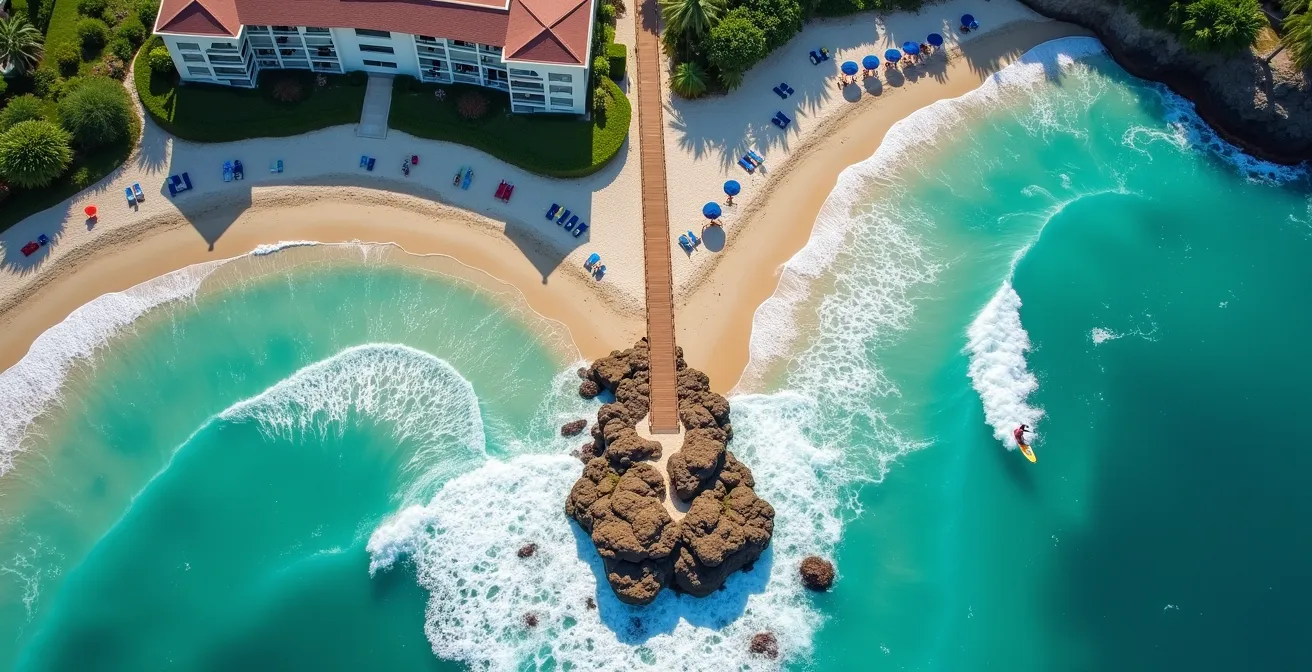
As the aerial view above demonstrates, some premium resorts are built around this very concept, offering both a high-energy surf zone and a tranquil, protected beach. Beyond geography, the resort’s amenities must also cater to both needs without compromise.
This table outlines the differing priorities and the ideal compromise solution to look for:
| Feature | Surfer Priority | Sunbather Priority | Compromise Solution |
|---|---|---|---|
| Beach Access | Quick path to break | Protected calm area | Resort with both zones |
| Amenities | Board storage, rinse stations | Quality loungers, umbrellas | Full beach service both areas |
| Location | Near famous surf spots | Wind protection, soft sand | High-end resort near breaks |
| Services | Tide/swell updates | Poolside service | Knowledgeable concierge for both |
| Social Spaces | Casual beach bar | Quiet relaxation zones | Multiple venue options |
Ultimately, choosing the right beachfront resort is the final piece of the puzzle. It requires diligent research into a location’s microclimate and geography and a resort’s specific amenities. When you find one that caters equally to the adrenaline-seeker and the peace-seeker, you’ve found the perfect hub for your multi-generational family adventure.
Start planning your next family trip not by asking “where?”, but by asking “how?”. Use this strategic framework to design a vacation that respects individual needs, minimizes parental stress, and creates lasting, shared memories for everyone, from your toddler to your teen.