

The success of your next adventure trip hinges not on the destination’s fame, but on a strategic matrix of skill, infrastructure, and logistics.
- Booking a “pro-level” trip as an intermediate often leads to frustration, not flow, due to a fundamental skill-to-challenge mismatch.
- Evaluating a destination’s “infrastructure density”—emergency access, connectivity, accommodation—is as crucial as assessing its beauty.
Recommendation: Shift from asking “Where should I go?” to “What operational parameters does my current skill level require for a successful and enjoyable trip?”
As an intermediate adventurer, you’ve graduated from the guided tours and now stand at a thrilling, yet daunting, crossroads. The world’s iconic peaks, rivers, and trails call to you, but a quiet fear persists: “Am I ready for this?” The common advice is to simply “assess your fitness” or “pick a destination that matches your skills.” This is both obvious and useless. It ignores the complex interplay of variables that truly define an adventure. You’re no longer just a tourist; you’re the expedition manager, and your success depends on a new way of thinking.
The internet offers endless lists of “Top 10” destinations, but these are merely catalogs of places, not strategic blueprints. They fail to address the critical logistical friction and the hidden risks that can turn a dream trip into a costly ordeal. What if the key to unlocking your next level of adventure wasn’t about pushing your physical limits recklessly, but about mastering the strategic planning that surrounds the activity? The real challenge isn’t just the mountain; it’s the matrix of decisions you make months before you even step on the trail.
This guide provides that strategic framework. We will deconstruct the myth of the passive “bucket list” and replace it with an active system for decision-making. We’ll move beyond the ‘what’ and ‘where’ to explore the ‘how’ and ‘why’—analyzing the crucial, often-overlooked factors like safety verification, infrastructure density, seasonal nuances, and the real cost of logistical oversights. This is your new playbook for choosing smarter, training harder, and adventuring with confidence.
This article provides a comprehensive framework to help you make informed decisions. The following summary outlines the key strategic pillars we will explore to ensure your next trip is a perfectly calibrated challenge, not a source of stress.
Summary: The Adventure Matrix: A Strategic Guide to Global Destinations
- Why passive sightseeing drains your energy more than a 10km run?
- Why booking a “Pro-Level” destination as an intermediate leads to 50% less enjoyment?
- How to verify safety standards of adventure tour operators in remote regions?
- Patagonia or The Alps: Which offers better infrastructure for solo trekkers?
- When to book New Zealand adventures to avoid the “shoulder season” rain?
- How to check if the package insurance actually covers medical evacuation?
- The airline baggage fee oversight that adds $300 to your adventure trip
- Why a Concierge Saves You 15 Hours of Logistics on Active Trips?
Why passive sightseeing drains your energy more than a 10km run?
The paradox of modern travel is that a week of “relaxing” sightseeing can leave you more exhausted than a period of intense physical activity. A 10km run, while demanding, has a clear start, finish, and a singular focus. Your mind enters a state of flow, a near-meditative immersion where challenge and skill are in perfect harmony. In contrast, passive sightseeing is a battle of a thousand micro-decisions: “Which museum first? What time is the train? Where should we eat? Did I validate my ticket correctly?” This constant, low-level cognitive load creates decision fatigue, draining your mental energy far more than a focused physical effort.
Well-chosen adventure sports counter this drain by creating a structured environment for “flow.” As research into adventure education highlights, activities with professional guidance and clear objectives minimize the decision fatigue that plagues unstructured tourism. The goal is defined, the rules are clear, and your focus is narrowed to the task at hand. Your mind isn’t splintered across a dozen logistical problems; it’s engaged in a single, rewarding challenge.
This is why the transition from sightseeing to adventure travel is so energizing. You are trading the chaotic energy drain of constant, trivial choices for the focused, restorative state of a singular, meaningful challenge. Even a beginner’s activity has this benefit; structured activities with clear guardrails, like beginner open-water diving where protocols limit you to a maximum depth of 59 feet, prevent cognitive overload and allow you to fully immerse in the experience. The key is finding that perfect balance where the challenge is high enough to command your full attention but not so high that it induces anxiety.
Why booking a “Pro-Level” destination as an intermediate leads to 50% less enjoyment?
The allure of an iconic, “pro-level” destination is powerful. You see the stunning photos from the Everest Base Camp trek or a technical ascent in the Andes and think, “I want to do that.” However, for an intermediate adventurer, this ambition can be a trap. The biggest risk isn’t necessarily catastrophic failure, but a “strategic mismatch” between your capabilities and the objective demands of the trip. This mismatch erodes enjoyment, turning a thrilling challenge into a grueling slog. You spend the entire time managing anxiety and physical discomfort instead of experiencing the sought-after flow state.
The environment itself adds a hidden layer of difficulty that brochures don’t mention. For instance, even if you are fit at sea level, research shows that altitude adds a 30% difficulty increase for any given physical effort. This is a quantifiable stressor that an intermediate traveler may not be prepared for, both physically and mentally. The goal is to choose a destination where you operate at 70-80% of your maximum capacity, leaving a crucial buffer for unexpected challenges, rather than red-lining from day one.
This doesn’t mean you shouldn’t be ambitious. It means your ambition must be paired with an honest, structured self-assessment. Before you book that epic trip, you must audit your current skill set against the destination’s non-negotiable requirements. A specific training plan should be the bridge between your current state and your goal. For a trekking goal, this means building up to long hikes with a weighted pack. For a climbing objective, it requires a dedicated focus on grip strength and endurance in a gym setting, starting weeks or months in advance.
Action Plan: Your 5-Point Skill-to-Destination Audit
- Skill Inventory: List your concrete, recent experiences. Be specific: “Five 10-mile day hikes with 2,000ft elevation gain in the last year,” not just “I’m a hiker.”
- Demand Analysis: Research the non-negotiable demands of your target trip. List them out: “Requires carrying a 40lb pack for 8 consecutive days,” “involves 3 nights above 14,000ft,” “basic rope skills necessary.”
- Gap Identification: Compare your inventory to the demands. Where are the gaps? Honesty is critical. “My longest trip was 3 days, not 8,” or “I have no experience with altitude acclimatization.”
- Motivation Core: What is the single most important part of this experience for you? Is it the technical challenge, the cultural immersion, or the remote wilderness? Knowing this helps you make smart compromises if needed.
- Bridging Plan: For each identified gap, define a concrete, time-bound action to close it before your trip. Examples: “Complete a weekend wilderness first aid course,” “Hire a coach for 4 sessions on rock-climbing technique.”
How to verify safety standards of adventure tour operators in remote regions?
Once you’ve aligned your skills with a destination, the next critical layer of your strategic matrix is vetting the people you trust with your safety. In remote regions, your guide and operator are your lifeline. Relying on glossy brochures or a few positive online reviews is insufficient. You need to investigate an operator’s safety culture with the rigor of a professional consultant. This means looking for tangible evidence of systems and standards, not just marketing promises.
A key indicator of professionalism is their guide-to-client ratio. As established in professional adventure destinations, these ratios are not arbitrary. A simple trek might safely accommodate a 1:8 guide-to-client ratio, but a technical peak demanding rope work and complex decision-making requires a much tighter 1:2 ratio for adequate safety margins. Ask potential operators for their specific ratios for your intended activity. A vague answer or a one-size-fits-all approach is a significant red flag. Furthermore, reputable operators enforce mandatory medical screenings for activities like diving or high-altitude sports, demonstrating a proactive approach to risk management.
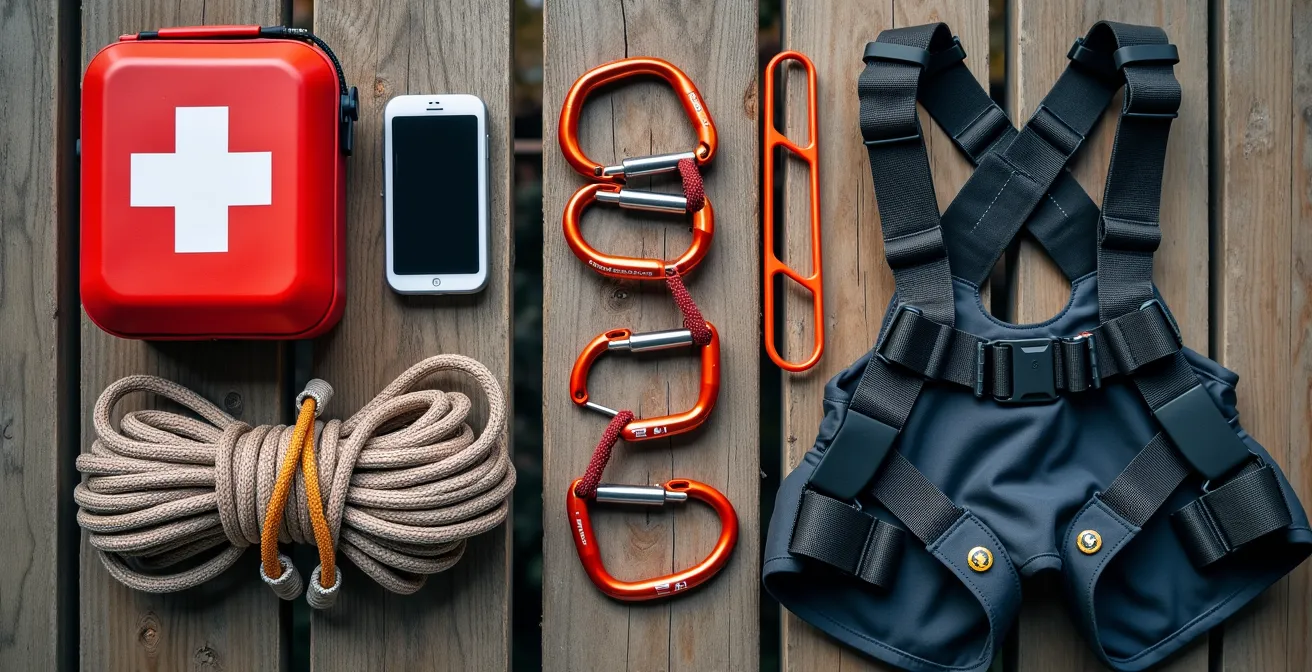
Beyond ratios and paperwork, inquire about their equipment maintenance and guide training. Ask questions like: “What are your protocols for gear inspection and retirement?” and “What level of wilderness medical certification do your lead guides hold, and how often are they recertified?” A professional outfit will have clear, immediate answers. They should be able to tell you their guides are certified as Wilderness First Responders (WFR) or higher, and that they conduct regular in-house training on emergency protocols. Their confidence and transparency in answering these questions is often as telling as the answers themselves.
Patagonia or The Alps: Which offers better infrastructure for solo trekkers?
Choosing between two world-class trekking destinations like Patagonia and the European Alps beautifully illustrates the concept of “infrastructure density.” Both offer breathtaking landscapes, but they present vastly different operational environments for a solo trekker. The decision shouldn’t be based on which has more dramatic peaks, but on which system better aligns with your desired level of self-sufficiency and your personal risk tolerance. The Alps represent a system of high infrastructure density, while Patagonia is characterized by a lower density and a demand for greater autonomy.
The primary difference lies in the support and bailout options available. In the Alps, a dense network of mountain huts (“refuges” or “hütten”) means you are rarely more than a day’s hike from shelter, a hot meal, and other people. This system dramatically lowers the consequence of a minor error—like a twisted ankle or bad weather. Digital connectivity is often available daily. In contrast, many classic Patagonian treks are more isolated. Accommodation is primarily in campsites that require advance booking, and a problem can mean a multi-day trek back to an exit point or a costly helicopter evacuation. A satellite messenger isn’t a luxury; it’s a mandatory piece of gear.
This comparative analysis, as detailed in a recent analysis of trekking infrastructures, highlights the trade-offs in cost, safety, and experience. The Alps, with their robust infrastructure, often come with a higher daily cost but provide a significant safety net. Patagonia may be cheaper on paper but demands a higher investment in personal gear, planning, and self-reliance.
| Aspect | The Alps | Patagonia |
|---|---|---|
| Emergency Exit Time | 1-day from most routes | Multi-day trek or helicopter |
| Digital Connectivity | Daily check-in possible | Satellite messenger required |
| Accommodation System | Dense hut network, communal | Campsite booking, isolated |
| Weekly Cost Range | $2,500-$5,000 | $1,800-$4,000 |

Ultimately, neither is “better”—they are different operational models. For an intermediate trekker stepping into solo adventures, the Alps offer a structured environment to build confidence. For a more experienced intermediate looking to test their expedition skills, Patagonia offers a rawer, more committing challenge. Your choice should be a conscious decision based on this understanding of infrastructure, not just a preference for granite spires or snow-capped peaks.
When to book New Zealand adventures to avoid the “shoulder season” rain?
New Zealand, often hailed as the “Adventure Capital of the World,” is a prime destination for intermediate adventurers due to its superb safety standards and variety of activities. However, its geographical position creates distinct and often counter-intuitive microclimates between the North and South Islands. A generic understanding of “shoulder season” (the period between peak and off-peak seasons) is dangerously inadequate here. Choosing the right time to go requires a more granular, island-specific strategy to avoid trip-ruining weather.
The common mistake is assuming that spring (September-November) and autumn (March-May) are uniformly good across the country. In reality, the optimal booking windows are staggered. For alpine trekking in the South Island, the period from March to April is often considered the ‘golden season.’ It offers the most stable weather, fewer crowds, and stunning autumn colors. Crucially, this window allows you to avoid the early onset of the rainy season that can plague the North Island during the same period.
Furthermore, local knowledge is key to navigating NZ’s notoriously fickle weather, especially in regions like Fiordland. Rain is a year-round feature that creates the area’s iconic, powerful waterfalls; trying to avoid it completely is futile. The more strategic approach is to monitor the “freezing level.” This metric, which indicates the altitude at which precipitation turns to snow and ice, is a far more critical safety indicator for trekkers than a simple rain forecast. For real-time, on-the-ground conditions, the official Department of Conservation (DOC) website is the definitive source. Its ranger reports provide ground-truth information that is infinitely more reliable than generic, international weather apps.
How to check if the package insurance actually covers medical evacuation?
For an adventurer, travel insurance is not a commodity; it’s a critical piece of safety equipment. Yet, many travelers purchase policies without understanding the fine print, assuming “adventure travel” coverage is a simple checkbox. As one travel insurance expert notes, this is a dangerous assumption.
Many policies have broad ‘adventure sports’ exclusions hidden in the fine print
– Travel Insurance Expert, Travel Triangle Adventure Sports Guide
This means you must become a forensic analyst of your own policy document. The marketing brochure is irrelevant; the policy PDF is your source of truth. The first step is to use the search function (Ctrl+F) to look for the exact name of your intended activity. “Trekking” might be covered, but “mountaineering” might be excluded. “Scuba diving” might be covered, but only to a depth of 30 meters, leaving you uninsured for an advanced dive.
The term “medical evacuation” is another area requiring intense scrutiny. You must verify the distinction between two critical clauses: “evacuation to the nearest suitable facility” and “repatriation to your home country.” The former could mean being transported to a basic regional clinic, while the latter means being flown home for care. The cost difference is astronomical, and you need to know exactly what you’ve paid for. Additionally, check if “search and rescue” costs are covered as a separate line item. A policy might cover the helicopter flight from a field clinic to a hospital, but not the initial helicopter cost to find and lift you off the mountain.
Finally, confirm the specific limits of coverage. Many policies have explicit altitude or depth limits. If your policy covers trekking but excludes claims for incidents occurring above 4,000 meters, it’s useless for a high-altitude trek. Verifying these details is a tedious but non-negotiable part of your pre-trip contingency calculus.
Key Takeaways
- Strategic Mismatch: The greatest risk is not physical danger but the frustration from a mismatch between your skills and the destination’s demands.
- Infrastructure Density: Evaluate destinations based on their safety nets (huts, connectivity, emergency access), not just their scenic value.
- Contingency Calculus: Proactive verification of operator standards and insurance policies is a core skill, not an afterthought.
The airline baggage fee oversight that adds $300 to your adventure trip
The financial planning for an adventure trip often focuses on big-ticket items like flights and tour costs, while underestimating the impact of “logistical friction.” A prime example is the transport of specialized sports equipment. Overlooking airline baggage policies for oversized or overweight gear is an amateur mistake that can add hundreds of dollars in unexpected fees, creating stress before the adventure even begins. This isn’t just about money; it’s about the strategic decision of whether to bring your own trusted gear or rent at your destination.
The budget for an adventure can vary dramatically, and these hidden costs are a major factor. Comprehensive budget planning reveals costs ranging from $800 to $9,000 per week, and a significant part of that variance comes from gear logistics. Before deciding to haul your skis, surfboard, or climbing rack across the globe, you must do the math. Calculate the airline’s specific fees for sports equipment or oversized luggage and multiply by two for the return journey. Compare this total to the cost and, crucially, the quality of rental gear available locally.
Creating a smart gear transport decision matrix involves weighing several factors:
- Cost Analysis: Total baggage fees (return) vs. total rental cost for the trip duration.
- Quality & Availability: Is high-quality, well-maintained rental gear guaranteed at your destination, or is it a gamble? For highly technical or safety-critical gear, bringing your own is often non-negotiable.
- Hassle Factor: What is the non-monetary cost of dragging a giant ski bag or a heavy pack through multiple airports, taxis, and hotels?
- Airline Policy Nuances: Research if the airline offers a flat-rate for sports equipment, which can sometimes be cheaper than standard oversized baggage fees.
Making this decision consciously, based on research, is a hallmark of a strategic adventurer. It’s about optimizing your resources—time, money, and energy—to focus on the adventure itself, not on logistical firefights at the check-in counter.
Why a Concierge Saves You 15 Hours of Logistics on Active Trips?
After exploring the complex matrix of skills, safety, infrastructure, and logistics, it becomes clear that planning a next-level adventure is a significant undertaking. While empowering, the sheer volume of research can be overwhelming. This is where the ultimate strategic move comes into play: outsourcing the logistical friction to a local expert or a specialized travel concierge. It’s a shift from being the expedition’s overworked manager to its focused and present CEO.
The value of a concierge is not in booking flights; it’s in their “zero latency” local knowledge. As one expert in adventure travel planning puts it, they provide an instant shortcut across what would otherwise be weeks of frustrating research.
A local concierge has zero latency; they know the answer instantly. They are a shortcut across weeks of research
– Adventure Travel Planning Expert, Professional Travel Services Study
Consider the time investment. Finding reliable transport to a remote trailhead, verifying the opening hours of a permit office, or researching local gear compatibility can each consume hours of your time. A concierge handles these tasks instantly. Their value is quantified not just in hours saved but in problems preemptively solved. They know which trail is washed out, which guide has the best safety record, and the optimal timing to secure a high-demand permit.
The following table, based on a comparative analysis of planning time, starkly illustrates the efficiency gained by using a dedicated service. This isn’t about luxury; it’s about a strategic investment in the quality of your limited and valuable vacation time.
| Task | DIY Research Time | Concierge Time |
|---|---|---|
| Finding trailhead transport | 3 hours | Instant |
| Permit office hours verification | 2 hours | Pre-verified |
| Local gear compatibility research | 4 hours | Expert knowledge |
| Emergency protocol planning | 3 hours | Pre-established |
| Weather window optimization | 3 hours | Local expertise |
By delegating the logistics, you free up your most valuable resource—your mental energy—to focus entirely on the challenge and beauty of the adventure. It ensures you arrive at the trailhead prepared and present, ready to achieve the flow state that you set out to find. For the intermediate adventurer looking to step up, this strategic delegation is often the final piece of the puzzle.
Frequently Asked Questions on a Strategic Approach to Adventure Travel
What’s the best season for South Island alpine trekking?
March-April offers the most stable conditions with golden light, while avoiding the North Island’s early rainy season.
How do I track real-time trail conditions?
Use the Department of Conservation (DOC) website for ground-truth ranger reports rather than generic forecasts.
Should I worry about rain in Fiordland?
Rain is year-round and creates iconic waterfalls; focus instead on tracking the ‘freezing level’ for snow/ice risks above the bushline.