
In summary:
- The frustration of not seeing wildlife stems from not knowing the silent language of the environment; a guide is your interpreter.
- Success isn’t about luck, but about decoding subtle “disturbance patterns”—bent leaves, faint scents, and broken spider webs.
- Your own presence (movement, noise, even your clothing) creates a bubble of disturbance. A guide teaches you to shrink it.
- Timing is everything. Understanding the crepuscular hours of dawn and dusk is non-negotiable for seeing an active ecosystem.
You’ve been there. You’ve travelled to a place renowned for its incredible fauna, full of anticipation. You have the binoculars, the field guide, and the patience. Yet, after hours of trekking, the forest remains stubbornly silent, the animals seemingly a myth. The frustration is palpable; it feels like the wildlife is actively avoiding you. The common advice—”be quiet,” “look closely”—feels hollow when the most you’ve spotted is a common squirrel.
The core of this frustration isn’t a lack of effort, but a lack of interpretation. We move through a natural environment as outsiders, functionally deaf and blind to the constant dialogue happening around us. While some believe hiring a guide is simply paying for a “good pair of eyes,” this misses the fundamental truth. A local guide doesn’t just see better; they possess a deep, layered sensory intelligence. They read the landscape not as a static picture, but as a living narrative of recent events. Research indicates that with 48% of wildlife species declining globally, the opportunity for meaningful encounters is more precious than ever, and requires more than just luck.
This article moves beyond the platitudes. We will deconstruct the “magic” of a great naturalist guide into observable skills and principles. This is not about what they see, but *how* they see. The key is understanding that the ecosystem is constantly broadcasting information. A guide is simply tuned to the right frequency. By the end, you won’t just understand why you need a guide; you’ll begin to see the world through their eyes, recognizing the subtle clues that transform a silent forest into a theater of life.
This exploration will cover the specific techniques guides use to interpret the environment, manage their presence, and maximize encounters. We will break down everything from reading vegetation to the unseen impact of your clothing choices, giving you a new appreciation for this profound expertise.
Summary: Decoding the Guide’s Toolkit for Unlocking the Wild
- How to read disturbed vegetation to know an animal passed 10 minutes ago?
- Why a group of 4 sees more than a group of 12?
- Day or Night: When is the jungle truly alive with activity?
- The clothing error that scares away birds before you even see them
- How to enter a tribal village with a guide without being intrusive?
- What are the 3 plants you must never touch while clearing a path?
- How to turn a snorkeling trip into a marine biology lesson without them knowing?
- How to Prevent Blisters on Multi-Day Treks with Wet Feet?
How to read disturbed vegetation to know an animal passed 10 minutes ago?
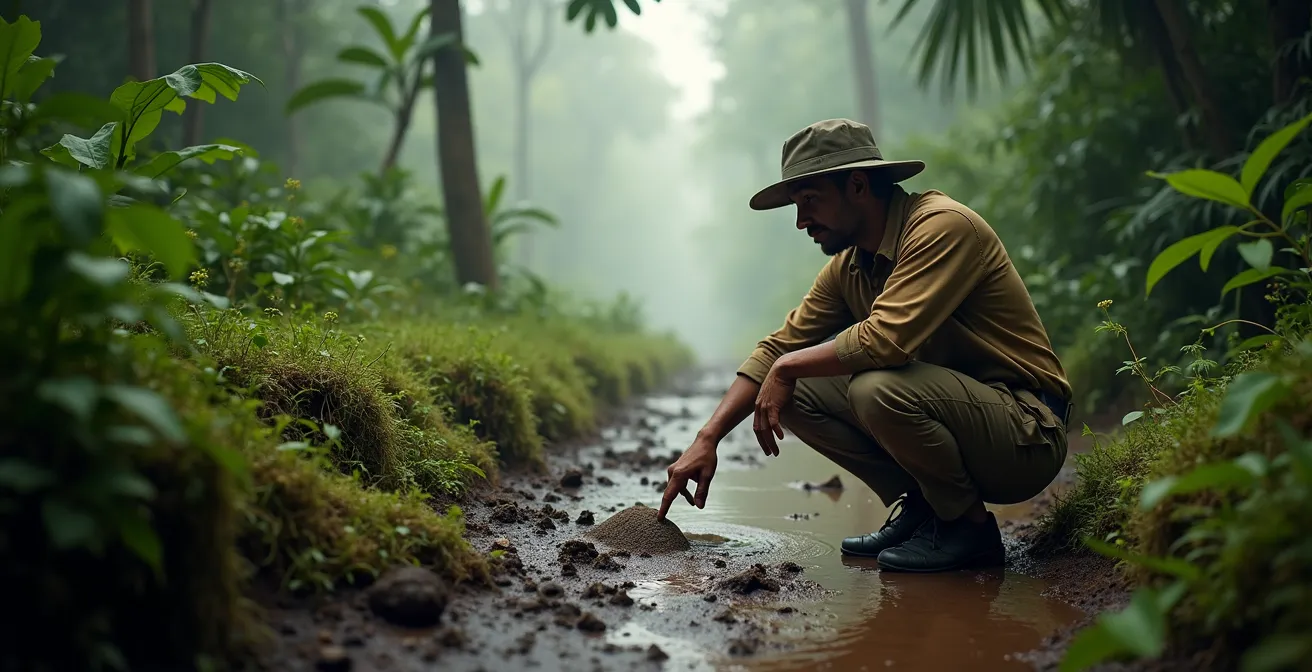
An experienced guide walks through the forest with a fundamentally different mindset. They are not looking *for* an animal; they are looking for anomalies in the environment’s baseline. Every ecosystem has a natural state of rest, a “normal” look. An animal’s passage, no matter how brief, creates a temporary deviation from this norm—a disturbance pattern. Learning to read these signs is like reading a story written in a language of bent grass and broken twigs. It’s the difference between seeing a “messy forest floor” and seeing a clear direction of travel.
The key is to focus on the freshness of these signs. For example, a bent leaf that is still slowly springing back into position indicates movement within the last few minutes. A broken stem that is still weeping fresh, wet sap points to a passage likely within the last half-hour. Even spider webs become storytellers; a web across a trail that is broken but has no dew on its snapped threads is a far more recent sign than one where moisture has already begun to collect. This is the sensory intelligence at work: it’s not just observing a sign, but interpreting its age and context.
A guide also uses their other senses. A faint, musky odor could be a fresh territorial marking from a cat or a mustelid, an aromatic signal that fades quickly with time. They look at dust on lower leaves; if it’s been unsettled and is still slowly settling, an animal has likely passed in the last 10 to 15 minutes. By piecing together these dozens of micro-observations, they build a dynamic map of recent activity, turning a seemingly empty landscape into one brimming with recent, tangible presence.
This skill transforms a walk into a hunt for clues, making the process of searching as engaging as the sighting itself.
Why a group of 4 sees more than a group of 12?
The conventional logic might suggest that more eyes mean a higher chance of spotting wildlife. In reality, the opposite is almost always true. The success of a wildlife-watching expedition is inversely proportional to the group’s size. A small group of four people, led by a competent guide, will consistently outperform a group of twelve. The reason lies in two concepts: the radius of disturbance and the cohesiveness of sensory awareness.
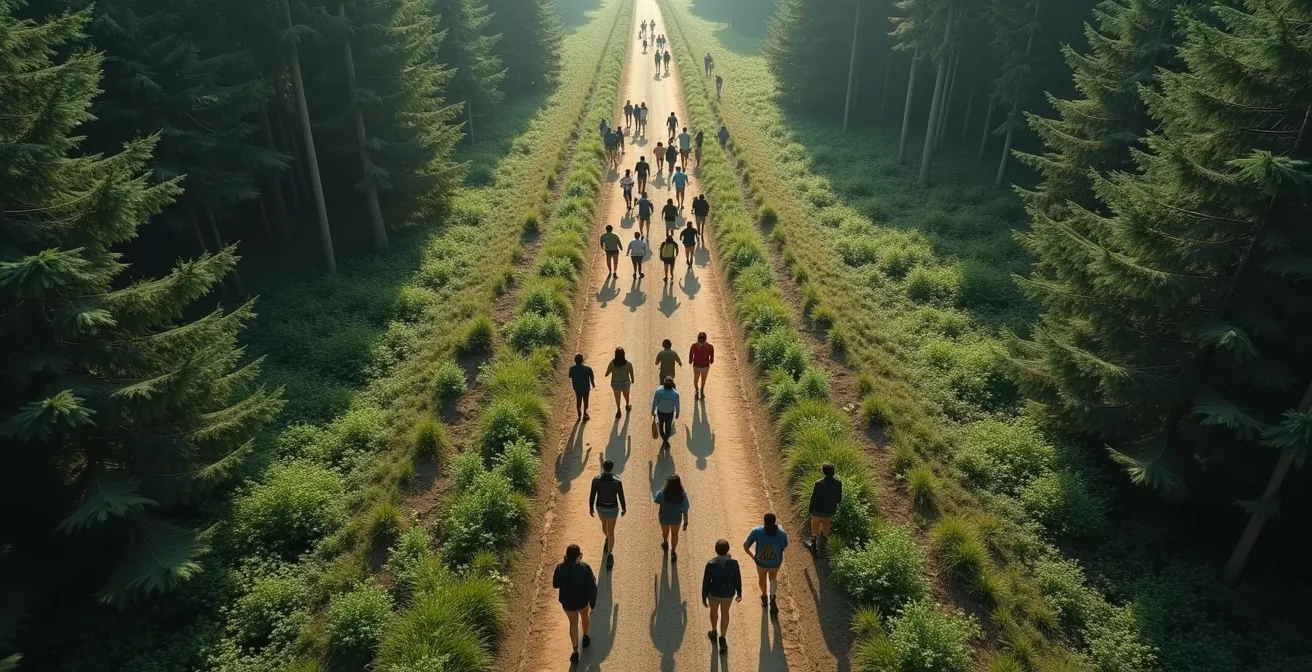
Every individual moving through a natural space creates a “bubble” of disturbance. This includes the snap of a twig underfoot, the swish of a synthetic jacket, a cough, or a sudden movement. In a large group, these individual bubbles merge and multiply, creating a massive wave of sound and motion that travels far ahead, alerting every creature to your presence long before you are in visual range. A small group, however, can sync their movements, walk in a tighter formation, and communicate with hand signals. This dramatically shrinks the collective radius of disturbance, allowing the group to move within the ecosystem rather than crashing through it.
This shows how a small, focused group can move almost silently, their disturbance radius minimal, allowing them to approach wildlife undetected. In contrast, a larger group creates a wide, chaotic zone of noise and movement that effectively scares everything away.
Furthermore, a smaller group can maintain a shared “sensory bubble.” The guide can easily signal a stop, point to a subtle sign, and have everyone’s attention focused on the same point in an instant. In a large group, information transmission is slow and chaotic. By the time a message from the front reaches the back, the opportunity is often lost. A guide might use binoculars with a wider field of view, like 7x or 8x magnification, which are perfect for quickly scanning the environment and sharing a sighting with a compact group, a task that becomes impossible with a spread-out crowd.
Ultimately, a small group becomes a focused, single-minded tracking unit, while a large group devolves into a collection of individual disturbances.
Day or Night: When is the jungle truly alive with activity?
Many novice nature enthusiasts make the mistake of planning their treks for midday, assuming that the best light equals the best viewing. A local guide knows that the jungle’s pulse beats strongest in the liminal hours of dawn and dusk. This period, known as the crepuscular window, is when the ecosystem undergoes a dramatic shift change. Diurnal (day-active) animals are finishing their foraging, while nocturnal (night-active) creatures are just beginning to stir. This transition creates a flurry of activity that is largely absent during the heat and stillness of noon.
As a general rule, wildlife is most active in the early morning and late evening hours. This is driven by several factors. Cooler temperatures allow animals to move without overheating. The low light provides cover from predators, emboldening more timid species to venture into the open. For many animals, these are the primary times for feeding, defending territory, and engaging in social or mating behaviors. A guide will structure the entire day around being in the most promising habitat precisely during these peak hours.
As the experts at Nature Mentor wisely advise, timing is a variable you can control:
Animals tend to be most active at dawn & dusk. If you usually go into the woods at the same time every day… you might have better luck by switching to a different time. Try getting out there an hour earlier, or an hour later.
– Nature Mentor Wildlife Experts, How To See Animals: Easy Wildlife Viewing Techniques
This table illustrates how different species dominate different times of the day, showing why a guide prioritizes the dawn and dusk periods for the highest probability of diverse sightings.
| Time Period | Active Species | Activity Level | Best For Viewing |
|---|---|---|---|
| Dawn (5-7 AM) | Birds, deer, primates | Very High | Feeding, territorial displays |
| Midday (12-2 PM) | Reptiles, some insects | Low | Basking behaviors |
| Dusk (5-7 PM) | Bats, nocturnal mammals emerging | Very High | Transition activities |
| Night (9 PM-3 AM) | Owls, frogs, nocturnal mammals | High | Hunting, vocalizations |
Ignoring this natural rhythm is like showing up to a concert after the band has already left the stage. A guide ensures you have a front-row seat for the main event.
The clothing error that scares away birds before you even see them
One of the most overlooked aspects of wildlife observation is also one of the most critical: your clothing. We tend to choose outdoor wear for comfort and durability, but a guide knows that your choice of fabric and color can be the difference between a spectacular sighting and a fleeting glimpse of a disappearing tail. The most common mistake is wearing bright colors, but the science behind why this is a problem is more fascinating than you might think, especially concerning birds.
Many birds have tetrachromatic vision, meaning they can see ultraviolet (UV) light, a spectrum invisible to humans. Modern detergents often contain UV brighteners to make clothes appear “whiter and brighter” to our eyes. To a bird, these fabrics don’t just look bright; they glow with an unnatural, alarming intensity. You might as well be wearing a neon sign. Evidence suggests you’re more likely to see wildlife if you stay hidden by choosing muted, natural tones that blend with the environment, as birds can spot these artificially brightened materials from great distances.
Beyond color, the sound your clothing makes is equally important. Stiff, synthetic fabrics like nylon can create a constant “swish-swish” sound as you walk, a repetitive, unnatural noise that cuts through the forest’s soundscape. A guide will always opt for softer materials like fleece or wool that move silently. The goal is to break up your human silhouette and sound profile. Here are key considerations for wildlife-friendly attire:
- UV-Free Detergent: Wash your field clothes in detergents specifically made without UV brightening agents.
- Silent Fabrics: Choose soft-faced materials that don’t produce friction noise when you move.
- Earth Tones: Select muted greens, browns, and grays that match the specific habitat you’ll be in.
- Matte Materials: Avoid anything with a sheen. Shiny zippers, buttons, or even camera equipment can catch the light and create a flash that will startle animals.
- Broken Patterns: While not essential, camouflage patterns work because they break up the solid, recognizable outline of the human form.
Dressing appropriately isn’t just about personal comfort; it’s a fundamental sign of respect for the environment and its inhabitants, allowing you to observe their world without disrupting it.
How to enter a tribal village with a guide without being intrusive?
A guide’s expertise often extends beyond the natural world and into the complex realm of human culture. For many travelers, visiting a remote tribal village is a powerful experience, but it walks a fine line between respectful cultural exchange and intrusive tourism. Doing so without a guide who has an established relationship with the community is not only unwise but can be deeply disrespectful. A professional guide acts as a crucial cultural bridge, ensuring the encounter is based on mutual consent and understanding.
The guide’s most important role begins long before you arrive. They engage in a “Cultural Bridge Protocol,” which involves pre-briefing both sides. They will have already communicated with the village elders, explaining who is visiting, the purpose of the visit, and ensuring the community consents to the interaction on that specific day. This transforms the encounter from a surprise intrusion into an anticipated, structured exchange. Concurrently, the guide briefs the visitors on the specific cultural protocols: how to greet people, what topics are taboo, whether photography is permitted, and where it is acceptable to walk.
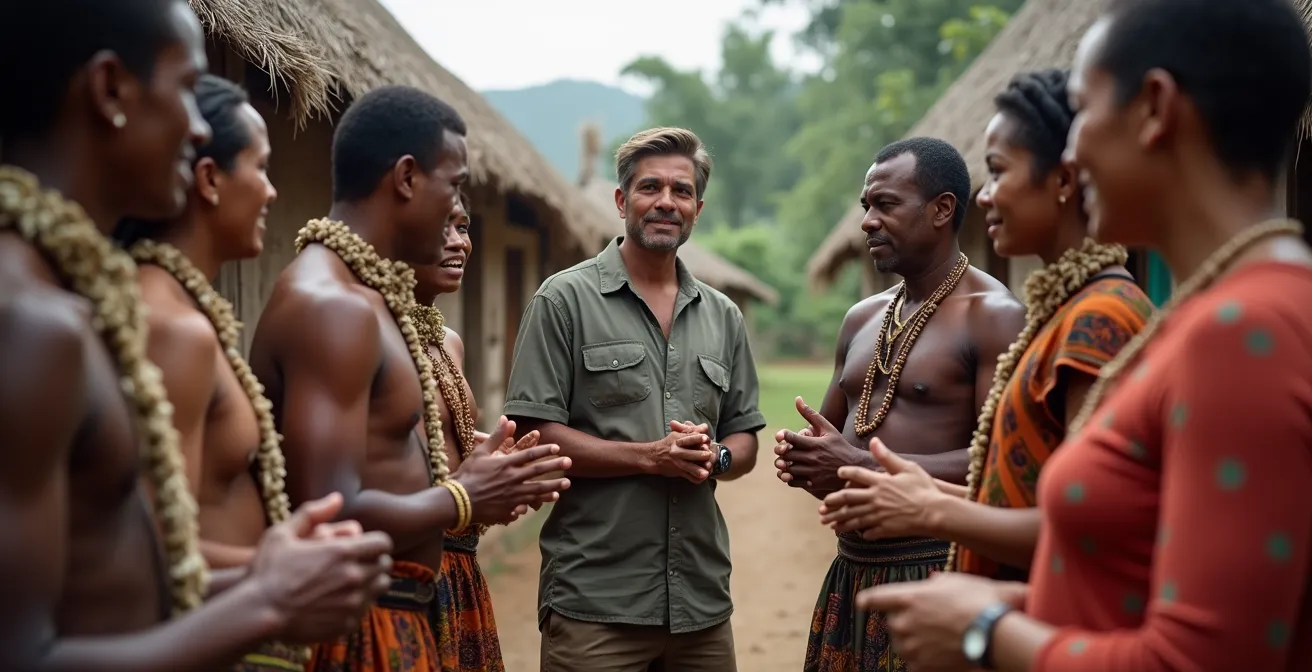
A guide facilitates a respectful exchange, acting as a bridge between visitors and a local community, ensuring interactions are based on mutual understanding and clear boundaries.
This structured approach prevents countless faux pas. For example, in some cultures, pointing with a finger is offensive, while in others, handing an object with the left hand is an insult. A guide navigates these nuances seamlessly. They often facilitate interaction not through direct translation, but by initiating shared activities—perhaps observing a craft or helping with a simple task. This creates a more authentic connection than the transactional feeling of simply watching people as if they are exhibits. The guide’s presence shifts the dynamic from “us watching them” to a shared human moment, however brief.
Without this bridge, a well-intentioned visit can easily become a negative experience for the hosts, reinforcing the importance of a guide who values the community as much as the wildlife.
What are the 3 plants you must never touch while clearing a path?
A guide’s deep knowledge of the local ecosystem includes a crucial, life-saving library of what *not* to touch. While trekking, the instinct can be to push aside any vegetation blocking the way. This is a dangerous habit, as many harmless-looking plants can cause severe reactions. A guide’s ability to instantly differentiate between a benign plant and its toxic lookalike is a skill honed over years of experience. They know which plants are merely irritants and which pose a genuine threat.
This knowledge is not just academic; it’s a practical, constantly applied layer of safety. The difference between two plants can be as subtle as the color of their berries or the arrangement of their leaves, yet the consequence of a mistake can range from a painful rash to a medical emergency. For example, the Manchineel tree of the American tropics is so toxic that even standing beneath it during a rain shower can cause severe skin burns from the dripping water. A local guide knows not only to avoid it but also the cultural taboos surrounding it, understanding its role in the local ecology and folklore.
Knowing what to avoid is as important as knowing what to look for. Here are three critical examples of dangerous plants that a guide would steer you clear of, demonstrating the importance of expert identification.
Your Action Plan: Identifying Key Dangerous Plants
- The Manchineel Tree: Often called the ‘tree of death’, every part of it is extremely toxic. Found in the Caribbean and Americas, contact with its milky sap causes severe blistering, and even inhaling smoke from its burning wood can cause temporary blindness. It is a prime example of a ‘look but never touch’ organism.
- The Stinging Tree (Dendrocnide species): Found in Australia and Southeast Asia, this plant looks deceptively like a harmless broadleaf shrub. Its leaves and stems are covered in microscopic, silica-tipped hairs that inject a powerful neurotoxin upon contact, causing excruciating pain that can last for months.
- Giant Hogweed: This invasive plant can be confused with the benign Queen Anne’s Lace. However, its sap is phototoxic. If the sap gets on your skin and is then exposed to sunlight, it causes severe, third-degree burns and painful blisters that can leave permanent scars.
This is not about fear, but about respect. A guide’s expertise provides the freedom to move confidently through the environment, knowing that an expert is managing these unseen risks.
How to turn a snorkeling trip into a marine biology lesson without them knowing?
A great guide is, above all, a master storyteller. This skill is never more apparent than during an activity like snorkeling. A novice might simply point out fish, naming species: “That’s a parrotfish. That’s a triggerfish.” An expert guide, however, transforms the experience from a “what is that?” exercise into a “what is that *doing*?” narrative. They weave the individual sightings into a compelling story about the ecosystem, turning the coral reef into a bustling underwater city full of characters, drama, and intrigue.
As the Marine Biology Education Network states, the focus should be on behavior:
Great guides shift focus from ‘what is that fish’ to ‘what is that fish doing?’ – pointing out symbiotic relationships, predator-prey dynamics, and competitive behaviors teaches ecological principles through observation.
– Marine Biology Education Network, Best Practices in Marine Environmental Education
This narrative approach makes complex ecological concepts accessible and memorable. Instead of a dry lecture on herbivory, the guide paints a picture of the parrotfish as the “relentless gardeners of the reef,” whose constant munching on algae keeps the coral healthy and whose excretions literally create the white sand beaches we enjoy. The tiny cleaner wrasse is no longer just a small fish, but the proprietor of the reef’s “day spa,” a critical service station that all the bigger fish line up for. Suddenly, you’re not just watching fish; you’re witnessing a complex social and economic system in action.
Case Study: The “Coral Reef Soap Opera” Method
Guides using this technique create simple, compelling narratives to explain complex interactions. They might describe two territorial damselfish as “feuding neighbors constantly fighting over their patch of algae farm.” A moray eel and a grouper hunting together become an “unlikely team of collaborators,” each using their unique skills to trap prey. By framing these behaviors in relatable, human-like terms—a ‘soap opera’ of alliances, rivalries, and daily jobs—guides make the science of marine biology stick. Guests leave not just having seen pretty fish, but with a genuine understanding of the reef’s delicate interconnectedness.
This is the guide’s ultimate skill: to educate without lecturing, to inspire awe, and to leave you with a profound sense of connection to a world you’ve only just visited.
Key takeaways
- True wildlife spotting is not about luck; it’s about reading the subtle language of the environment—the “disturbance patterns” that signal recent animal activity.
- Your effectiveness is inversely proportional to your group’s size. Small, quiet groups minimize their disturbance radius and maximize their sensory awareness.
- Timing is a critical, non-negotiable tool. The crepuscular hours of dawn and dusk are when the ecosystem is most alive and visible.
How to Prevent Blisters on Multi-Day Treks with Wet Feet?
While the skills of tracking and observation are glorious, none of them are possible if you are hobbled by pain. On a multi-day trek, especially in a wet or humid environment, your feet are your most critical asset and your greatest vulnerability. A blister might seem like a minor inconvenience, but it can quickly become a debilitating injury that ends an expedition. An experienced guide knows that blister prevention is not a reaction, but a proactive protocol that begins before the first step is even taken.
The enemy is a combination of three things: moisture, heat, and friction. Wet socks soften the skin, making it far more susceptible to tearing. A guide’s foot care strategy is therefore obsessed with moisture management and friction reduction. This goes far beyond just “wearing good boots.” It involves a multi-layered system that anticipates problems before they begin. For instance, professional guides report that preventive taping is remarkably effective; some studies suggest that pre-taping reduces blister formation by 90% on long treks by creating a protective second skin over known hotspots like heels and toes.
This is a non-negotiable daily ritual, not an emergency measure. A guide will insist on a disciplined routine at the end of each day’s hike: boots and socks off immediately, feet washed and meticulously dried, and any “hot spots”—areas of redness or tenderness—treated instantly before they can develop into full-blown blisters. This disciplined self-care is the unglamorous foundation upon which all great wilderness adventures are built. A guide’s professional protocol typically includes:
- Pre-Taping: Applying durable zinc oxide tape or moleskin to known friction areas *before* the hike starts.
- Lubrication: Using an anti-chafe balm or simple petroleum jelly on the feet to reduce friction.
- The Two-Sock System: Wearing a thin, synthetic liner sock that wicks moisture away from the skin, underneath a thicker wool or wool-blend outer sock that provides cushioning.
- Camp Foot Care: Immediately removing boots and socks upon reaching camp to allow feet to air out. Washing and thoroughly drying them is mandatory.
- Instant Treatment: Addressing any “hot spot” the moment it’s felt by stopping and applying tape or a blister pad. Ignoring it is not an option.
Ultimately, a guide ensures you can remain focused on the wonders around you, rather than the pain beneath you. This foundational care is the silent, essential skill that makes everything else possible.