
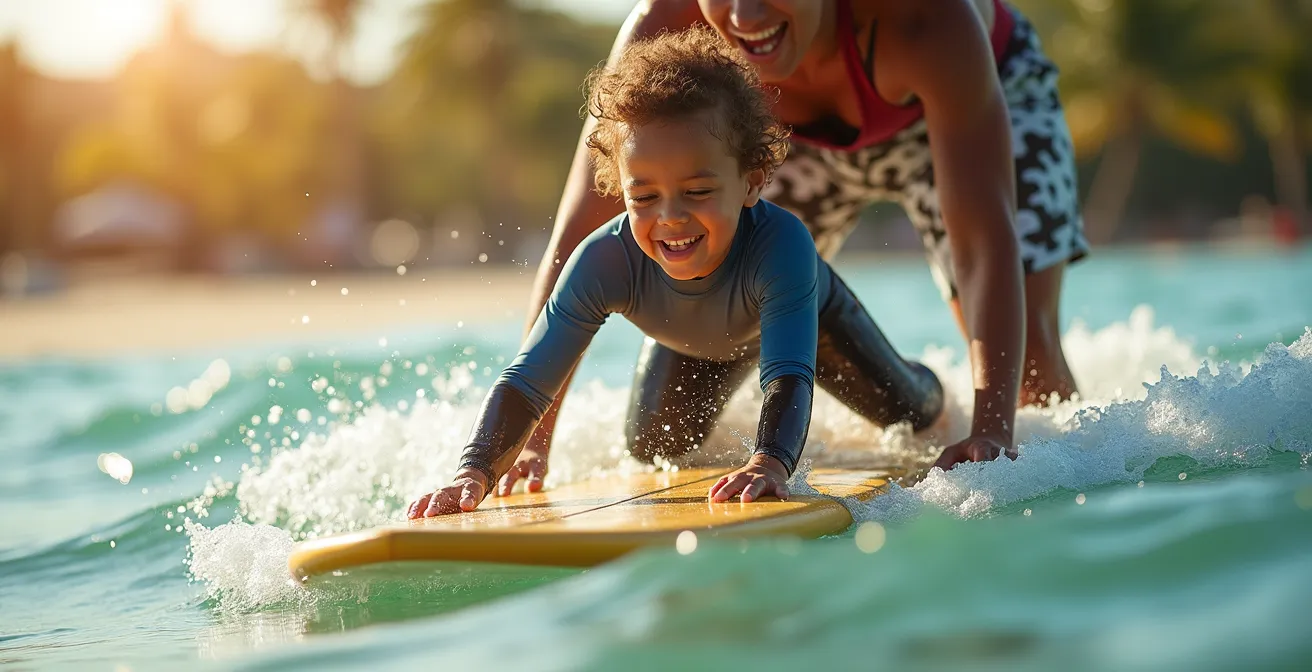
Vacation sports coaching is not about creating elite athletes; it is a powerful, focused strategy for building deep, transferable confidence in your child.
- It establishes a safe environment to practice resilience through structured failure, teaching children to recover from setbacks.
- The right coach acts as a mentor who shifts a child’s focus from external results to an “internal scorecard” of effort and progress.
Recommendation: When choosing a program, look beyond the sport itself and select a coaching experience based on its potential to develop your child’s character and mental fortitude.
As a parent, you want to see your child succeed, but more than that, you want to see them become resilient, disciplined, and self-assured. We often enroll them in local sports leagues hoping for this outcome, but the long seasons, social pressures, and focus on winning can sometimes have the opposite effect. The common advice is to simply “find a good sport” or “make sure they have fun,” but these ideas barely scratch the surface of true character development.
What if the most impactful environment for building confidence wasn’t the year-long local league, but a short, intensive coaching experience during a vacation? The unique context of being away from home, in a new environment, and with a professional mentor offers a rare opportunity. It’s a chance to intentionally build what I call the “resilience muscle”—the ability to fall, analyze, and get back up with more determination than before. This isn’t about escaping pressure; it’s about learning to handle it in a controlled, supportive setting.
This article moves beyond the simple idea that “sports are good for kids.” We will explore the specific mechanisms that make professional vacation coaching a transformative tool for building your child’s inner strength. We will break down how to identify a truly empowering coach, understand the dynamics of failure and success, and, most importantly, how to help your child transfer these newfound mental skills from the playing field back to their daily life, including their schoolwork.
This guide will walk you through the key elements that turn a simple sports lesson into a profound lesson in confidence. We will cover everything from the psychology of learning to the practical steps you can take to ensure the experience has a lasting impact.
Summary: A Parent’s Guide to Building Confidence Through Sport
- Why falling down in a surf lesson teaches resilience better than a classroom?
- How to spot a coach who empowers kids vs. one who just barks orders?
- Private or Group: Which format builds better social skills for shy children?
- The “Stage Parent” mistake that makes kids hate the sport forever
- How to help your child apply the focus learned in archery to their homework?
- How to verify if “included lessons” are taught by certified pros or interns?
- Why hesitating mid-jump causes 90% of heavy crashes?
- How to Maintain Muscle Mass While Traveling for Business?
Why falling down in a surf lesson teaches resilience better than a classroom?
A classroom teaches theory, but a surfboard teaches reality. When a child learns to surf, they are not just learning to balance; they are enrolling in a masterclass on resilience. Every wave that knocks them down is a low-stakes failure—a practical, immediate test of their resolve. There is no grade, no judgment from peers in the same way, just the salt water and the desire to try again. This creates a powerful competence loop: try, fail, learn, adjust, and try again. Each “wipeout” becomes a data point, not a defeat. This is where the “resilience muscle” gets its first real workout.
Unlike a failed math test, which can feel abstract and discouraging, the feedback in surfing is physical and instantaneous. The child feels the reason for the fall—a foot misplaced, a moment of hesitation. A great coach helps them decode this feedback, turning frustration into strategy. This process builds an internal scorecard, where the child starts measuring success not by how long they stand up, but by how quickly and intelligently they get back on the board. They learn that progress isn’t a straight line but a series of adjustments.
This type of learning is fundamentally different from academic settings. It bypasses the fear of being “wrong” and instead celebrates the effort of “trying.” The joy isn’t just in the eventual successful ride; it’s in the small victories along the way—paddling stronger, popping up faster, reading a wave better. This environment, where falling is an expected and even necessary part of the process, teaches a profound lesson: that failure is not the opposite of success, but an integral part of it.
How to spot a coach who empowers kids vs. one who just barks orders?
The single most important factor in a positive sports experience is the coach. A coach who simply barks orders creates a performance-based environment where a child fears making mistakes. An empowering coach, however, creates a psychological safety net, where a child feels safe to try, to fail, and to be vulnerable. The difference is stark and visible. An empowering coach kneels to make eye contact. They ask open-ended questions like, “What did that feel like?” or “What do you think you could try differently?” instead of issuing commands like, “Do this.” They are building autonomy, not obedience.
This distinction is not just a matter of feeling good; it directly impacts development. An empowering coach focuses on what youth development experts call an autonomy-supportive style. They provide choices, offer a rationale for tasks, and acknowledge the athlete’s feelings. This approach nurtures intrinsic motivation, optimism, and resilience.
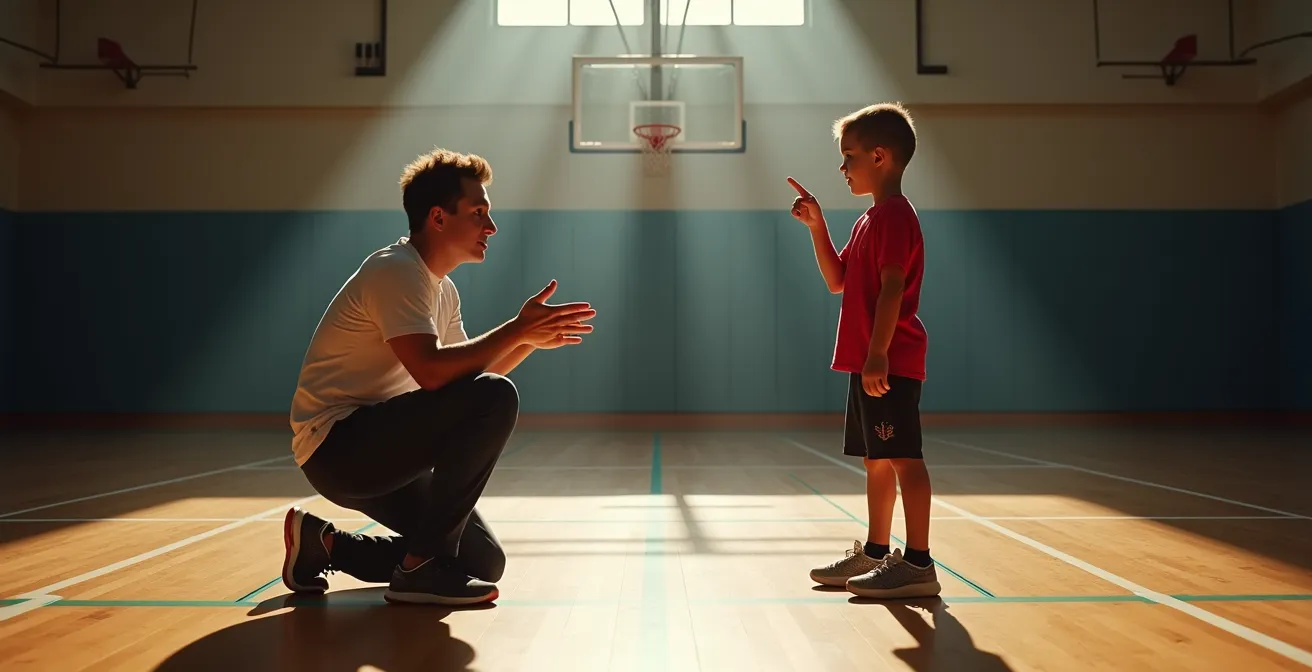
Observe the coach’s language. A commanding coach uses judgmental words: “That was wrong,” “Don’t do that.” An empowering coach uses descriptive, effort-based language: “I saw how hard you were paddling on that wave,” or “Your focus on your breathing that time was excellent.” They are separating the child’s effort (which is always praiseworthy) from the outcome (which is a variable). This teaches the child to value their own hard work, building a robust self-esteem that isn’t dependent on external validation.
Case Study: The Power of Autonomy-Supportive Coaching
A landmark 2024 study of 325 youth athletes found a clear link between autonomy-supportive coaching and enhanced development. The research demonstrated that when coaches satisfy an athlete’s fundamental psychological needs for autonomy and competence, it creates a powerful pathway to building resilience and optimism. This style of coaching doesn’t just improve skills; it builds the mental framework for long-term confidence and sustained engagement in sports.
Private or Group: Which format builds better social skills for shy children?
The choice between private and group lessons for a shy child is a classic dilemma. The instinctive choice for many parents is private lessons, assuming the one-on-one attention will create a safer, less intimidating environment. While this is true for initial comfort and rapid technical skill acquisition, it completely bypasses the opportunity to develop crucial social skills. Group lessons, on the other hand, can feel overwhelming and may cause a shy child to retreat further. So, what is the answer? It’s not an either/or question. As coaching professionals, we recommend a “scaffolding approach.”
This strategy involves starting with a private lesson to build a baseline of skills and, more importantly, a trusting relationship with the coach. This initial session builds what we call “skill confidence.” Once the child feels competent in the basic mechanics of the sport, they are less anxious about performing in front of others. The coach can then transition them into a small, carefully selected group. This provides progressive social exposure in a controlled environment, allowing them to practice collaboration, turn-taking, and peer encouragement without feeling thrown into the deep end.
As Sport England’s research highlights, enjoyment is the single biggest driver of participation. A child forced into a stressful social situation will not enjoy it, no matter how much they like the sport itself. According to their findings in the “Play Their Way” coaching philosophy:
Sport England’s research has found that enjoying activities is the biggest driver of participation among children.
– Sport England, Play Their Way – Coaching Philosophy
The scaffolding approach prioritizes that enjoyment while still pushing the child’s boundaries gently. It uses skill confidence as a bridge to social confidence. The table below outlines how these formats serve different goals, and how a blended approach can offer the best of both worlds.
| Aspect | Private Lessons | Group Lessons | Scaffolding Approach |
|---|---|---|---|
| Initial Comfort | High – one-on-one attention | Low – peer pressure | Start private, transition to small group |
| Skill Development | Faster technical progress | Varied pace | Build baseline skills first |
| Social Skills | Adult interaction only | Peer collaboration | Progressive social exposure |
| Cost | Higher per session | More affordable | Mixed investment |
| Confidence Building | Safe environment | Real-world practice | Graduated challenges |
The “Stage Parent” mistake that makes kids hate the sport forever
The car ride home after a lesson or game is one of the most critical moments in a child’s athletic development, and it’s where many well-intentioned parents make a devastating mistake. The dreaded question, “Did you win?” or “Why did you miss that shot?” immediately shifts the focus to external outcomes. It turns a developmental experience into a performance review, creating pressure and anxiety. This pressure is a primary reason why an alarming 70% of kids quit organized sports by age 13. They burn out not from the sport, but from the weight of expectations.
The “Stage Parent” isn’t necessarily a loud, aggressive figure on the sidelines. It can also be the parent who is overly invested, who analyzes every play, and whose mood is visibly tied to their child’s performance. This behavior sends a clear message: “My love or approval is conditional on your success.” It undermines the very confidence you are trying to build by teaching your child that their worth is tied to their achievements. It sabotages the coach’s efforts to build an internal scorecard by constantly reinforcing an external one.

The antidote is to consciously shift your role from evaluator to supporter. Your job is not to be a second coach; it’s to be a safe harbor. This means changing the conversation entirely. Instead of asking about the score or the mistakes, ask about their experience. By focusing on their feelings and effort, you reinforce the idea that their intrinsic experience is what truly matters. Here are a few powerful, alternative questions to ask:
- What was the most fun part of today’s lesson?
- What felt different in your body when you tried that new technique?
- Which sensation was the trickiest to manage today?
- What made you smile during practice?
- What would you like to try again next time?
These questions open a dialogue about the process of learning, not the pressure of performing. They show your child you are interested in them, not just their athletic accomplishments. This is how you protect their love for the sport and allow their confidence to grow organically.
How to help your child apply the focus learned in archery to their homework?
The intense focus required in a sport like archery—where breathing, posture, and mental stillness are paramount—is a powerful skill. However, that skill often remains locked within the context of the sport. The real parenting win is helping your child achieve “focus transfer”—the conscious application of that mental discipline to other areas of life, like a daunting math worksheet. This doesn’t happen by accident; it requires a deliberate strategy of bridging the two worlds.
First, you must help your child become aware of their own mental state. Talk to them about the *feeling* of focus in archery. What do they do right before a shot? They get quiet, they control their breathing, they block out distractions. Help them create a “homework prep ritual” that mimics their pre-shot routine. This could be as simple as taking three deep, slow breaths—just like they do before drawing the bow—before starting the first problem. This ritual acts as a mental trigger, signaling to their brain that it’s time to enter a state of concentration.
A powerful method for building this transferable confidence is the ESP Technique, which helps children recognize their own capabilities across different domains. It’s a simple but effective tool for reflection.
Case Study: The ESP Technique for Transferable Confidence
Developed by Dr. Zinsser at West Point, the ESP (Effort, Success, Progress) Technique is a mental tool to build self-confidence. As confirmed by Dr. Caringi of University Hospitals, it is highly effective for both athletics and academics. After a session (of sports or homework), you guide your child to identify one example of good Effort (“I kept trying even when it was hard”), one Success (“I solved that one problem by myself”), and one area of Progress (“This felt easier than last time”). This reflection, detailed in resources like those from leading sports psychology experts, teaches children to build their own confidence from within, making it a skill they can apply anywhere.
Using sports metaphors can also be effective. Frame homework as a series of targets. “One arrow, one math problem.” The goal isn’t to hit a bullseye every time, but to execute the process—aim, breathe, release—with focus for each individual task. By making these connections explicit, you are teaching your child that focus is not something that happens *to* them, but a tool they can choose to wield in any challenge they face.
How to verify if “included lessons” are taught by certified pros or interns?
Many vacation packages or resorts advertise “included sports lessons,” but the quality of this instruction can vary dramatically. You may be picturing a seasoned professional, but your child could end up with an enthusiastic but untrained summer intern. Ensuring the coach is qualified is not just about getting your money’s worth; it’s about your child’s safety and the quality of their developmental experience. Parents inherently understand this; according to the Aspen Institute’s 2024 State of Play report, an overwhelming 94% of parents prioritize coaches who have passed background checks, and 83% want coaches who are well-trained in skills and safety.
So, how do you verify the quality of a coach before you book? You must be willing to ask direct and specific questions. Vague assurances like “our coaches are great with kids” are not enough. A professional organization will be transparent and proud of their staff’s credentials. Don’t be afraid to dig deeper. Ask about their hiring process, their training protocols, and their experience with children in your child’s specific age group. A top-tier program will have this information readily available.
Your goal is to confirm expertise in three areas: technical skill in the sport, child safety certification, and experience with your child’s specific needs (e.g., shyness, anxiety, or a physical disability). A “certified pro” has credentials in all three. An intern may only have the first, if that. Use the following checklist to guide your inquiries and ensure you are entrusting your child to a true professional.
Your Coach Verification Checklist
- Request Specific Certifications: Ask for child-protection certifications (like SafeSport in the U.S.) in addition to technical sport-specific qualifications.
- Confirm Coach-to-Child Ratio: Inquire about the exact ratio for your child’s specific age group, as this is a key indicator of safety and individual attention.
- Check Independent Reviews: Search for the school or resort on platforms like Google Maps and read reviews that mention individual coaches by name.
- Inquire About Specialized Experience: Ask directly about their experience coaching children with specific needs, such as anxiety, ADHD, or shyness.
- Verify Mental and Physical Health Training: Ask if coaches receive mental health first-aid training and if the facility has critical safety equipment like automatic external defibrillators (AEDs) on-site.
Why hesitating mid-jump causes 90% of heavy crashes?
In sports like skiing, snowboarding, or even diving, there is a moment of truth: the commitment to the jump. Hesitation in that split-second—a slight pullback, a moment of doubt—is what causes the most severe falls. This isn’t just physics; it’s psychology. A committed body is aligned, strong, and prepared for impact. A hesitant body is conflicted, unbalanced, and vulnerable. This physical reality serves as a powerful metaphor for building confidence: full commitment is safer than partial commitment.
A vacation coaching environment is the perfect laboratory to learn this lesson. The jumps are smaller, the risks are managed, and the coach is there to guide the child through the fear. They teach the child to visualize success and to execute the plan without second-guessing. They learn to trust their preparation and commit to the action. This teaches them to manage the internal monologue of fear and replace it with a focus on execution. When they land a jump they were afraid of, the surge of confidence is immense. They didn’t just perform a trick; they conquered a fear.
This process is central to building true resilience. As experts in youth sports point out, these experiences in a safe, controlled environment are invaluable.
The Structure of Sport as a Resilience-Builder
As outlined by organizations like Thrive Gym, the very structure of sport forces participants to practice resilience. It’s not a question of ‘if’ a child will miss a shot or make a mistake, but ‘when’. These inevitable setbacks, paired with the joy of learning a new skill and the deep satisfaction of progress, provide children with critical opportunities to navigate a wide range of emotions. Sport provides a safe container for these big feelings, allowing a child to experience and overcome frustration, disappointment, and fear in a low-stakes context, building the emotional regulation skills needed for life.
However, this positive feedback loop only works with proper guidance. As the Aspen Institute notes, the system needs structure. This underscores the importance of not just any coaching, but high-quality, intentional coaching.
Behavior change comes from a feedback loop and the coaching field generally lacks accountability and people consistently coaching the coaches.
– Aspen Institute, State of Play 2024 – Coaching Trends
Key Takeaways
- True confidence is built from mastering the internal process of effort, failure, and recovery—not from external results like winning.
- An empowering coach is a mentor who asks questions and fosters autonomy, creating a psychological safety net for the child to take risks.
- The mental skills learned in a focused sports environment, like concentration and resilience, can and should be consciously transferred to academics and other life challenges.
Sustaining the Spark: Keeping the Momentum Going for the Whole Family
The vacation ends, but the work of building confidence doesn’t. The momentum gained during an intensive coaching week can quickly fade if it isn’t integrated into daily life back home. This final section, while seemingly about a parent’s personal discipline (like the title’s reference to maintaining muscle mass while traveling), is truly about a holistic, family-wide commitment to sustaining growth. As a parent, you are the primary role model. Your discipline, whether in your work, your health, or your own learning, sets the tone for the entire family. When your child sees you applying the same principles of focus and consistency that they learned on vacation, the lessons become deeply embedded.
Your child has just experienced a powerful “competence loop.” Your role now is to help them maintain it. This means continuing the conversation around the internal scorecard. Celebrate their effort in homework, their courage in trying something new at school, and their progress in their local sports league. The vocabulary of empowerment you learned to look for in a coach should now become part of your family’s language.
The goal is to create a home environment that champions a growth mindset. This means framing challenges as opportunities and reinforcing the idea that skills are built, not born. By scheduling continued practice, creating reminders of their vacation successes, and adopting the coach’s encouraging language, you build a bridge from that peak experience back to everyday reality. The following strategies will help you maintain the confidence gains your child made and turn a week-long lesson into a lifelong asset.
- Create a digital “Confidence Portfolio” with photos and video clips from the vacation coaching sessions.
- Schedule a local continuation of the sport within three weeks of returning to maintain skill momentum.
- Adopt the coach’s growth-mindset vocabulary (e.g., “I noticed how you…”) in daily family conversations.
- Set up regular “ESP reflection” sessions (Effort, Success, Progress) using vacation experiences as a reference point.
- Use powerful quotes from the vacation coach as daily affirmations for new challenges.
The next step is not just to plan another trip, but to invest in a transformative experience for your child. Start your search for a program and a coach that builds character first, knowing that with a strong inner foundation, skill and success will naturally follow.