
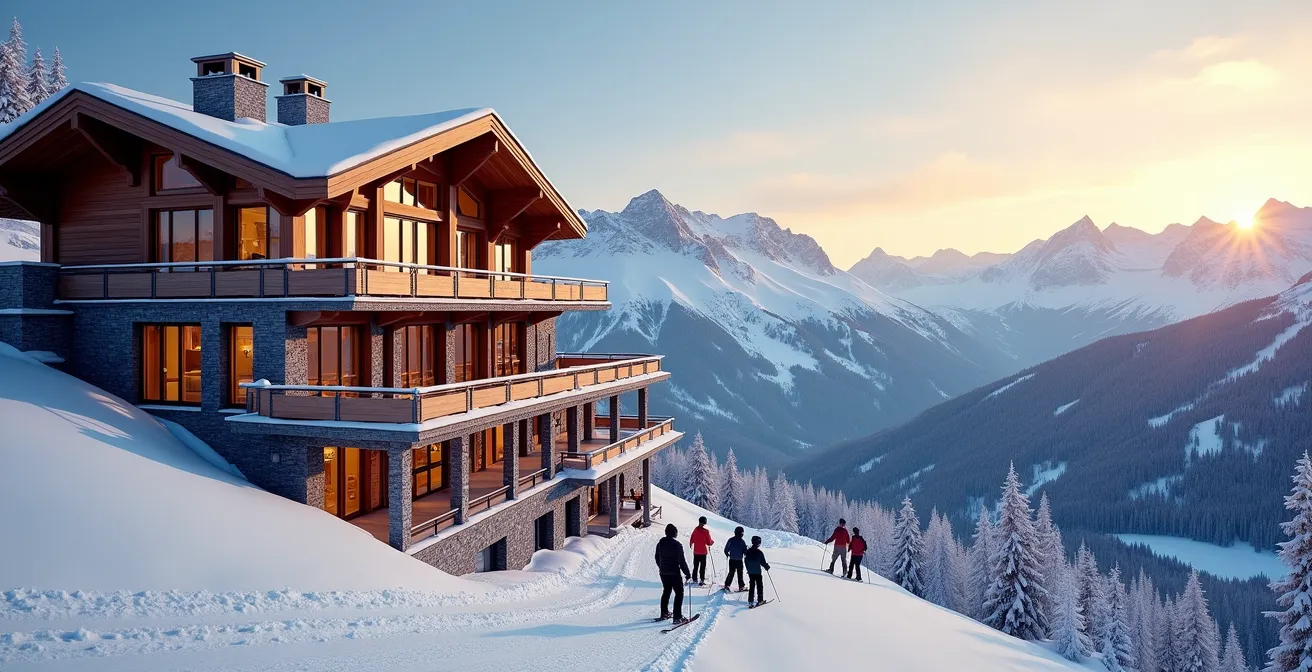
A fully-serviced luxury chalet functions as a high-performance operational base that manufactures time, transforming the group organizer from a stressed coordinator into an active participant.
- The true value lies not in opulence, but in an integrated service ecosystem (driver, chef, concierge) designed to eliminate logistical friction.
- This “cognitive offloading” saves quantifiable hours on planning, transport, and F&B, directly converting them into more time on the slopes or relaxing.
Recommendation: Shift your evaluation criteria from cost-per-night to the return on investment in experience, measuring value in reclaimed hours and stress-free group cohesion.
As the organizer of a significant group ski trip, whether for a multi-generational family reunion or a corporate retreat, your primary challenge extends far beyond finding a property with enough beds. The success of the trip hinges on seamless execution, and the largest drains on enjoyment are not the challenging black runs, but the countless moments of logistical friction: coordinating morning departures, navigating packed resort car parks, resolving mixed dietary needs for dinner, and managing the disparate energy levels of skiers and non-skiers.
The conventional approach focuses on the chalet’s physical attributes—its size, location, or view. While important, this perspective misses the most critical asset. The real question isn’t just “where will we stay?” but “how will we reclaim our time to actually enjoy the destination?” The endless planning, the daily micro-decisions, and the constant “what’s next?” questions from the group accumulate, placing an immense cognitive load on the organizer.
But what if the accommodation itself was the solution? The modern luxury chalet has evolved beyond a simple dwelling into a sophisticated service ecosystem. Its value is not in the thread count of the linens, but in its ability to systematically dismantle logistical hurdles. This guide reframes the luxury chalet not as an expense, but as a strategic investment in time and tranquility. We will deconstruct how each premium service—from the private driver to the in-house concierge—acts as a tool to save you hours of stress, offload your mental burden, and ultimately maximize the one thing everyone came for: the mountain experience.
This article explores the specific, quantifiable benefits of this service-led approach. We will examine how to leverage these integrated services to engineer a frictionless holiday, ensuring every member of your group, including you, can fully immerse themselves in the trip.
Summary: The Strategic Value of a Fully Serviced Chalet for Group Travel
- Why a chalet with a private driver saves 2 hours of stress per day?
- How to customize a chalet menu for a group with mixed dietary restrictions?
- Ski-in/Ski-out or Village Center: Which is better for non-skiers in the group?
- The amenity oversight that makes mornings miserable for the whole group
- When to secure your Christmas chalet to ensure you get the best view?
- Villa or Hotel: Which fosters better social connection for a reunion?
- How to move 4 bike boxes between hotels without lifting a finger?
- Why a Concierge Saves You 15 Hours of Logistics on Active Trips?
Why a chalet with a private driver saves 2 hours of stress per day?
For a large group, transportation is a primary source of daily logistical friction. The seemingly simple act of getting everyone to and from the slopes involves a cascade of time-consuming challenges. The morning rush to find parking in a crowded resort lot can easily consume 30 to 45 minutes, a period filled with stress before a single boot is buckled. A dedicated driver service entirely eliminates this pain point. Your group is dropped off directly at the lift base, transforming a frustrating search into a seamless transition onto the snow.
This service provides a level of flexibility that is impossible with self-driving. It decouples the group’s schedule, allowing for staggered departure times. The most avid skiers can be on the first lifts at 8 a.m., while families with young children can opt for a more relaxed 10 a.m. start, all without penalizing the others. This same flexibility applies throughout the day; a tired skier can discreetly return to the chalet for a rest without forcing the entire group to leave the mountain early.
The value extends into the evening. A private driver acts as an on-demand shuttle to restaurants and bars, removing the need for a designated driver and resolving the complex logistics of coordinating multiple taxis. This freedom to enjoy après-ski or a fine dining experience without transport worries adds another layer of relaxation. By removing the parking search, enabling flexible schedules, and simplifying evening plans, a private driver service doesn’t just offer convenience; it performs time arbitrage, buying back hours of potential stress and converting them directly into more valuable vacation time.
How to customize a chalet menu for a group with mixed dietary restrictions?
Mealtime with a large group can quickly become a logistical minefield. Catering to a mix of allergies, dietary preferences (vegan, gluten-free), children’s tastes, and even performance-oriented nutritional goals can turn every meal into a complex negotiation. A luxury chalet with a private chef transforms this potential stressor into a guaranteed highlight through a process of professional, pre-emptive planning. This is a prime example of cognitive offloading for the group organizer.
The process begins weeks, not hours, before your arrival. A professional chalet team initiates a bespoke menu consultation. This is a detailed discussion where the chef gathers information on every single guest’s needs and preferences. Based on this, a comprehensive menu proposal for the entire week is created and sent for your approval. This means that upon arrival, the daily question of “what’s for dinner?” is already answered, and every meal is designed to delight everyone without compromise.
This level of curation ensures that mealtimes are about connection and enjoyment, not problem-solving. It eliminates the risks of cross-contamination in an unfamiliar kitchen and saves the organizer from the daily mental load of checking ingredients or finding suitable restaurant options for every single member of the group. The private chef and host team manage everything from sourcing high-quality ingredients to service and cleanup, creating a private dining experience that rivals a top restaurant, night after night.
Case Study: The Bespoke Menu Consultation Process
Many top-tier properties now include this service as standard. According to the experts at Ski In Luxury, the detailed consultation process is key. By creating and agreeing on a week-long menu in advance that accommodates all dietary requirements, from severe allergies to specific wellness goals, the chalet team transforms mealtimes from a logistical challenge into a seamless and highly anticipated part of the vacation experience.

The result is a service that goes beyond mere cooking. It’s a fully integrated culinary program that anticipates needs, removes decision fatigue, and ensures that the dining table is a place of shared pleasure rather than a source of organizational anxiety.
Ski-in/Ski-out or Village Center: Which is better for non-skiers in the group?
One of the classic dilemmas for a group with mixed interests is choosing the right location. A ski-in/ski-out chalet offers unparalleled convenience for avid skiers but can feel isolating for non-skiers who wish to explore the village’s shops, cafes, and activities. Conversely, a village-center property provides immediate access to amenities but forces skiers to deal with daily transport to the slopes. For a luxury chalet, however, this is often a false choice. The right answer is to have both, made possible by the integrated service ecosystem.
For a luxury chalet, this is a false choice. The combination of a private driver and concierge means a group can enjoy the privacy, views, and immediate ski access of a secluded ski-in/ski-out location while non-skiers have on-demand chauffeur service to the village center.
– Ultimate Luxury Chalets, Ultimate Luxury Chalets Portfolio Guide
The optimal solution for most high-end groups is a private, ski-in/ski-out chalet complemented by a full-time driver service. This configuration delivers the best of all worlds. Skiers enjoy the ultimate luxury of clicking into their skis right at the door. Meanwhile, non-skiers are not stranded; they have a chauffeur at their disposal to take them to the village for a morning of shopping, a spa appointment, or a leisurely lunch. This on-demand access completely negates the traditional downside of a secluded location.
This approach also enhances group cohesion. The chalet remains the central hub, making it easy for skiers to return midday for lunch with the non-skiers before heading out for the afternoon. In a hotel or a village-center apartment, the group is more likely to fragment, with skiers and non-skiers operating in entirely different locations all day. The right combination of location and service allows for both independence and easy reconnection.
This table breaks down how the addition of a private driver fundamentally changes the value equation of the chalet’s location.
| Aspect | Ski-in/Ski-out Chalet | Village Center Chalet |
|---|---|---|
| Skier Convenience | Maximum – Direct slope access | Moderate – Requires transport |
| Non-Skier Activities | Limited without transport | Immediate access to shops/cafes |
| With Private Driver Service | Best of both – Privacy + village access on demand | Good but less slope convenience |
| Group Cohesion | Excellent – Easy midday meet-ups | Challenging – Group splits by location |
| In-Chalet Amenities Value | Critical for non-skiers | Nice-to-have supplement |
Ultimately, a luxury service layer makes the location debate less about compromise and more about optimization. You can select a chalet for its privacy, views, and ski access, confident that the village remains effortlessly accessible for everyone in the group, as demonstrated by this comparative analysis from chalet experts.
The amenity oversight that makes mornings miserable for the whole group
A successful group ski day is built on a smooth, stress-free morning. Yet, this is precisely where many trips falter due to seemingly minor amenity oversights that create significant logistical friction. The difference between a joyful start and a miserable one often lies in a few critical, non-negotiable features designed to handle the scale and needs of a large group. A high-end chalet anticipates these choke points and engineers solutions directly into its design and service.
The single most common point of failure is gear preparation. A pile of cold, damp boots and gloves is a guaranteed way to start the day on a negative note. A properly specified heated boot room is therefore not a luxury, but a necessity. This means individual boot and glove warmers for every single guest, ensuring everyone starts the day with warm, dry equipment. It eliminates the morning scramble and the misery of putting on yesterday’s damp gear.

The second major bottleneck is breakfast and coffee. A single consumer-grade coffee machine for a group of 12 or more creates queues and frustration. A premium chalet addresses this with multiple professional-grade coffee machines and, crucially, a staffed breakfast service. This ensures that everyone can have their preferred coffee and a hot breakfast on their own schedule, without waiting in line. Similarly, having en-suite bathrooms for nearly every bedroom removes the need for a “shower schedule,” another common source of group friction.
Finally, information chaos can derail a morning. A simple, professionally managed briefing board displaying the day’s weather, lift status, agreed departure times, and the day’s plan reduces repetitive questions and ensures everyone is on the same page. These details—warm boots, on-demand coffee, private bathrooms, and clear communication—are the invisible engines of a perfect ski day.
Your Audit Checklist: Engineering a Frictionless Morning
- Heated Boot Room: Confirm there is a dedicated, heated boot room with enough individual boot and glove warming stations for every guest.
- Breakfast Service: Verify the presence of multiple, professional-grade coffee machines and a staffed breakfast service to prevent morning queues.
- Bathroom Ratio: Ensure a high ratio of en-suite bathrooms to bedrooms to eliminate scheduling conflicts and provide personal space.
- Information Hub: Check for a centralized system, like a daily briefing board, to communicate weather, lift status, and group schedules clearly.
- Gear Space: Confirm there is ample, organized space for skis, poles, helmets, and jackets to prevent a chaotic and cluttered entrance area.
When to secure your Christmas chalet to ensure you get the best view?
When planning a ski trip for a peak week like Christmas or New Year, the booking timeline is radically different from a standard vacation. The question is not just about securing a property, but about securing the *right* property with the best team. The conventional wisdom of booking a few months in advance is dangerously inadequate. For the most desirable chalets in prime resorts, the process begins 12 to 18 months in advance.
This extended timeline is driven by intense demand. Market analysis consistently shows that for top-tier destinations like Courchevel, Zermatt, and Val d’Isère, the best properties for Christmas and New Year weeks are often fully booked by early summer, if not late spring. Waiting until autumn means you will be choosing from a severely limited and often compromised selection of remaining options. Securing a chalet with a prime location and commanding views requires acting when the inventory is at its peak, which is well over a year out.
However, the most crucial reason for this long lead time is not the physical property itself, but the elite service team that comes with it. The best, most experienced chalet managers, chefs, hosts, and drivers are a finite resource. They are typically assigned to chalets on a first-booked, first-served basis. By securing your chalet 18 months in advance, you are not just reserving the bricks and mortar; you are getting first choice of the human element that will define your experience.
You’re not just booking a property; you’re booking an elite service team. The best, most experienced teams are assigned to chalets on a first-booked basis. Booking 12-18 months in advance secures the best people, which is more critical than the view.
– Leo Trippi Luxury Chalets, Christmas Booking Guide 2025/26
This early commitment also unlocks access to other scarce resources. The best private ski instructors, childcare services, and tables at Michelin-starred restaurants are also booked up many months ahead. A concierge working on your behalf 12 months out has the leverage and time to secure these coveted reservations, weaving together a truly seamless itinerary. In this high-stakes environment, booking early isn’t just about the view; it’s about securing the entire A-team for your service ecosystem.
Villa or Hotel: Which fosters better social connection for a reunion?
For a family or corporate reunion, the primary goal is to foster connection. While a luxury hotel offers excellent amenities, its very structure can work against this objective. Groups are atomized into separate rooms, often on different floors, and interactions become scheduled and formal. A private chalet or villa, by contrast, is architecturally designed to create spontaneous, meaningful interactions under one roof.
The magic of a chalet lies in its shared spaces. Chance encounters happen naturally—while grabbing a coffee in the morning, relaxing by the fire after skiing, or during an impromptu movie night in the private cinema. These “in-between” moments are where the most authentic connections are made, and they are largely absent in a hotel environment where guests retreat to their private rooms. A chalet provides a single, exclusive sanctuary where the group can truly be themselves without concern for other guests or quiet hours.
Case Study: Fostering Multi-Generational Connections
Luxury chalets excel at integrating different generations. Architectural design often includes dedicated but connected zones: a playroom for children, a cozy library for quiet reading, and a main lounge for social gatherings. This allows different age groups to coexist comfortably in their own spaces while remaining part of the same shared experience. This integrated environment enables the kind of spontaneous cross-generational interactions—a grandparent teaching a grandchild a card game, for example—that are nearly impossible to orchestrate in a dispersed hotel setting.
The private nature of a chalet also allows for curated group experiences that are difficult to replicate elsewhere. A private chef can host a cooking class in the chalet’s kitchen, or the concierge can arrange for a private yoga instructor to lead a morning session in the living room. These activities take place within your exclusive domain, enhancing privacy and comfort.
This comparative table highlights the fundamental differences in fostering social bonds.
The inherent design of a chalet creates a private, unified world for your group. For an in-depth comparison, consider the factors influencing social dynamics in group accommodations.
| Connection Factor | Private Chalet/Villa | Hotel |
|---|---|---|
| Spontaneous Interactions | High – Shared common areas encourage natural meetings | Low – Atomized into separate rooms |
| Privacy for Group Activities | Complete – No other guests, no quiet hours | Limited – Public spaces, noise restrictions |
| Multi-Generational Integration | Seamless – Different spaces under one roof | Challenging – Groups naturally disperse |
| Shared Experience Facilitation | Built-in – Private chef dinners, movie nights | Requires coordination across venues |
| In-Between Moments | Maximized – Kitchen encounters, fireside chats | Minimized – Limited to scheduled activities |
How to move 4 bike boxes between hotels without lifting a finger?
For active travelers, particularly those on multi-stop trips like a cycling tour through the Alps, the logistics of moving bulky sports equipment can be a significant burden. The thought of packing, carrying, and transporting multiple large bike boxes or ski bags between destinations can detract from the enjoyment of the trip. This is a classic example of logistical friction where a high-end concierge service provides a completely seamless solution, allowing guests to move between locations without ever touching their heavy luggage.
The process is a masterclass in delegation and professional coordination. It is not simply a transfer; it is a full-cycle logistics service. As a guest, your involvement is minimal. The protocol typically involves these simple steps, all handled by the concierge team:
- The guest sends a single email or message to the concierge with the equipment details and the address of the next destination.
- The concierge coordinates with a vetted, specialist logistics partner experienced in handling high-value sports equipment.
- A professional packing and collection service is dispatched to your current location at a pre-arranged time.
- Your equipment is transported with full tracking and insurance to its next destination.
- Upon your arrival at the next hotel or chalet, your equipment is already unpacked and waiting for you in your room.
This service transforms a major physical and mental hassle into a non-event. The value is in the complete removal of the task from your to-do list and your physical presence. You are free to enjoy a scenic drive or a leisurely lunch, confident that your valuable equipment is being handled professionally and will be ready for your next adventure upon arrival.
True luxury service isn’t just a transfer. It’s a complete cycle: coordinating pre-arrival shipping, having items unpacked and ready in the room, and managing professional packing and onward shipping post-departure.
– Luxury Chalet Co, Premium Service Standards Guide
This level of service is the epitome of true luxury: the ability to have complex logistical problems solved invisibly in the background, freeing you to focus entirely on the experience.
Key takeaways
- A fully-serviced chalet is a strategic asset for time reclamation, not just a luxury accommodation.
- The integrated service ecosystem (driver, chef, concierge) works to eliminate “logistical friction” and provide “cognitive offloading” for the group organizer.
- Booking 12-18 months in advance for peak weeks is critical to secure not just the property, but the elite service team that defines the experience.
Why a Concierge Saves You 15 Hours of Logistics on Active Trips?
For a group organizer, the hidden workload of an active trip is immense. The constant stream of micro-decisions, research, bookings, and confirmations can easily add up to hours of work each day, effectively turning your vacation into a full-time logistics job. A dedicated chalet concierge is the antidote to this, acting as your personal operations manager. The time savings are not trivial; expert agencies calculate that a good concierge can save an organizer approximately 15 hours of logistical work over a one-week trip.
This time is reclaimed from a variety of tasks that would otherwise fall on your shoulders. A significant portion is saved in the planning phase alone. For instance, researching, vetting, and booking ski schools that can accommodate a mixed-ability group can take hours of calls and emails. A concierge, leveraging their local network and expertise, can accomplish this in a fraction of the time. The savings continue throughout the week with tasks like:
- Daily Reconfirmations (7 hours saved): A concierge spends at least an hour a day reconfirming all restaurant, activity, and transport bookings, ensuring there are no unpleasant surprises.
- Complex Transfers (4 hours saved): Coordinating airport transfers for a group arriving on five different flights from three different countries is a complex puzzle that a concierge solves seamlessly.
- Crisis Management (1+ hours saved): When the unexpected happens—a minor injury, a sudden change in weather, a last-minute cancellation—the concierge is the on-the-ground problem-solver, insulating you from the stress.
However, the true value of a concierge extends beyond just the quantifiable hours saved. It’s about the offloading of cognitive and emotional labor.
Case Study: The Cognitive Offloading Value of a Concierge
Leading chalet operators emphasize that the greatest benefit is the transfer of mental load. A concierge acts as a “cognitive offloader” by handling the endless stream of micro-decisions, contingency planning, and information management. Their local expertise provides immediate shortcuts, bypassing the trial-and-error research that would consume an organizer’s time. This fundamental shift transforms the organizer’s role from a logistics coordinator to an actual vacation participant, allowing them to be present and enjoy the trip alongside their group.
By delegating these responsibilities, you are not just saving time; you are buying back the mental energy and presence of mind to fully engage with your family, friends, or colleagues. The concierge’s fee becomes an investment with an incredible return: your own enjoyment of the vacation you worked so hard to plan. According to data from industry leader Leo Trippi, this service is what truly separates a good trip from an unforgettable one.
To fully leverage these benefits for your next group trip, the next logical step is to engage with a specialist who can translate these concepts into a concrete, tailored proposal for your group’s unique needs.