
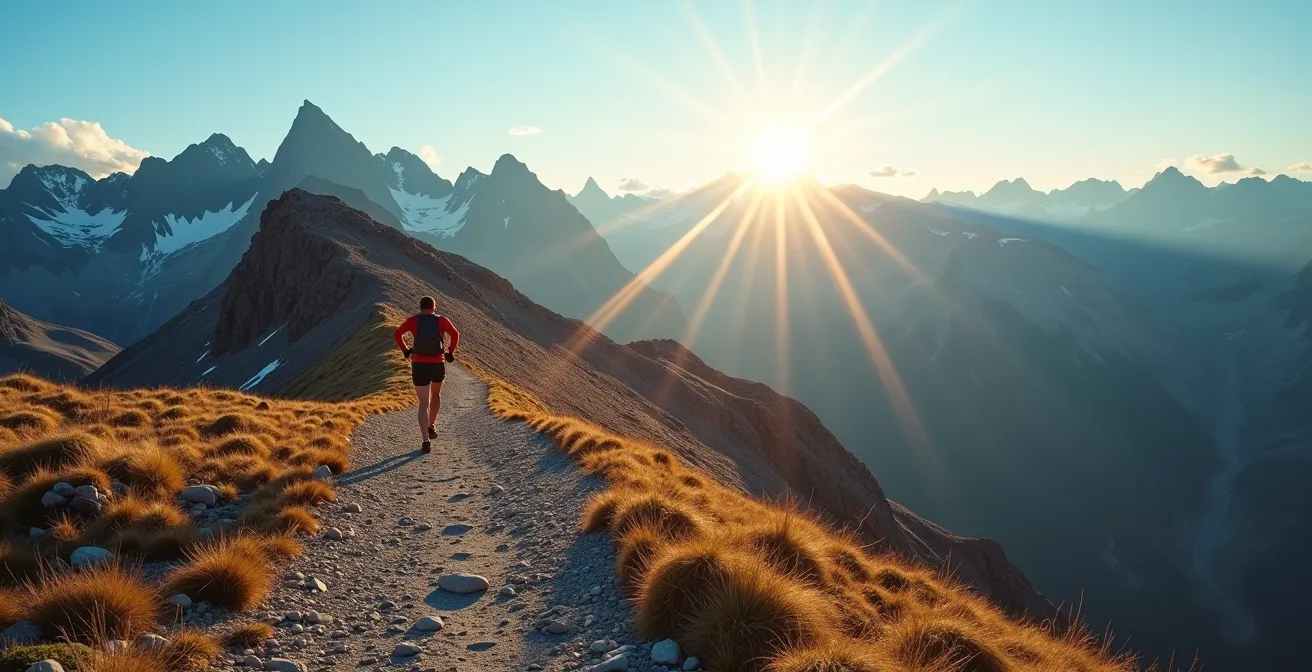
Contrary to the “tougher is better” myth, summer provides a logistically superior environment for effective altitude acclimatization and performance gains.
- Summer allows for precise control over key variables like hydration, training intensity (Zone 2), and nutrition.
- Winter introduces significant “physiological overhead”—energy wasted on thermoregulation and navigating unpredictable terrain—which detracts from quality training.
Recommendation: For a flatland athlete’s first high-altitude block, prioritize a summer camp to build a true aerobic base without the compounding risks of a winter environment.
As a flatland athlete, you’ve decided to leverage high-altitude training to boost your red blood cell count and gain a competitive edge. The common wisdom suggests simply heading for the mountains, with a romanticized image of enduring harsh, snowy conditions to forge resilience. Many athletes assume that winter training, being inherently more difficult, must yield greater rewards. This thinking, however, confuses hardship with productive stress.
The fundamental goal of an altitude camp is to expose your body to hypoxia in a controlled manner, forcing it to adapt by producing more red blood cells. Success isn’t measured by how much you suffer, but by how consistently you can execute quality training while your body acclimatizes. The real question isn’t about which season is harder, but which season provides the most predictable and manageable environment to optimize this physiological process.
This logistical breakdown moves beyond the platitudes. We will dissect why the perceived “ease” of summer—with its accessible water, clear trails, and predictable conditions—is not a weakness but a strategic advantage. It allows you to minimize uncontrolled variables, reduce physiological overhead, and focus your energy squarely on what matters: effective, consistent training that drives real aerobic adaptation.
This guide will examine the critical factors, from the misunderstood “Day 3 dip” and precise hydration needs to the nuances of fuel metabolism and cognitive function under hypoxia. By the end, you will understand why choosing a summer alpine range is the more intelligent, performance-oriented decision for achieving your goals.
Summary: A Strategic Comparison of Summer and Winter Altitude Training
- Why you feel worse on day 3 of altitude training than on day 1?
- How to calculate your increased water intake in dry alpine air?
- Running or Hiking: Which keeps heart rate in Zone 2 for effective adaptation?
- The skin protection error that results in burns even on cloudy days
- How to identify uncrossable ridges on a map before you start climbing?
- Why burning fat requires more oxygen than burning carbs at 3000m?
- Why hypoxia causes bad decisions above 2,500 meters without you noticing?
- How to Navigate Alpine Terrain Safely Without a Guide?
Why you feel worse on day 3 of altitude training than on day 1?
One of the most counter-intuitive experiences for a flatland athlete is the “altitude honeymoon” followed by the “Day 3 dip.” You arrive and feel surprisingly good for the first 24 to 48 hours, tempted to push the pace. Then, around the third day, a wave of fatigue, headaches, and lethargy hits. This is not a sign of failure; it’s a predictable physiological response. The initial feeling of well-being is misleading. Your body hasn’t adapted yet; it’s simply running on its sea-level reserves in a new, oxygen-poor environment.
The science behind this dip is clear. In response to hypoxia, your body triggers a massive hormonal surge. Specifically, research shows EPO increases of 92-400% after 24h at 2,800m. This kicks off the long process of creating new red blood cells, a metabolically expensive task. By day three, your body is deep in this demanding construction phase, while also dealing with fluid shifts and respiratory changes. You feel worse because your body is finally doing the hard adaptive work you came for. Understanding this prevents the classic mistake of overdoing it on day one and paying the price for the rest of the week.
Managing this phase is critical. In summer, stable weather and less extreme temperatures make it easier to prioritize rest and recovery. In winter, the added stress of cold and potential storms can exacerbate the symptoms of this dip, turning a manageable phase into a full-blown setback. Your primary goal during these first 72 hours is not to train hard, but to facilitate adaptation.
Your Action Plan: Managing the Day 3 Altitude Dip
- Pre-Hydrate and Recover: Focus on hydration, sleep, and healthy eating in the first 48 hours. Avoid alcohol and other stressors.
- Resist the Honeymoon: Deliberately keep all activity in Zone 1 or low Zone 2 on day one, even if you feel fantastic.
- Monitor Symptoms: Be vigilant for the early signs of altitude sickness: persistent headaches, nausea, unusual fatigue, or poor sleep.
- Acclimatize Gradually: When planning camps above 3000m, build in a stop at an intermediate altitude for a night or two if logistics permit.
- Prioritize Rest: If symptoms appear on day 3, don’t push through. Take a rest day or engage in very light active recovery. This is adaptation, not de-training.
How to calculate your increased water intake in dry alpine air?
At altitude, dehydration is your primary enemy. The air is significantly drier, and your respiration rate increases to compensate for lower oxygen levels. This leads to a huge, often unnoticed, loss of water through breathing alone—a phenomenon known as respiratory water loss. As a coach, I emphasize that you can’t rely on thirst; you must have a disciplined hydration strategy. Your water needs can easily double, requiring an intake of 4-6 liters per day, depending on your body weight and exertion level.
A practical starting point is to add at least 1.5 liters to your normal daily intake. However, the best method is to monitor your body’s signals. Check your urine: it should be a pale straw color. Weighing yourself before and after a workout can also reveal fluid loss. In summer, sweat is a visible reminder to drink, making this monitoring process more intuitive. You have ready access to liquid water from streams (with purification) or taps, making it logistically simple to carry and consume large volumes.
Winter presents a far greater challenge to hydration. The cold, dry air maximizes respiratory water loss, but you don’t have sweat as a cue. Thirst is suppressed in the cold, and accessing water often means stopping to melt snow—a time-consuming and energy-intensive process that athletes often skip. This “physiological overhead” of simply staying hydrated is significantly higher in winter, making it a major point of failure for training camps.
The following table illustrates why managing hydration is fundamentally different and more complex in winter, reinforcing summer as the superior choice for logistical control.
| Factor | Summer Loss Pattern | Winter Loss Pattern |
|---|---|---|
| Primary Loss Route | Sweat (visible, triggers thirst) | Respiratory (invisible, no thirst signal) |
| Hydration Monitoring | Urine color, pre/post workout weight | Disciplined schedule every 15 min |
| Water Accessibility | Liquid water readily available | Energy-intensive snow melting required |
Running or Hiking: Which keeps heart rate in Zone 2 for effective adaptation?
The primary goal of most of your training at altitude is to accumulate time in Zone 2 (a low, conversational-effort heart rate). This intensity is optimal for stimulating mitochondrial growth and aerobic adaptations without adding excessive stress while your body is already working hard to acclimatize. The challenge for a fit flatland athlete is that at 2,500 meters, even a slow jog can push your heart rate into Zone 3 or 4. Therefore, the modality of exercise becomes a critical tool for intensity control.
Here, summer offers unparalleled versatility. The varied and accessible terrain allows you to seamlessly switch between modalities to keep your heart rate in the target zone. A steep section that would send your heart rate skyrocketing if you tried to run it becomes a perfect Zone 2 power-hike. On flats and gentle downhills, you can switch to a light run. This is precisely the strategy used by elite athletes. For example, summer camps in places like Val d’Isère (1,800m) are popular because the vast network of mountain trails and roads allows athletes to mix hiking, running, and cycling to meticulously manage their training zones.
Winter locks you into a far more rigid training model. If your only option is running on a snow-packed road, you have very little ability to modulate intensity besides slowing to a walk. Running in deep snow is incredibly taxing and almost guarantees a high heart rate, making it unsuitable for base-building. As two-time Olympic champion Alistair Brownlee noted in an interview with 220 Triathlon Magazine, a more moderate altitude is key for quality work:
At about 1,800m it’s not too extreme and means I can still complete the really tough track sessions. Going higher is for the off-season.
– Alistair Brownlee, 220 Triathlon Magazine Interview
Summer not only provides access to these “perfect” moderate altitudes but also gives you the terrain to implement a smart, multi-modal approach. Hiking steep grades is not a compromise; it’s the intelligent way to build your aerobic engine at altitude. It is the key to keeping your heart rate in Zone 2 for effective, low-stress adaptation.
The skin protection error that results in burns even on cloudy days
A significant, and often painful, mistake athletes make at altitude is underestimating the intensity of ultraviolet (UV) radiation. The thinner atmosphere filters out less UV light; for every 1000 meters you ascend, UV exposure increases by 10-12%. This means at 3,000 meters, you are facing at least 30% more intense radiation than at sea level. This danger is present regardless of the season, but the nature of the risk and the ease of management differ significantly.
The most common error is equating temperature with UV risk. A cool, breezy summer day can feel deceptively safe, yet the UV index can be extreme. Likewise, cloud cover offers minimal protection, as up to 80% of UV rays can penetrate clouds. In summer, the sun’s intensity is more obvious, prompting athletes to apply sunscreen. However, they often miss critical spots like under the chin, behind the ears, and inside the nostrils—areas that get significant exposure from light reflected off the ground.
In winter, this reflected danger is magnified exponentially. Clean, white snow can reflect up to 80% of UV radiation, meaning you’re being hit from above and below. This can lead to severe burns in unexpected places, even on completely overcast days. The cold makes you less likely to think about sun protection, and a lower sun angle can create a false sense of security. Furthermore, high-quality sunglasses are non-negotiable in both seasons to prevent photokeratitis, or “snow blindness,” a painful burn to the cornea.
While the risk is high year-round, summer’s conditions make protection more straightforward. You are already wearing less clothing, making sunscreen application a more natural habit. In winter, the constant layering and un-layering, combined with the insidious nature of reflected light, make a consistent protection strategy logistically more difficult to maintain. The key is a disciplined protocol: apply high SPF, broad-spectrum sunscreen 30 minutes before every session and reapply every two hours, regardless of the weather.
How to identify uncrossable ridges on a map before you start climbing?
For the flatland athlete, alpine terrain presents a new and complex navigational challenge. Your ability to execute a training plan depends on your ability to choose viable routes. A key skill is pre-trip map reconnaissance to identify terrain that is either impassable or too dangerous. The features to look for differ dramatically between summer and winter, and summer conditions are far more forgiving for the novice.
In summer, your main concern on a topographic map is contour lines. Extremely dense contour lines indicate cliffs or very steep, scrambly terrain that may be un-runnable or require technical climbing skills. A “knife-edge” ridge will appear as contour lines packed tightly together on both sides of the ridgeline. The advantage of summer is that what you see on the map largely corresponds to what you will see on the ground. A trail marked on the map will almost always be visible and followable.
Winter navigation is a different world. The map is only a starting point, as the snowpack completely alters the terrain. A gentle summer slope can become a high-risk avalanche path. A simple ridge crossing can be guarded by a cornice—an overhanging ledge of wind-blown snow that is invisible from the windward side and prone to collapse. These features are not marked on a standard topographic map. As modern training guidance suggests, athletes in winter camps increasingly rely on 3D visualization tools to pre-inspect routes, specifically to identify hazards like cornices that are invisible on 2D maps. This highlights the increased cognitive load and reliance on technology for basic safety in winter.
For the self-guided athlete, summer offers a much safer learning environment. Route-finding is more straightforward, the consequences of a minor navigational error are lower, and the terrain is more predictable. You can focus on your training, not on a life-or-death battle with hidden winter hazards.
Why burning fat requires more oxygen than burning carbs at 3000m?
At altitude, oxygen is the single most valuable currency. Your performance is dictated by how efficiently your body can use the limited supply available. While you may have a highly developed fat-burning engine at sea level, the rules change dramatically as you ascend. As altitude physiology research demonstrates, there’s about 25% less available oxygen at 9,000 feet (approx. 2,750m). This scarcity forces a shift in your body’s fuel preference due to a simple biochemical fact: burning fat requires more oxygen than burning carbohydrates to produce the same amount of energy (ATP).
Think of it as an “oxygen economy.” Carbohydrates are a more oxygen-efficient fuel. When supply is low, your body will preferentially burn carbs to get the most bang for its buck. Therefore, your sea-level nutrition strategy might not work. Trying to do low-carb or fasted training at altitude is a recipe for disaster. It places a huge, unnecessary strain on your system and can lead to rapid bonking and an inability to maintain even Zone 2 intensity.
Your strategy must be to keep your carbohydrate stores topped up. This means consuming easily digestible carbs before, during, and after your workouts. This is logistically simpler in summer. Gels, chews, and drink mixes are easy to consume, and your appetite is generally more stable. In winter, the cold itself increases your caloric needs for thermoregulation, adding another layer of demand. It can be difficult to consume frozen bars or fumble with gel packets with gloved hands. The priority in both seasons is carbs, but the overall caloric demand and logistical difficulty are higher in winter.
The key takeaway for the performance-focused athlete is to fuel for the environment. At altitude, this means prioritizing carbohydrates to maximize your oxygen economy. This shift is a non-negotiable part of a successful acclimatization and training strategy, and it’s far easier to manage in the stable conditions of a summer camp.
Why hypoxia causes bad decisions above 2,500 meters without you noticing?
Beyond the physical challenges, hypoxia has a direct and insidious impact on your brain. Your brain is an oxygen-hungry organ, consuming about 20% of your body’s oxygen at rest. When supply is reduced, your cognitive function is one of the first things to degrade, often without you even realizing it. This can manifest as difficulty with complex problem-solving, impaired short-term memory, and, most dangerously, poor judgment and risk assessment.
You might forget to reapply sunscreen, misread your map, ignore early signs of altitude sickness, or push on when you should be turning back. The effect is subtle at first. You don’t feel “dumb”; you just feel a bit off, maybe more irritable or apathetic. This is your brain on low oxygen. This cognitive impairment is a major reason why small mistakes can escalate into serious incidents in the mountains.
The historical record provides clear evidence of this phenomenon. A famous example is the 1968 Olympics held at 2,240 meters in Mexico City. While athletes in short, anaerobic sprint events (less reliant on continuous oxygen supply) broke world records, performances in endurance events that required pacing, strategy, and sustained aerobic effort were significantly below sea-level records. This demonstrates how altitude selectively impacts tasks requiring sustained cognitive and physical output.
This risk is present in any season, but it is dramatically compounded by the additional stressors of winter. Cold, wind, potential storms, and complex avalanche-aware navigation all add to the cognitive load on a brain that is already compromised. In summer, the simpler logistics and more benign environment create a larger margin for error. Reducing external stressors is a key strategy for mitigating the unavoidable internal stress of hypoxia on your brain.
Key takeaways
- The “Day 3 dip” is a normal part of acclimatization; manage it with rest, not by pushing through.
- Summer terrain offers superior versatility for maintaining Zone 2 heart rate by seamlessly blending hiking and running.
- At altitude, carbohydrates are a more oxygen-efficient fuel. Prioritize carb intake to maximize your limited oxygen supply.
How to Navigate Alpine Terrain Safely Without a Guide?
For the self-sufficient athlete, safe navigation is the bedrock of a successful training camp. It’s not just about getting from A to B; it’s about managing risk, conserving energy, and reducing cognitive load so you can focus on your workout. While basic map and compass skills are essential in any season, the environmental context of summer versus winter makes the practical application of these skills vastly different. For an athlete new to the alpine environment, summer offers a far more forgiving and effective classroom.
Summer navigation is a process of confirmation. Marked trails are generally visible, landmarks are clear, and bailout options (alternative routes to descend) are plentiful. The terrain is “what you see is what you get.” Winter navigation, by contrast, is a process of constant interpretation and high-stakes prediction. Trails are buried under snow, forcing reliance on GPS, and hazards like crevasses and avalanche zones are hidden. A simple route choice can have severe consequences.
This fundamental difference in navigational challenge is why summer is the logical starting point. It allows you to build a solid foundation of mountain sense in a lower-risk environment. You learn to read contour lines, estimate travel times, and orient yourself using prominent features without the compounding stress of avalanche risk or whiteout conditions. This reduces the mental overhead, allowing your focus to remain on the quality of your training session.
This table starkly contrasts the navigational realities of each season, making it clear why summer is the strategic choice for a first-time alpine trainee.
| Navigation Factor | Summer Conditions | Winter Conditions |
|---|---|---|
| Trail Visibility | Clear, marked trails above treeline | Obscured by snow, requires GPS |
| Bailout Options | Multiple escape routes available | Limited, committing routes |
| Hidden Hazards | Minimal, visible terrain | Crevasses, avalanche zones hidden |
| Route Reliability | Consistent conditions day-to-day | Variable with weather/snow conditions |
Ultimately, the choice between a summer or winter altitude camp is a strategic one. The goal is not to prove your toughness but to elicit a specific physiological adaptation in the most efficient way possible. By minimizing logistical friction and controlling key variables, you create the space for high-quality, consistent training. The evidence is clear: for the flatland athlete aiming to optimize performance, the predictable and manageable environment of a summer alpine range offers the smartest path to success.